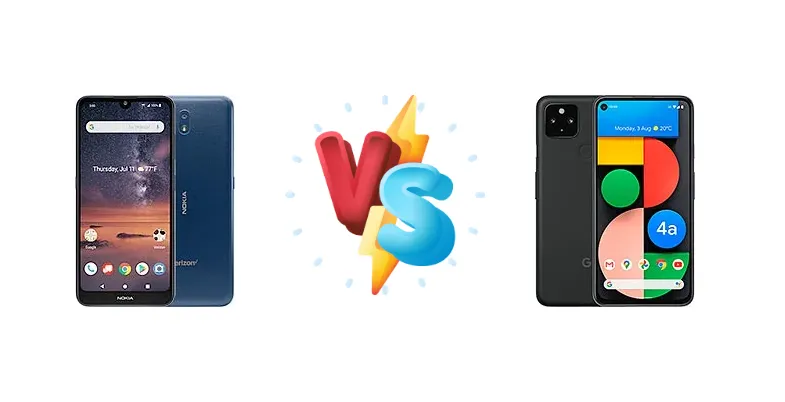
The Nokia 3 V and Google Pixel 4a 5G represent different approaches to affordable 5G connectivity. The Nokia 3 V aims for ultimate affordability, while the Pixel 4a 5G prioritizes a smoother user experience and Google’s renowned camera software. This comparison dissects the core hardware differences to determine which phone delivers the best value for your money.
🏆 Quick Verdict
For most users, the Google Pixel 4a 5G is the superior choice. Its Snapdragon 765G chipset provides significantly faster performance and a more responsive experience, justifying the price premium. However, the Nokia 3 V remains a viable option for those on an extremely tight budget who prioritize basic functionality.
| Network |
|---|
| 2G bands | GSM 850 / 900 / 1800 / 1900 | GSM 850 / 900 / 1800 / 1900 |
| 3G bands | HSDPA 850 / 900 / 1700(AWS) / 1900 / 2100 | HSDPA 850 / 900 / 1700(AWS) / 1900 / 2100 |
| 4G bands | 1, 2, 4, 5, 8, 13 | 1, 2, 3, 4, 5, 7, 8, 12, 13, 14, 17, 18, 19, 20, 25, 26, 28, 29, 30, 32, 38, 39, 40, 41, 42, 46, 48, 66, 71 |
| 5G bands | - | 1, 2, 3, 5, 7, 8, 12, 28, 41, 66, 71, 77, 78 Sub6, mmWave (market dependant) |
| Speed | HSPA 42.2/5.76 Mbps, LTE Cat4 150/50 Mbps | HSPA, LTE, 5G |
| Technology | GSM / HSPA / LTE | GSM / HSPA / LTE / 5G |
| Launch |
|---|
| Announced | 2020, August 20. Released 2019, August 23 | 2020, September 30 |
| Status | Discontinued | Available. Released 2020, November 05 |
| Body |
|---|
| Build | Glass front, plastic back, plastic frame | Glass front (Gorilla Glass 3), plastic back, plastic frame |
| Dimensions | 161.2 x 76.2 x 9.1 mm (6.35 x 3.00 x 0.36 in) | 153.9 x 74 x 8.2 mm (Sub-6) or 8.5 mm (Sub-6 and mmWave) |
| SIM | Nano-SIM | Nano-SIM + eSIM |
| Weight | 188.6 g (6.67 oz) | 168 g (5G Sub-6); 171 g ( 5G Sub-6 and mmWave) (5.93 oz) |
| Display |
|---|
| Protection | - | Corning Gorilla Glass 3 |
| Resolution | 720 x 1520 pixels, 19:9 ratio (~269 ppi density) | 1080 x 2340 pixels, 19.5:9 ratio (~413 ppi density) |
| Size | 6.26 inches, 97.8 cm2 (~79.6% screen-to-body ratio) | 6.2 inches, 95.7 cm2 (~84.1% screen-to-body ratio) |
| Type | IPS LCD | OLED, HDR |
| | - | Always-on display |
| Platform |
|---|
| CPU | Quad-core 1.8 GHz Cortex-A53 | Octa-core (1x2.4 GHz Kryo 475 Prime & 1x2.2 GHz Kryo 475 Gold & 6x1.8 GHz Kryo 475 Silver) |
| Chipset | Qualcomm SDM429 Snapdragon 429 (12 nm) | Qualcomm SM7250 Snapdragon 765G 5G (7 nm) |
| GPU | Adreno 504 | Adreno 620 |
| OS | Android 9.0 (Pie), upgradable to Android 10, Android One | Android 11, upgradable to Android 14 |
| Memory |
|---|
| Card slot | microSDXC (dedicated slot) | No |
| Internal | 16GB 2GB RAM | 128GB 6GB RAM |
| | eMMC 5.1 | UFS 2.1 |
| Main Camera |
|---|
| Dual | - | 12.2 MP, f/1.7, 27mm (wide), 1/2.55", 1.4µm, dual pixel PDAF, OIS
16 MP, f/2.2, 107˚ (ultrawide), 1.0µm |
| Features | LED flash | LED flash, Pixel Shift, Auto-HDR, panorama |
| Single | 13 MP, f/2.2, 1/3.1", 1.12µm, AF | - |
| Video | 1080p@30fps | 4K@30/60fps, 1080p@30/60/120/240fps; gyro-EIS |
| Selfie camera |
|---|
| Features | - | HDR |
| Single | 5 MP, f/2.2, 27mm (wide), 1/5.0", 1.12µm | 8 MP, f/2.0, 24mm (wide), 1/4.0", 1.12µm |
| Video | - | 1080p@30fps |
| Sound |
|---|
| 3.5mm jack | Yes | Yes |
| 35mm jack | Yes | Yes |
| Loudspeaker | Yes | Yes, with stereo speakers |
| Comms |
|---|
| Bluetooth | 4.2, A2DP, LE, aptX | 5.0, A2DP, LE, aptX HD |
| NFC | No | Yes |
| Positioning | GPS, GLONASS, BDS | GPS, GLONASS, GALILEO, QZSS, BDS |
| Radio | FM radio | No |
| USB | microUSB 2.0, OTG | USB Type-C 3.1 |
| WLAN | Wi-Fi 802.11 b/g/n | Wi-Fi 802.11 a/b/g/n/ac, dual-band, Wi-Fi Direct |
| Features |
|---|
| Sensors | Accelerometer, proximity | Fingerprint (rear-mounted), accelerometer, gyro, proximity, compass, barometer |
| Battery |
|---|
| Charging | 10W wired | 18W wired, PD2.0 |
| Type | Li-Ion 4000 mAh | Li-Po 3885 mAh |
| Misc |
|---|
| Colors | Blue | Just Black, Clearly White |
| Models | - | GD1YQ, G025I, G025E, G025H, G6QU3 |
| Price | About 140 EUR | About 140 EUR |
Nokia 3 V
- Extremely affordable price point
- Functional for basic smartphone tasks
- Potentially longer battery life due to less powerful processor
- Slow performance for demanding apps
- Outdated chipset and limited future-proofing
- Slow 10W charging
Google Pixel 4a 5G
- Significantly faster performance with Snapdragon 765G
- Excellent camera quality thanks to Google’s software
- Faster 18W charging with PD2.0
- Higher price compared to Nokia 3 V
- LCD display isn't as vibrant as OLED alternatives
- May experience some thermal throttling under heavy load
Display Comparison
Neither device boasts a standout display. While specific panel details for the Nokia 3 V are unavailable, its market positioning suggests a basic LCD panel. The Pixel 4a 5G also utilizes an LCD, but its focus is on color accuracy and viewing angles, benefiting from Google’s image processing. The real difference lies in the processing power driving the display; the Snapdragon 765G in the Pixel 4a 5G can handle more complex graphics and animations, resulting in a smoother visual experience.
Camera Comparison
While both phones feature multiple rear cameras, the Pixel 4a 5G holds a clear advantage. Google’s computational photography prowess is well-known, and the Snapdragon 765G’s image signal processor (ISP) plays a crucial role in delivering excellent image quality, even in challenging lighting conditions. The Nokia 3 V’s camera system, while functional, lacks the advanced processing capabilities of the Pixel. Details regarding sensor sizes are unavailable for the Nokia 3V, but it's likely to be a smaller sensor than the Pixel 4a 5G, resulting in less detail and dynamic range. The Pixel 4a 5G’s superior ISP and software algorithms will produce sharper, more vibrant, and more detailed photos.
Performance
The performance gap is the most significant differentiator. The Nokia 3 V’s Qualcomm SDM429 Snapdragon 429, a quad-core Cortex-A53 processor built on a 12nm process, is designed for basic tasks. In contrast, the Google Pixel 4a 5G’s Snapdragon 765G, an octa-core processor fabricated on a more efficient 7nm node, offers a substantial performance boost. The 765G’s Kryo architecture – Prime, Gold, and Silver cores – dynamically allocate resources for optimal performance and power efficiency. This translates to faster app loading times, smoother multitasking, and a more enjoyable gaming experience on the Pixel 4a 5G. The 7nm process also contributes to better thermal management, reducing the likelihood of throttling during sustained workloads.
Battery Life
The Nokia 3 V’s 10W wired charging is significantly slower than the Pixel 4a 5G’s 18W charging with PD2.0 support. While battery capacity isn’t specified for the Nokia 3 V, the Snapdragon 429’s lower power consumption may partially offset the slower charging. However, the Pixel 4a 5G’s more efficient processor and faster charging capabilities mean less time tethered to an outlet. A full charge on the Pixel 4a 5G will be considerably quicker, offering more convenience for users who rely heavily on their smartphones.
Buying Guide
Buy the Nokia 3 V if you need a functional smartphone for essential tasks like calls, texts, and light social media, and your budget is under $150. Buy the Google Pixel 4a 5G if you prioritize a smooth, responsive user experience, better camera quality, and future-proofing with 5G connectivity, and are willing to spend around $300.
Frequently Asked Questions
❓ Will the Nokia 3 V struggle with popular apps like TikTok or Instagram?
Yes, the Snapdragon 429 is a low-end processor. While it can run these apps, you'll likely experience noticeable lag, slow loading times, and potential crashes, especially when multitasking or using the apps for extended periods.
❓ Is the 5G on the Pixel 4a 5G truly useful, or is it just a marketing gimmick?
The 5G on the Pixel 4a 5G is genuinely useful if you live in an area with 5G coverage. It provides significantly faster download and upload speeds compared to 4G LTE, making streaming, gaming, and downloading large files much quicker. However, 5G coverage is still limited, so its benefit depends on your location.
❓ Does the Nokia 3 V receive regular software updates and security patches?
Nokia generally provides decent software support for its phones, but the 3 V is a budget device. Expect fewer updates and a shorter support lifespan compared to the Pixel 4a 5G, which benefits from Google's direct software updates and guaranteed security patches.
❓ How does the Snapdragon 765G handle gaming on the Pixel 4a 5G?
The Snapdragon 765G is capable of handling most mobile games at medium to high settings. While it's not a flagship gaming chip, it provides a smooth and enjoyable gaming experience for the majority of titles. Expect some frame drops in the most demanding games, but overall performance is significantly better than the Nokia 3 V.