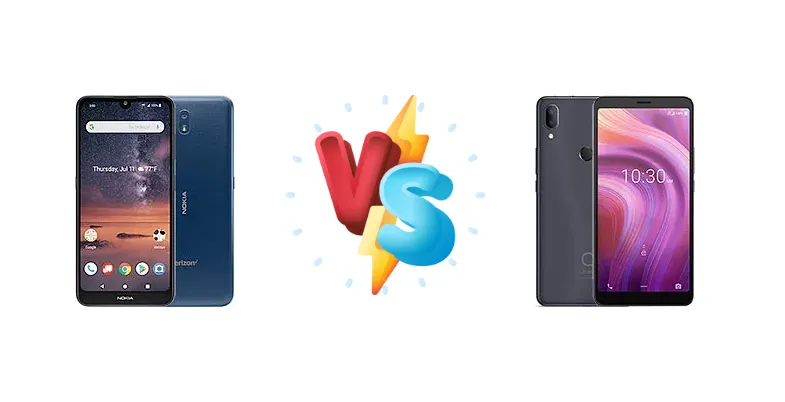
The Nokia 3 V and the alcatel 3v (2019) represent the lower end of the smartphone market, targeting users prioritizing affordability. Both devices aim to deliver a functional Android experience, but they differ significantly in their core hardware. This comparison dissects those differences, focusing on the impact of their respective chipsets and charging capabilities on everyday use.
🏆 Quick Verdict
For the average user, the alcatel 3v (2019) offers a slight edge due to its more powerful octa-core Helio P22 processor. While the Nokia 3 V benefits from the Qualcomm ecosystem, the alcatel's faster CPU clock speed translates to a more responsive experience, especially when multitasking. However, the Nokia 3 V's cleaner software experience is a notable advantage.
| Network |
|---|
| 2G bands | GSM 850 / 900 / 1800 / 1900 | GSM 850 / 900 / 1800 / 1900 |
| 3G bands | HSDPA 850 / 900 / 1700(AWS) / 1900 / 2100 | HSDPA 850 / 900 / 1700(AWS) / 1900 / 2100 |
| 4G bands | 1, 2, 4, 5, 8, 13 | 1, 2, 3, 4, 5, 7, 12, 13, 17, 20, 25, 26, 41, 66, 71 |
| Speed | HSPA 42.2/5.76 Mbps, LTE Cat4 150/50 Mbps | HSPA 42.2/11.5 Mbps, LTE Cat4 150/50 Mbps |
| Technology | GSM / HSPA / LTE | GSM / HSPA / LTE |
| Launch |
|---|
| Announced | 2020, August 20. Released 2019, August 23 | 2019, Q2. Released 2019, Q4 |
| Status | Discontinued | Discontinued |
| Body |
|---|
| Build | Glass front, plastic back, plastic frame | Glass front (DragonTrail Pro glass), plastic back, plastic frame |
| Dimensions | 161.2 x 76.2 x 9.1 mm (6.35 x 3.00 x 0.36 in) | 174.5 x 83.3 x 8.4 mm (6.87 x 3.28 x 0.33 in) |
| SIM | Nano-SIM | Nano-SIM |
| Weight | 188.6 g (6.67 oz) | 197.9 g (6.98 oz) |
| Display |
|---|
| Protection | - | DragonTrail Pro |
| Resolution | 720 x 1520 pixels, 19:9 ratio (~269 ppi density) | 720 x 1440 pixels, 18:9 ratio (~240 ppi density) |
| Size | 6.26 inches, 97.8 cm2 (~79.6% screen-to-body ratio) | 6.7 inches, 115.8 cm2 (~79.7% screen-to-body ratio) |
| Type | IPS LCD | IPS LCD |
| Platform |
|---|
| CPU | Quad-core 1.8 GHz Cortex-A53 | Octa-core 2.0 GHz Cortex-A53 |
| Chipset | Qualcomm SDM429 Snapdragon 429 (12 nm) | Mediatek MT6762 Helio P22 (12 nm) |
| GPU | Adreno 504 | PowerVR GE8320 |
| OS | Android 9.0 (Pie), upgradable to Android 10, Android One | Android 9.0 (Pie) |
| Memory |
|---|
| Card slot | microSDXC (dedicated slot) | microSDXC (dedicated slot) |
| Internal | 16GB 2GB RAM | 32GB 3GB RAM |
| | eMMC 5.1 | eMMC 5.1 |
| Main Camera |
|---|
| Dual | - | 16 MP, PDAF
Auxiliary lens |
| Features | LED flash | LED flash, HDR, panorama |
| Single | 13 MP, f/2.2, 1/3.1", 1.12µm, AF | - |
| Video | 1080p@30fps | 1080p@30fps |
| Selfie camera |
|---|
| Single | 5 MP, f/2.2, 27mm (wide), 1/5.0", 1.12µm | 8 MP |
| Video | - | 720p@30fps |
| Sound |
|---|
| 3.5mm jack | Yes | Yes |
| 35mm jack | Yes | Yes |
| Loudspeaker | Yes | Yes, with stereo speakers |
| Comms |
|---|
| Bluetooth | 4.2, A2DP, LE, aptX | 4.2, A2DP, LE |
| NFC | No | No |
| Positioning | GPS, GLONASS, BDS | GPS |
| Radio | FM radio | FM radio |
| USB | microUSB 2.0, OTG | USB Type-C 2.0 |
| WLAN | Wi-Fi 802.11 b/g/n | Wi-Fi 802.11 a/b/g/n, dual-band, Wi-Fi Direct |
| Features |
|---|
| Sensors | Accelerometer, proximity | Fingerprint (rear-mounted), accelerometer, proximity, compass |
| Battery |
|---|
| Charging | 10W wired | 15W wired |
| Type | Li-Ion 4000 mAh | Li-Po 4000 mAh |
| Misc |
|---|
| Colors | Blue | Elegant Black |
| Models | - | 5032W |
| Price | About 140 EUR | About 170 EUR |
Nokia 3 V
- Clean Android experience with potential for updates
- Qualcomm chipset known for power efficiency
- Potentially better single-core performance
- Slower CPU clock speed compared to the alcatel
- Slower 10W charging
- Quad-core processor may struggle with multitasking
alcatel 3v (2019)
- Faster octa-core Helio P22 processor
- Faster 15W wired charging
- More responsive multitasking experience
- Potentially less frequent software updates
- Mediatek chipset may be less power efficient
- Software experience may include bloatware
Display Comparison
Neither device boasts a standout display. Both utilize panels likely around 720p resolution, typical for this price bracket. The focus here isn't on visual fidelity, but on efficiency. Detailed display specs (brightness, color gamut) are unavailable, but the emphasis is on providing a functional viewing experience for basic tasks. Bezels are expected to be substantial on both devices, reflecting their budget positioning.
Camera Comparison
Camera performance is likely to be similar, with both devices featuring basic camera setups. Without specific sensor details, it's safe to assume both rely on affordable sensors. The alcatel 3v (2019) may have a slight edge if it incorporates more advanced image processing algorithms, but image quality will be heavily dependent on lighting conditions. Expect acceptable results in good light, but significant noise and softness in low-light scenarios. The inclusion of a 2MP macro lens on either device is largely a marketing gimmick, offering minimal practical benefit.
Performance
The core difference lies in the chipsets. The alcatel 3v (2019) features the Mediatek Helio P22, an octa-core processor clocked at 2.0 GHz, built on a 12nm process. This contrasts with the Nokia 3 V’s Qualcomm Snapdragon 429, a quad-core processor running at 1.8 GHz, also on a 12nm node. While both are 12nm, the Helio P22’s eight cores provide a significant advantage in multi-threaded tasks. The Snapdragon 429 excels in single-core performance and power efficiency, but the alcatel’s CPU will handle more demanding apps and multitasking more smoothly. Neither chipset is designed for intensive gaming, but the Helio P22 will offer a slightly better experience.
Battery Life
Battery capacity is not specified, but both devices likely house batteries in the 3000-4000 mAh range. However, the alcatel 3v (2019) supports 15W wired charging, while the Nokia 3 V is limited to 10W. This means the alcatel will charge significantly faster, reducing downtime. While a larger battery capacity on the Nokia 3 V might offer slightly longer runtimes, the faster charging of the alcatel is a more tangible benefit for most users.
Buying Guide
Buy the Nokia 3 V if you prioritize a clean Android experience with guaranteed updates and value the Qualcomm chipset's generally efficient power management. Buy the alcatel 3v (2019) if you need a bit more processing power for multitasking and light gaming, and if faster charging is a key consideration, despite potentially less frequent software updates.
Frequently Asked Questions
❓ Will the alcatel 3v (2019)'s Helio P22 struggle with popular apps like Facebook or WhatsApp?
No, the Helio P22 is capable of running common social media apps like Facebook and WhatsApp without significant issues. While it's not a powerhouse, it provides sufficient processing power for everyday tasks and light app usage. However, expect some slowdown with multiple apps open simultaneously.
❓ How long will it take to fully charge the Nokia 3 V with its 10W charger?
Given the likely battery capacity (3000-4000 mAh) and the 10W charging rate, a full charge from 0% to 100% on the Nokia 3 V will likely take between 3 to 4 hours. This is considerably slower than the alcatel 3v (2019)'s 15W charging.
❓ Is the Nokia 3 V a good choice for someone upgrading from a very old smartphone?
Yes, the Nokia 3 V is a solid option for someone upgrading from a very old smartphone. It offers a modern Android experience, even if it's a basic one, and provides a significant improvement in performance and features compared to older devices. The clean software is a particular benefit for first-time smartphone users.
❓ Does the alcatel 3v (2019) support fast charging protocols beyond its 15W standard?
Information on support for additional fast charging protocols (like Quick Charge) is limited. It's unlikely the alcatel 3v (2019) supports advanced fast charging standards, and will likely only benefit from the included 15W charger.