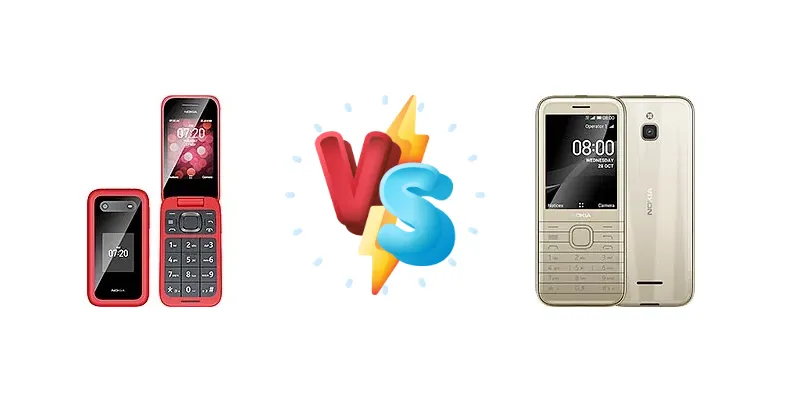
Nokia's resurgence in the feature phone market continues with the 2780 Flip and 8000 4G, both offering a nostalgic flip phone experience. But which one delivers the better package? This detailed comparison will break down the key differences to help you decide.
🏆 Quick Verdict
The Nokia 2780 Flip edges out the 8000 4G thanks to its slightly more powerful chipset and improved performance. While both offer a classic design, the 2780 Flip's smoother operation and slightly better features make it the more compelling choice for most users.
| Network |
|---|
| 2G bands | GSM 850 / 900 / 1800 / 1900 | GSM 850 / 900 / 1800 / 1900 |
| 3G bands | HSDPA 850 / 1700(AWS) / 1900 | HSDPA 850 / 900 / 2100 |
| 4G bands | 2, 4, 5, 7, 12, 13, 17, 25, 26, 41, 66, 71 | 1, 3, 5, 7, 8, 20, 28, 38, 40 - ROW |
| Speed | HSPA, LTE Cat4 150/50 Mbps | HSPA, LTE Cat4 150/50 Mbps |
| Technology | GSM / HSPA / LTE | GSM / HSPA / LTE |
| | - | 1, 3, 5, 7, 8, 20, 28, 38, 39, 40, 41 - MENA, GCR |
| Launch |
|---|
| Announced | 2022, November 03 | 2020, November 13. Released 2021, January 06 |
| Status | Available. Released 2022, November 15 | Discontinued |
| Body |
|---|
| Build | - | Plastic frame, plastic back |
| Dimensions | 202.1 x 58 x 11.5 mm (7.96 x 2.28 x 0.45 in) | 132.2 x 56.5 x 12.3 mm (5.20 x 2.22 x 0.48 in) |
| SIM | Nano-SIM | · Nano-SIM· Nano-SIM + Nano-SIM |
| Weight | 131.2 g (4.62 oz) | 110.2 g (3.88 oz) |
| Display |
|---|
| Resolution | 240 x 320 pixels, 4:3 ratio (~148 ppi density) | 240 x 320 pixels, 4:3 ratio (~143 ppi density) |
| Size | 2.7 inches, 22.6 cm2 (~19.3% screen-to-body ratio) | 2.8 inches, 24.3 cm2 (~32.5% screen-to-body ratio) |
| Type | TFT LCD | TFT LCD, 16M colors |
| | Secondary external 1.77" display | - |
| Platform |
|---|
| CPU | Quad-core 1.3 GHz Cortex-A53 | Quad-core 1.1 GHz Cortex-A7 |
| Chipset | Qualcomm QM215 Snapdragon 215 (28 nm) | Qualcomm MSM8909 Snapdragon 210 (28 nm) |
| GPU | Adreno 308 | Adreno 304 |
| OS | KaiOS 3.1 | KaiOS 2.5 |
| Memory |
|---|
| Card slot | microSDHC (dedicated slot) | microSDHC |
| Internal | 4GB 512MB RAM | 4GB 512MB RAM |
| Main Camera |
|---|
| Features | LED flash | LED flash |
| Single | 5 MP | 2 MP |
| Video | Unspecified | - |
| Sound |
|---|
| 3.5mm jack | Yes | Yes |
| 35mm jack | Yes | Yes |
| Loudspeaker | Yes | Yes |
| Comms |
|---|
| Bluetooth | 4.2, A2DP | Yes |
| NFC | No | - |
| Positioning | GPS | GPS |
| Radio | FM radio | FM radio |
| USB | USB Type-C 2.0 | microUSB |
| WLAN | Wi-Fi 802.11 b/g/n | Yes, hotspot |
| Battery |
|---|
| Type | Li-Ion 1450 mAh, removable | Removable Li-Ion 1500 mAh battery |
| Misc |
|---|
| Colors | Red, Blue | Onyx/Black, Opal/White, Topaz/Blue, Cintrine/Gold |
| Models | - | TA-1303, TA-1311, TA-1305, TA-1300 |
| Price | $ 97.05 | About 110 EUR |
| SAR EU | - | 0.99 W/kg (head) 1.56 W/kg (body) |
Nokia 2780 Flip
- Slightly better performance
- More responsive UI
- Affordable price
- Good battery life
- Classic flip phone design
- Basic camera
- Small screen
- Limited app support
Nokia 8000 4G
- Premium design
- Larger screen
- 4G connectivity
- Good battery life
- Nostalgic appeal
- Slower performance
- Less responsive UI
- Basic camera
- Higher price
Display Comparison
The Nokia 8000 4G boasts a slightly larger 2.8-inch display compared to the 2780 Flip's 2.4-inch screen. Both utilize QVGA resolution, so image quality is comparable, though the 8000 4G's larger size offers a marginally better viewing experience. The 8000 4G's design also incorporates a more pronounced curved display, adding to its aesthetic appeal.
Camera Comparison
Both phones feature a basic 2MP rear camera. Image quality is adequate for casual snapshots, but don't expect exceptional results. Low-light performance is poor on both devices. The 2780 Flip's slightly newer chipset might offer a marginal improvement in image processing, but the difference is minimal.
Performance
The Nokia 2780 Flip holds a performance advantage with its Qualcomm QM215 Snapdragon 215 chipset and a 1.3 GHz Quad-core Cortex-A53 CPU. This translates to noticeably smoother navigation and app loading compared to the 8000 4G's Snapdragon 210 and 1.1 GHz Quad-core Cortex-A7. While neither phone is a powerhouse, the 2780 Flip feels more responsive.
Battery Life
Battery life is a strong point for both phones. Both offer excellent standby times. The Nokia 2780 Flip typically provides slightly longer talk time due to its more efficient chipset, but both should easily last for several days on a single charge.
Buying Guide
The Nokia 2780 Flip is ideal for those seeking a reliable, affordable flip phone for basic communication and light entertainment. The Nokia 8000 4G appeals to those prioritizing a more premium design and a slightly larger screen, but are willing to compromise on performance.
Frequently Asked Questions
❓ Does the Nokia 2780 Flip support 4G?
No, the Nokia 2780 Flip only supports 3G connectivity.
❓ Can I install apps on these phones?
Yes, both phones run KaiOS, which allows you to install a limited selection of apps, including WhatsApp and Google Maps.
❓ Which phone is more durable?
Both phones are built to withstand everyday wear and tear, but the Nokia 8000 4G's more elaborate design might make it slightly more susceptible to damage.