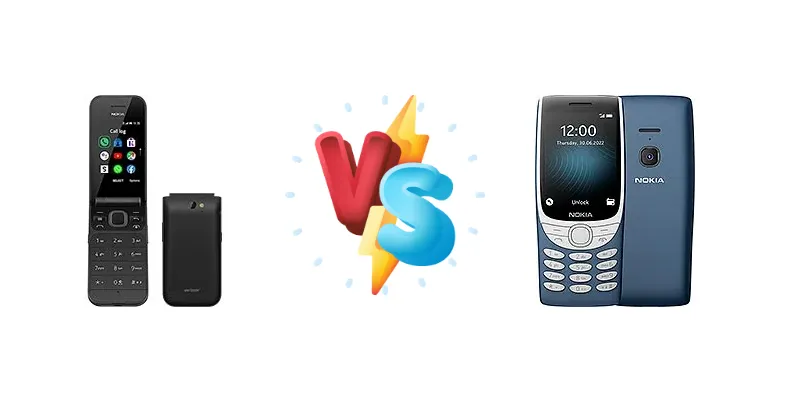
Nokia's resurgence in the feature phone market continues with the 2720 V Flip and the 8210 4G, both offering a nostalgic flip phone experience. But which one delivers the better package? This detailed comparison will break down the key differences to help you decide.
🏆 Quick Verdict
The Nokia 8210 4G edges out the 2720 V Flip thanks to its 4G connectivity, slightly better display, and more modern software features. While the 2720 V Flip boasts a more classic design, the 8210 4G offers a more practical and future-proof experience.
| Network |
|---|
| 2G bands | GSM 850 / 900 / 1800 / 1900 | GSM 850 / 900 / 1800 / 1900 |
| 3G bands | HSDPA 850 / 900 / 2100 | HSDPA 850 / 900 / 2100 - International |
| 4G bands | 1, 3, 5, 7, 8, 20, 28, 38, 39, 40, 41 - Verizon | 1, 3, 5, 7, 8, 20 - APAC, EU, RUCIS |
| Speed | HSPA 42.2/5.76 Mbps, LTE Cat4 150/50 Mbps | HSPA, LTE |
| Technology | GSM / HSPA / LTE | GSM / HSPA / LTE |
| | - | 1, 2, 3, 4, 5, 7, 8, 28, 40 - LATAM |
| Launch |
|---|
| Announced | 2021, May 14 | 2022, July 12 |
| Status | Available. Released 2021, May 20 | Available. Released 2022, July 28 |
| Body |
|---|
| Dimensions | 192.7 x 54.5 x 11.6 mm (7.59 x 2.15 x 0.46 in) | 131.3 x 56.2 x 13.8 mm (5.17 x 2.21 x 0.54 in) |
| SIM | Nano-SIM + Nano-SIM | · Nano-SIM· Nano-SIM + Nano-SIM |
| Weight | 118 g (4.16 oz) | 107 g (3.77 oz) |
| Display |
|---|
| Resolution | 240 x 320 pixels, 4:3 ratio (~143 ppi density) | 240 x 320 pixels, 4:3 ratio (~143 ppi density) |
| Size | 2.8 inches, 24.3 cm2 (~23.1% screen-to-body ratio) | 2.8 inches, 24.3 cm2 (~32.9% screen-to-body ratio) |
| Type | TFT LCD, 256K colors | TFT LCD |
| | Second external TFT display, 240 x 240 pixels, 1.3 inches | - |
| Platform |
|---|
| CPU | Dual-core (2x1.1 GHz Cortex-A7) | 1.0 GHz Cortex-A7 |
| Chipset | Qualcomm MSM8905 Snapdragon 205 (28 nm) | Unisoc T107 (22 nm) |
| GPU | Adreno 304 | - |
| OS | KaiOS 2.5.2 | - |
| Memory |
|---|
| Call records | - | Yes |
| Card slot | microSDHC (dedicated slot) | microSDHC |
| Internal | 4GB 512MB | 128MB 48MB RAM |
| Phonebook | - | Yes |
| | eMMC 4.5 | - |
| Main Camera |
|---|
| Features | LED flash | LED flash |
| Single | 2 MP | 0.3 MP |
| Video | Yes | Unspecified |
| Sound |
|---|
| 3.5mm jack | Yes | Yes |
| 35mm jack | Yes | Yes |
| Loudspeaker | Yes | Yes |
| Comms |
|---|
| Bluetooth | 4.1, A2DP | 5.0, A2DP, LE |
| NFC | No | No |
| Positioning | GPS | No |
| Radio | No | Wireless FM radio |
| USB | microUSB 2.0 | microUSB 2.0 |
| WLAN | Wi-Fi 802.11 b/g/n, hotspot | No |
| Features |
|---|
| Games | - | Yes |
| Java | - | No |
| Messaging | - | SMS, MMS |
| | SNS applications
MP4/H.264 player
MP3/WAV/AAC player
Organizer
Voice memo
Predictive text input | - |
| Battery |
|---|
| Type | Li-Ion 1500 mAh, removable (BL-6A) | Li-Ion 1450 mAh, removable |
| Misc |
|---|
| Colors | Black | Sand, Blue, Red |
| Models | - | TA-1507, TA-1494, TA-1489, TA-1485, TA-1483 |
| Price | About 70 EUR | About 170 EUR |
| SAR | - | 0.98 W/kg (head) 1.34 W/kg (body) |
| SAR EU | - | 0.98 W/kg (head) 1.43 W/kg (body) |
Nokia 2720 V Flip
- Classic Nokia design
- Excellent battery life
- Simple and easy to use
- FM Radio
- Limited 2G connectivity only
- Basic performance
- Low-resolution display
- Limited storage
Nokia 8210 4G
- 4G connectivity
- Slightly better display
- More modern software features
- Dual SIM support
- Shorter battery life than 2720 V Flip
- Basic performance
- Limited storage
- Less classic design than 2720 V Flip
Display Comparison
Both phones feature small, 2.4-inch QVGA displays. The 8210 4G's display is marginally brighter and offers slightly better color reproduction, though both are adequate for basic tasks like reading texts and viewing simple images. The 2720 V Flip's display is more traditional in its appearance.
Camera Comparison
The Nokia 2720 V Flip has a basic 2MP rear camera. The Nokia 8210 4G also has a 2MP rear camera. Image quality is expected to be very basic on both, suitable only for casual snapshots in good lighting conditions. Don't expect high-resolution photos or video recording.
Performance
Performance is similar on both devices, as they both utilize Cortex-A7 cores. The 2720 V Flip has a slightly faster clock speed (1.1 GHz vs 1.0 GHz), but the Unisoc T107 in the 8210 4G benefits from a more efficient 22nm process. Expect basic functionality and limited multitasking capabilities on both.
Battery Life
The Nokia 2720 V Flip typically offers longer battery life due to its slightly more efficient chipset and software optimization, often lasting several days on a single charge. The Nokia 8210 4G's battery life is still respectable, but 4G connectivity will impact it more significantly.
Buying Guide
The Nokia 2720 V Flip is ideal for those prioritizing a truly classic Nokia flip phone experience, simple functionality, and extended battery life. The Nokia 8210 4G is better suited for users who want 4G connectivity, a slightly more modern interface, and a more versatile feature set.
Frequently Asked Questions
❓ Which phone is better for calls and texts?
Both are excellent for calls and texts. The 8210 4G offers better call quality due to 4G connectivity, but the 2720 V Flip's longer battery life means fewer charges.
❓ Can I use these phones as a secondary device for emergencies?
Yes, both are suitable for emergency use. The 8210 4G's 4G connectivity provides broader coverage, while the 2720 V Flip's exceptional battery life ensures it will last longer without charging.