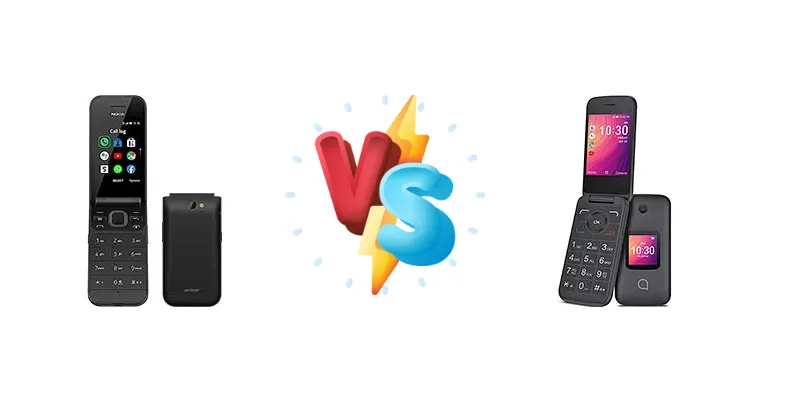
In a market dominated by smartphones, the simple flip phone persists, offering a refuge from constant connectivity. The Nokia 2720 V Flip and the alcatel Go Flip 3 represent modern iterations of this classic form factor, but beneath the familiar clamshell design lie key differences in processing power and overall capability. This comparison dissects those differences, focusing on the core hardware that dictates user experience.
🏆 Quick Verdict
For the average user prioritizing basic functionality like calls and texts, the alcatel Go Flip 3 offers a slight advantage. Its Qualcomm Snapdragon 210 chipset, featuring a quad-core CPU, provides a noticeable performance boost over the Nokia 2720 V Flip’s dual-core Snapdragon 205, translating to snappier menu navigation and app loading times.
| Network |
|---|
| 2G bands | GSM 850 / 900 / 1800 / 1900 | GSM 850 / 900 / 1800 / 1900 |
| 3G bands | HSDPA 850 / 900 / 2100 | HSDPA 850 / 1700(AWS) / 1900 |
| 4G bands | 1, 3, 5, 7, 8, 20, 28, 38, 39, 40, 41 - Verizon | 2, 4, 5, 12, 25, 26, 41, 66, 71 |
| Speed | HSPA 42.2/5.76 Mbps, LTE Cat4 150/50 Mbps | HSPA, LTE |
| Technology | GSM / HSPA / LTE | GSM / CDMA / HSPA / LTE |
| | - | CDMA 800 / 1900 |
| Launch |
|---|
| Announced | 2021, May 14 | 2019, September 19. Released 2019, September 19 |
| Status | Available. Released 2021, May 20 | Discontinued |
| Body |
|---|
| Dimensions | 192.7 x 54.5 x 11.6 mm (7.59 x 2.15 x 0.46 in) | 104.9 x 53.1 x 20.1 mm (4.13 x 2.09 x 0.79 in) |
| SIM | Nano-SIM + Nano-SIM | Nano-SIM |
| Weight | 118 g (4.16 oz) | 118 g (4.16 oz) |
| Display |
|---|
| Resolution | 240 x 320 pixels, 4:3 ratio (~143 ppi density) | 240 x 320 pixels, 4:3 ratio (~143 ppi density) |
| Size | 2.8 inches, 24.3 cm2 (~23.1% screen-to-body ratio) | 2.8 inches, 24.3 cm2 (~43.6% screen-to-body ratio) |
| Type | TFT LCD, 256K colors | TN TFT LCD |
| | Second external TFT display, 240 x 240 pixels, 1.3 inches | Second external TN TFT display, 1.44 inches, 128 x 128 pixels |
| Platform |
|---|
| CPU | Dual-core (2x1.1 GHz Cortex-A7) | Quad-core 1.1 GHz Cortex-A7 |
| Chipset | Qualcomm MSM8905 Snapdragon 205 (28 nm) | Qualcomm MSM8909 Snapdragon 210 (28 nm) |
| GPU | Adreno 304 | Adreno 304 |
| OS | KaiOS 2.5.2 | KaiOS 2.5.2 |
| Memory |
|---|
| Card slot | microSDHC (dedicated slot) | microSDHC (dedicated slot) |
| Internal | 4GB 512MB | 4GB 512MB RAM |
| | eMMC 4.5 | - |
| Main Camera |
|---|
| Features | LED flash | - |
| Single | 2 MP | 2 MP |
| Video | Yes | 720p@30fps |
| Sound |
|---|
| 3.5mm jack | Yes | Yes |
| 35mm jack | Yes | Yes |
| Loudspeaker | Yes | Yes |
| Comms |
|---|
| Bluetooth | 4.1, A2DP | 4.2, A2DP |
| NFC | No | No |
| Positioning | GPS | No |
| Radio | No | FM radio |
| USB | microUSB 2.0 | microUSB 2.0 |
| WLAN | Wi-Fi 802.11 b/g/n, hotspot | Wi-Fi 802.11 b/g/n, hotspot |
| Features |
|---|
| | SNS applications
MP4/H.264 player
MP3/WAV/AAC player
Organizer
Voice memo
Predictive text input | - |
| Battery |
|---|
| Type | Li-Ion 1500 mAh, removable (BL-6A) | Li-Ion 1350 mAh, removable |
| Misc |
|---|
| Colors | Black | Prime Black |
| Price | About 70 EUR | About 80 EUR |
| SAR | - | 1.28 W/kg (head) 1.16 W/kg (body) |
Nokia 2720 V Flip
- Established brand reputation (Nokia)
- Potentially simpler user interface
- Good battery life due to efficient chipset
- Slower processor (Snapdragon 205)
- Limited multitasking capabilities
- Outdated chipset architecture
alcatel Go Flip 3
- Faster processor (Snapdragon 210)
- Improved multitasking with quad-core CPU
- More responsive user experience
- Less well-known brand (alcatel)
- Potentially more pre-installed bloatware
- Slightly higher power consumption
Display Comparison
Neither device boasts a particularly impressive display. Both likely utilize TN panels given their market segment, prioritizing cost over color accuracy or viewing angles. Specifics like brightness nits are unavailable, but both are designed for basic visibility, not media consumption. Bezels are substantial on both, a common characteristic of flip phones, maximizing screen real estate within the limited form factor.
Camera Comparison
Camera performance is likely similar and underwhelming on both devices. Given the target demographic, image quality isn’t a priority. Both likely feature basic VGA or 2MP sensors, sufficient for capturing simple snapshots but lacking in detail and low-light performance. Analysis of sensor size or lens apertures is not possible given the lack of available data. Image processing will be minimal, focusing on basic noise reduction.
Performance
The core difference lies in the chipsets. The alcatel Go Flip 3’s Qualcomm MSM8909 Snapdragon 210, with its quad-core 1.1 GHz Cortex-A7 CPU, represents a clear upgrade over the Nokia 2720 V Flip’s Qualcomm MSM8905 Snapdragon 205 (dual-core, 1.1 GHz Cortex-A7). While both are based on the 28nm process, the additional cores in the Snapdragon 210 allow for better multitasking and faster application loading. This isn’t about gaming; it’s about a smoother experience navigating menus and using pre-installed apps. The Snapdragon 210 also includes an improved Adreno 304 GPU, though graphical demands on these devices are minimal.
Battery Life
Battery life is a key consideration for flip phone users, and both devices likely offer several days of standby time. Specific mAh ratings are unavailable, but the low-power chipsets and basic displays contribute to excellent efficiency. Charging times will be slow, likely several hours via micro-USB, as neither supports fast charging technologies. The Snapdragon 210’s slightly higher power consumption is likely offset by optimized software and similar battery capacities.
Buying Guide
Buy the Nokia 2720 V Flip if you prioritize a known brand with a reputation for durability and a slightly simpler user interface. It’s ideal for those who want the absolute bare minimum in features and are less concerned with speed. Buy the alcatel Go Flip 3 if you prefer a more responsive experience, even within the constraints of a basic phone. The quad-core processor makes a tangible difference in everyday usability, particularly when accessing pre-installed apps.
Frequently Asked Questions
❓ Will the alcatel Go Flip 3 struggle with pre-installed apps like Facebook or WhatsApp?
While the Snapdragon 210 is an improvement over the 205, these apps are still resource-intensive for a basic phone. Expect slower loading times and occasional lag, especially when multitasking. The alcatel will handle them *better* than the Nokia, but don't expect a smartphone-like experience.
❓ Is the difference in processor speed noticeable for basic tasks like making calls and sending texts?
For core functions like calls and texts, the difference is minimal. However, the quad-core processor in the alcatel Go Flip 3 makes a noticeable difference when navigating menus, accessing the contacts list, or using the built-in calendar. It's a smoother, more responsive experience overall.
❓ Can I easily transfer contacts from my smartphone to either of these flip phones?
Transferring contacts can be done via Bluetooth or by exporting them to a SIM card. Both phones support these methods, but the process can be slightly cumbersome compared to modern smartphones. The alcatel's slightly faster processor may speed up the Bluetooth pairing process.