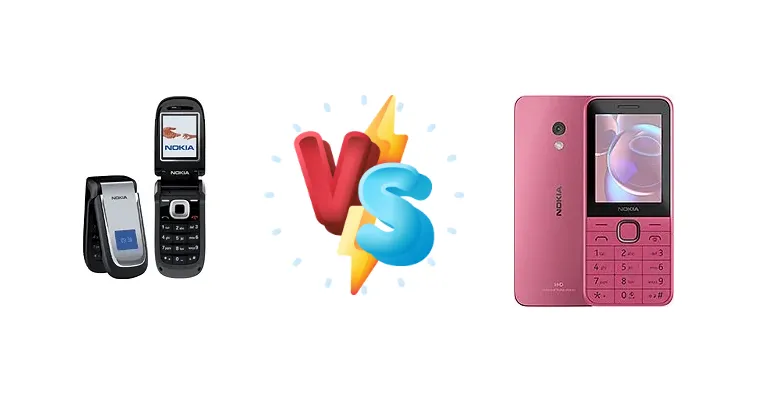
In a world dominated by smartphones, the appeal of a simple, reliable feature phone remains strong. We're pitting the Nokia 225 4G (2024) against the Nokia 2660 to determine which offers the best blend of essential features, connectivity, and affordability. The key differentiator here is the 225 4G's modern connectivity versus the 2660's likely focus on core functionality and extended battery life.
🏆 Quick Verdict
For users prioritizing 4G connectivity and basic app access, the Nokia 225 4G (2024) is the clear winner. Its Unisoc T107 chipset provides a slight performance edge and enables modern features. However, if ultimate simplicity and potentially longer battery life are paramount, the Nokia 2660 remains a viable, though less feature-rich, option.
| Network |
|---|
| 2G bands | GSM 900 / 1800 | GSM 850 / 900 / 1800 / 1900 |
| 3G bands | - | HSDPA 850 / 900 / 2100 |
| 4G bands | - | 1, 3, 5, 7, 8, 20, 28, 38, 40, 41 - EU, EMEA, APAC |
| EDGE | No | - |
| GPRS | Class 10 | - |
| Speed | - | HSPA, LTE |
| Technology | GSM | GSM / HSPA / LTE |
| Launch |
|---|
| Announced | 2007, May | 2024, April 30 |
| Status | Discontinued | Available. Released 2024, May |
| Body |
|---|
| Dimensions | 87 x 44.8 x 20.7 mm (3.43 x 1.76 x 0.81 in) | 121.5 x 52 x 11.6 mm (4.78 x 2.05 x 0.46 in) |
| SIM | Mini-SIM | Nano-SIM + Nano-SIM |
| Weight | 79 g (2.79 oz) | - |
| Display |
|---|
| Resolution | 128 x 160 pixels (~111 ppi density) | 240 x 320 pixels, 4:3 ratio (~167 ppi density) |
| Size | 1.85 inches, 10.8 cm2 (~27.6% screen-to-body ratio) | 2.4 inches, 17.8 cm2 (~28.2% screen-to-body ratio) |
| Type | TFT, 65K colors | TFT LCD |
| | Second external mono display (96 x 68 pixels)
Screensavers, themes and wallpapers | - |
| Platform |
|---|
| CPU | - | 1.0 GHz Cortex-A7 |
| Chipset | - | Unisoc T107 (22 nm) |
| Memory |
|---|
| Call records | 20 dialed, 20 received, 20 missed calls | Yes |
| Card slot | No | microSDHC |
| Internal | 2MB | 128MB 64MB RAM |
| Phonebook | Yes | Yes |
| Main Camera |
|---|
| Features | - | LED flash |
| Single | - | 0.3 MP |
| Video | - | Yes |
| Sound |
|---|
| 3.5mm jack | No | - |
| 35mm jack | No | Yes |
| Alert types | Vibration; Downloadable polyphonic, MP3 ringtones | - |
| Loudspeaker | Yes | Yes |
| Comms |
|---|
| Bluetooth | 2.0 | 5.0, A2DP, LE |
| NFC | - | No |
| Positioning | No | No |
| Radio | FM radio | Wireless FM radio |
| USB | Proprietary | USB Type-C |
| WLAN | No | No |
| Features |
|---|
| Browser | WAP 2.0/xHTML | - |
| Games | Yes + downloadable | Yes |
| Java | Yes, MIDP 2.1 | No |
| Messaging | SMS, MMS, Email, Instant Messaging | SMS |
| Sensors | - | No |
| | 3GPP player
Predictive text input
Organizer | - |
| Battery |
|---|
| Stand-by | Up to 310 h | - |
| Talk time | Up to 7 h | - |
| Type | Removable Li-Ion 700 mAh battery (BL-4B) | Li-Ion 1450 mAh, removable |
| Misc |
|---|
| Colors | Black | Pink, Dark Blue |
| Price | About 40 EUR | - |
| SAR | 1.01 W/kg (head) 1.01 W/kg (body) | - |
| SAR EU | 0.70 W/kg (head) | - |
Nokia 2660
- Potentially longer battery life due to simpler functionality.
- Extremely affordable.
- Highly durable and reliable.
- Lacks 4G connectivity.
- Limited functionality compared to the 225 4G.
- Older chipset and slower performance.
Nokia 225 4G (2024)
- 4G connectivity for clearer calls and faster data.
- Access to basic apps like WhatsApp.
- More modern chipset for smoother operation.
- Battery life may be shorter than the 2660.
- Slightly higher price point.
- Still limited in terms of advanced features.
Display Comparison
Given the lack of display specifications for the Nokia 2660, we can assume it utilizes a standard LCD panel common in feature phones of its era. The Nokia 225 4G (2024) likely features a similar LCD, but the inclusion of a more modern chipset *could* translate to slightly improved color reproduction. Both devices will likely prioritize readability over vibrant colors, and neither is expected to offer high brightness levels for outdoor visibility. Bezels will be substantial on both, as is typical for this class of device.
Camera Comparison
Neither device is positioned as a photography powerhouse. Without specific camera details for the Nokia 2660, it's safe to assume a basic VGA or 1.3MP sensor. The Nokia 225 4G (2024) likely features a similar low-resolution camera. Image quality will be limited in both cases, suitable only for basic snapshots in good lighting conditions. Focusing on camera specs here is largely irrelevant; these phones are about communication, not photography.
Performance
The Nokia 225 4G (2024) boasts a Unisoc T107 chipset with a 1.0 GHz Cortex-A7 CPU. This provides a measurable performance advantage over the Nokia 2660, which likely uses a significantly older and less powerful chipset. While neither phone is designed for demanding tasks, the T107 allows for smoother operation of basic apps and faster web browsing. The 22nm process node of the T107, while not cutting-edge, is more efficient than the likely older process used in the 2660, potentially contributing to slightly better battery life *while* offering more features. The 2660 will likely be limited to core phone functions with minimal multitasking capability.
Battery Life
The Nokia 2660 likely prioritizes battery life above all else, potentially utilizing a larger battery capacity than the Nokia 225 4G (2024). However, the more efficient Unisoc T107 chipset in the 225 4G (2024) could offset some of this difference. While the 2660 may offer longer standby time, the 225 4G (2024) will benefit from the ability to conserve power through 4G network optimization. Actual usage patterns will heavily influence real-world battery performance on both devices.
Buying Guide
Buy the Nokia 2660 if you need a phone solely for calls and texts, with a focus on maximum battery life and a minimal learning curve. It's ideal for those who actively *avoid* smartphone features. Buy the Nokia 225 4G (2024) if you want 4G connectivity for clearer calls, occasional internet browsing, and access to basic apps like WhatsApp, offering a bridge between a traditional phone and a smartphone.
Frequently Asked Questions
❓ Does the Nokia 225 4G (2024) support VoLTE calling, and will it work with all carriers?
The Nokia 225 4G (2024) *should* support VoLTE (Voice over LTE) for higher quality calls on 4G networks. However, carrier compatibility can vary. It's crucial to check with your specific carrier to ensure the phone is certified and will function correctly on their network, particularly regarding VoLTE and 4G bands.
❓ Can I use WhatsApp on the Nokia 225 4G (2024), and is the experience usable?
Yes, the Nokia 225 4G (2024) supports WhatsApp. However, the experience is basic. Expect a simplified interface and slower loading times compared to a smartphone. It's suitable for sending and receiving text messages and occasional image sharing, but not for extensive use or video calls. The Unisoc T107 chipset provides enough processing power for basic WhatsApp functionality.
❓ What kind of charging port does the Nokia 2660 use, and is a charger included in the box?
The Nokia 2660 almost certainly uses a Micro-USB port for charging, a standard for feature phones. Whether a charger is included in the box depends on the specific retail package. It's advisable to confirm this with the seller before purchasing, as some budget models may omit the charger to reduce costs.