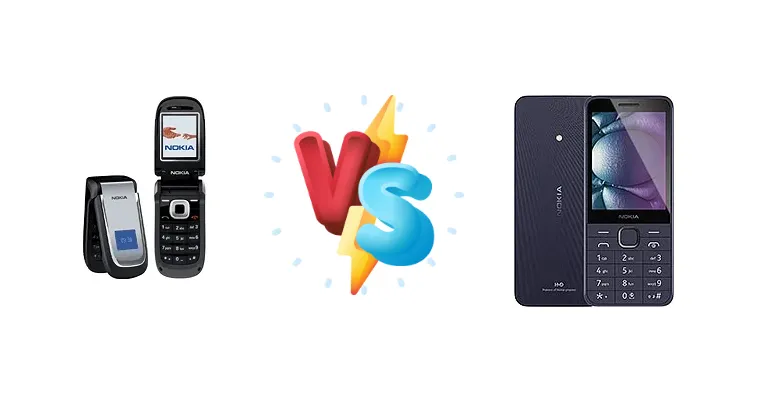
In a market saturated with smartphones, Nokia continues to cater to the demand for simple, reliable communication with the 2660 and the newer 215 4G (2024). This comparison dissects the core differences between these two feature phones, focusing on connectivity, performance, and the user experience they offer to those prioritizing essential functions over advanced features.
🏆 Quick Verdict
For users needing basic connectivity and extended battery life, the Nokia 2660 is a solid choice. However, the Nokia 215 4G (2024) wins for users who require 4G data capabilities and a slightly more modern chipset, despite the limited performance gains.
| Network |
|---|
| 2G bands | GSM 900 / 1800 | GSM 850 / 900 / 1800 / 1900 |
| 3G bands | - | HSDPA 850 / 900 / 2100 |
| 4G bands | - | 1, 3, 5, 7, 8, 20, 28, 38, 40, 41 - EU, EMEA, APAC |
| EDGE | No | - |
| GPRS | Class 10 | - |
| Speed | - | HSPA, LTE |
| Technology | GSM | GSM / HSPA / LTE |
| Launch |
|---|
| Announced | 2007, May | 2024, April 30 |
| Status | Discontinued | Available. Released 2024, May |
| Body |
|---|
| Dimensions | 87 x 44.8 x 20.7 mm (3.43 x 1.76 x 0.81 in) | 127.3 x 54.2 x 11.6 mm (5.01 x 2.13 x 0.46 in) |
| SIM | Mini-SIM | Nano-SIM + Nano-SIM |
| Weight | 79 g (2.79 oz) | - |
| Display |
|---|
| Resolution | 128 x 160 pixels (~111 ppi density) | 240 x 320 pixels, 4:3 ratio (~143 ppi density) |
| Size | 1.85 inches, 10.8 cm2 (~27.6% screen-to-body ratio) | 2.8 inches, 24.3 cm2 (~35.2% screen-to-body ratio) |
| Type | TFT, 65K colors | TFT LCD |
| | Second external mono display (96 x 68 pixels)
Screensavers, themes and wallpapers | - |
| Platform |
|---|
| CPU | - | 1.0 GHz Cortex-A7 |
| Chipset | - | Unisoc T107 (22 nm) |
| Memory |
|---|
| Call records | 20 dialed, 20 received, 20 missed calls | Yes |
| Card slot | No | microSDHC |
| Internal | 2MB | 128MB 64MB RAM |
| Phonebook | Yes | Yes |
| Sound |
|---|
| 3.5mm jack | No | - |
| 35mm jack | No | Yes |
| Alert types | Vibration; Downloadable polyphonic, MP3 ringtones | - |
| Loudspeaker | Yes | Yes |
| Comms |
|---|
| Bluetooth | 2.0 | 5.0, A2DP, LE |
| NFC | - | No |
| Positioning | No | No |
| Radio | FM radio | Wireless FM radio |
| USB | Proprietary | USB Type-C |
| WLAN | No | No |
| Features |
|---|
| Browser | WAP 2.0/xHTML | - |
| Games | Yes + downloadable | Yes |
| Java | Yes, MIDP 2.1 | No |
| Messaging | SMS, MMS, Email, Instant Messaging | SMS |
| Sensors | - | No |
| | 3GPP player
Predictive text input
Organizer | - |
| Battery |
|---|
| Stand-by | Up to 310 h | - |
| Talk time | Up to 7 h | - |
| Type | Removable Li-Ion 700 mAh battery (BL-4B) | Li-Ion 1450 mAh, removable |
| Misc |
|---|
| Colors | Black | Peach, Black, Dark Blue |
| Price | About 40 EUR | - |
| SAR | 1.01 W/kg (head) 1.01 W/kg (body) | - |
| SAR EU | 0.70 W/kg (head) | - |
Nokia 2660
- Exceptional battery life due to 2G connectivity.
- Simple and intuitive user interface.
- Highly affordable price point.
- Limited functionality – no 4G data.
- Older chipset and slower performance.
- Basic camera capabilities.
Nokia 215 4G (2024)
- 4G connectivity for faster data speeds.
- More responsive performance with Unisoc T107.
- Slightly more modern feature set.
- Shorter battery life compared to the Nokia 2660.
- Still limited in terms of advanced features.
- Camera quality remains basic.
Display Comparison
Neither device boasts a sophisticated display. Given the lack of specific display specs for the Nokia 2660, we can assume it utilizes a standard color LCD, typical of feature phones in its class. The Nokia 215 4G (2024) also features a color LCD, but the focus here isn’t on visual fidelity; it’s on legibility and power efficiency. Both displays are likely to have limited viewing angles and moderate brightness, sufficient for basic use but not ideal for outdoor visibility. The smaller screen sizes on both devices prioritize portability and ease of one-handed operation.
Camera Comparison
Both the Nokia 2660 and the Nokia 215 4G (2024) are unlikely to deliver impressive camera performance. Feature phones in this segment typically feature low-resolution sensors primarily intended for basic photo capture. Detailed camera specifications for the Nokia 2660 are unavailable, but it’s safe to assume a very basic camera setup. The Nokia 215 4G (2024) likely features a similar low-resolution sensor, and image quality will be limited by the sensor size, lens quality, and lack of image stabilization. These cameras are best suited for quick snapshots in good lighting conditions.
Performance
The Nokia 215 4G (2024) is equipped with the Unisoc T107 chipset, a 22nm processor featuring a 1.0 GHz Cortex-A7 CPU. While not a powerhouse, this chipset provides a noticeable performance advantage over the likely older, unspecified chipset in the Nokia 2660. The Unisoc T107 enables smoother operation of basic apps like the web browser and WhatsApp, and supports 4G connectivity for faster data speeds. The Nokia 2660, lacking a modern chipset, will be limited to 2G speeds and slower response times for any data-intensive tasks. The Cortex-A7 architecture, while dated, is still more efficient than the processors typically found in older feature phones.
Battery Life
Battery life is a key strength of both devices, but the Nokia 2660 likely holds an advantage. Without specific battery capacity details for the 2660, its lack of 4G connectivity and less powerful processor suggest significantly longer standby and talk times. The Nokia 215 4G (2024), while still offering respectable battery life, will consume more power due to the 4G radio and the Unisoc T107 chipset. The 2660 is geared towards users who need a phone that can last for days on a single charge, while the 215 4G (2024) offers a balance between connectivity and battery endurance.
Buying Guide
Buy the Nokia 2660 if you need a supremely long-lasting battery and only require 2G connectivity for calls and texts. It’s ideal for those in areas with limited 4G coverage or who simply want a phone for emergencies. Buy the Nokia 215 4G (2024) if you prioritize access to 4G data for basic internet browsing, WhatsApp, or occasional social media use, and are willing to trade some battery life for that added functionality.
Frequently Asked Questions
❓ Does the Nokia 215 4G (2024) support WhatsApp, and how well does it run?
Yes, the Nokia 215 4G (2024) supports WhatsApp. However, due to the Unisoc T107 chipset and limited RAM, performance will be basic. Expect slower loading times and a less fluid experience compared to smartphones. It's suitable for occasional messaging, but not for heavy WhatsApp usage.
❓ How much faster is the 4G connectivity on the Nokia 215 4G (2024) compared to the Nokia 2660?
The Nokia 2660 is limited to 2G connectivity, which offers very slow data speeds – suitable only for basic text messaging. The Nokia 215 4G (2024) provides significantly faster data speeds with 4G, enabling basic web browsing, social media access, and smoother WhatsApp usage. The difference is substantial, making the 215 4G a better choice for anyone needing internet access.
❓ Is the Nokia 2660 a good option for emergency use or as a backup phone?
Absolutely. The Nokia 2660 excels as an emergency or backup phone due to its incredibly long battery life and reliable call functionality. Its simplicity and durability make it a practical choice for situations where a smartphone might not be ideal or readily available.