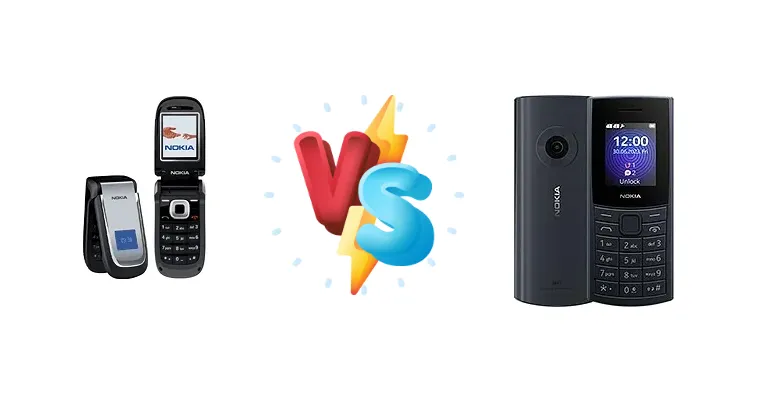
In a market saturated with smartphones, Nokia continues to cater to the demand for simple, reliable communication with feature phones. We're pitting the Nokia 2660 against the Nokia 110 4G 2nd Edition, two devices aimed at users prioritizing call quality, long battery life, and affordability over advanced features. This comparison will dissect their subtle differences to determine which best suits your needs.
🏆 Quick Verdict
For the average user seeking a dependable, long-lasting feature phone, the Nokia 110 4G 2nd Edition offers a slight edge due to its confirmed 4G connectivity and likely wider availability. However, the Nokia 2660 may appeal to those seeking a potentially more refined user experience, pending detailed specification confirmation.
| Network |
|---|
| 2G bands | GSM 900 / 1800 | GSM 900 / 1800 |
| 3G bands | - | HSDPA 850 / 900 / 1700(AWS) / 1900 / 2100 |
| 4G bands | - | LTE |
| EDGE | No | - |
| GPRS | Class 10 | - |
| Speed | - | HSPA, LTE |
| Technology | GSM | GSM / HSPA / LTE |
| Launch |
|---|
| Announced | 2007, May | 2024, December |
| Status | Discontinued | Available. Released 2024, December |
| Body |
|---|
| Dimensions | 87 x 44.8 x 20.7 mm (3.43 x 1.76 x 0.81 in) | 121.5 x 50 x 14.4 mm (4.78 x 1.97 x 0.57 in) |
| SIM | Mini-SIM | · Nano-SIM· Nano-SIM + Nano-SIM |
| Weight | 79 g (2.79 oz) | 94.5 g (3.35 oz) |
| Display |
|---|
| Resolution | 128 x 160 pixels (~111 ppi density) | 120 x 160 pixels, 4:3 ratio (~111 ppi density) |
| Size | 1.85 inches, 10.8 cm2 (~27.6% screen-to-body ratio) | 1.8 inches, 10.0 cm2 (~16.5% screen-to-body ratio) |
| Type | TFT, 65K colors | IPS LCD |
| | Second external mono display (96 x 68 pixels)
Screensavers, themes and wallpapers | - |
| Memory |
|---|
| Call records | 20 dialed, 20 received, 20 missed calls | Yes |
| Card slot | No | microSDHC |
| Internal | 2MB | 48MB 128MB RAM |
| Phonebook | Yes | Yes |
| Main Camera |
|---|
| Single | - | QVGA |
| Video | - | Yes |
| Sound |
|---|
| 3.5mm jack | No | - |
| 35mm jack | No | Yes |
| Alert types | Vibration; Downloadable polyphonic, MP3 ringtones | - |
| Loudspeaker | Yes | Yes |
| Comms |
|---|
| Bluetooth | 2.0 | 5.0, A2DP |
| NFC | - | No |
| Positioning | No | No |
| Radio | FM radio | Wireless FM radio |
| USB | Proprietary | USB Type-C |
| WLAN | No | No |
| Features |
|---|
| Browser | WAP 2.0/xHTML | - |
| Games | Yes + downloadable | Yes |
| Java | Yes, MIDP 2.1 | No |
| Messaging | SMS, MMS, Email, Instant Messaging | SMS |
| | 3GPP player
Predictive text input
Organizer | - |
| Battery |
|---|
| Stand-by | Up to 310 h | - |
| Talk time | Up to 7 h | - |
| Type | Removable Li-Ion 700 mAh battery (BL-4B) | Li-Ion 1450 mAh, removable |
| Misc |
|---|
| Colors | Black | Midnight Blue, Arctic Purple |
| Price | About 40 EUR | About 60 EUR |
| SAR | 1.01 W/kg (head) 1.01 W/kg (body) | - |
| SAR EU | 0.70 W/kg (head) | - |
Nokia 2660
- Potentially more refined user interface
- May feature a slightly improved camera
- Classic Nokia build quality (expected)
- Lack of confirmed specifications
- Availability may be limited initially
- 4G connectivity unconfirmed
Nokia 110 4G 2nd Edition
- Confirmed 4G connectivity for voice and text
- Wider availability and established market presence
- Excellent battery life
- Basic display and camera capabilities
- Limited processing power
- Simple user interface
Display Comparison
Given the lack of specific display data, we can infer both devices utilize color displays typical of their price segment. The Nokia 110 4G 2nd Edition likely features a slightly larger display, based on its overall dimensions, potentially offering a marginally better viewing experience for text and basic menus. However, neither is expected to offer high resolution or advanced features like brightness adjustments beyond basic levels. The Nokia 2660 may benefit from a newer display technology, but this remains unconfirmed.
Camera Comparison
Both devices are likely to feature basic cameras, primarily for capturing simple snapshots. Given the market segment, image quality will be limited, and features like optical image stabilization (OIS) are absent. The Nokia 2660 may offer a slightly improved camera sensor, but the difference will be negligible for most users. The primary function of these cameras is documentation, not photography.
Performance
Both phones operate on basic feature phone platforms, lacking the processing power of smartphones. The Nokia 110 4G 2nd Edition's inclusion of 4G connectivity suggests a more modern chipset capable of handling data connections, even if limited. The Nokia 2660's performance will likely be comparable, focusing on efficient call handling and basic application execution. RAM capacity is expected to be minimal on both, sufficient only for the core functionalities.
Battery Life
Feature phones excel in battery life, and both the Nokia 2660 and 110 4G 2nd Edition are expected to deliver days of usage on a single charge. The Nokia 110 4G 2nd Edition's 4G connectivity may introduce a slightly higher power draw, but its battery capacity is likely optimized to compensate. The Nokia 2660's battery performance will depend on its specific capacity and power management features, which are currently unknown. Both will likely support standard micro-USB charging.
Buying Guide
Buy the Nokia 2660 if you need a potentially more modern user interface and are willing to wait for detailed specifications. It's ideal for users who appreciate a slightly more polished experience within the basic phone category. Buy the Nokia 110 4G 2nd Edition if you prioritize confirmed 4G connectivity for voice calls and messaging, and require a readily available, budget-friendly option for reliable communication.
Frequently Asked Questions
❓ Does the Nokia 110 4G 2nd Edition support VoLTE calling?
Yes, the '4G' in the name indicates support for 4G networks, which generally includes VoLTE (Voice over LTE) for higher quality calls and faster connection times where available. This is a key benefit over older 2G/3G feature phones.
❓ What kind of SIM card does the Nokia 2660 use?
Based on Nokia's typical feature phone design, the Nokia 2660 is expected to utilize a standard Micro-SIM card. However, this is unconfirmed until official specifications are released.
❓ Can either of these phones connect to Wi-Fi?
The Nokia 110 4G 2nd Edition does support Wi-Fi connectivity, allowing for internet access when a Wi-Fi network is available. The Nokia 2660's Wi-Fi capabilities are currently unknown.
❓ Are these phones dual SIM capable?
The Nokia 110 4G 2nd Edition is available in both single and dual SIM variants. The Nokia 2660's SIM capabilities are currently unconfirmed, but a dual SIM option is plausible given the market trend.