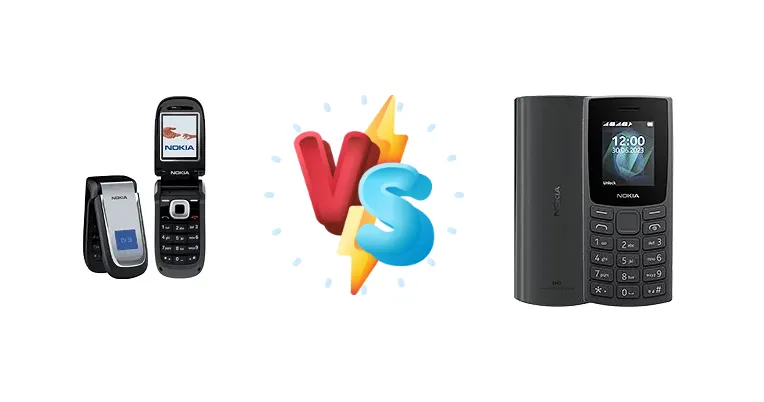
In a market saturated with smartphones, Nokia continues to cater to a segment seeking simplicity and reliability with its feature phones. We pit the Nokia 2660 against the Nokia 105 4G 2nd Edition, two devices representing modern takes on classic functionality. This comparison focuses on the nuances that matter to users prioritizing call quality, battery life, and essential features over advanced capabilities.
🏆 Quick Verdict
For the average user needing a dependable, long-lasting phone for calls and texts, the Nokia 105 4G 2nd Edition offers a slight edge due to its integrated 4G connectivity, providing wider network compatibility and potentially better call quality in areas with limited 3G coverage. However, the 2660 may appeal to those seeking a more traditional design.
| Network |
|---|
| 2G bands | GSM 900 / 1800 | GSM 900 / 1800 |
| 3G bands | - | HSDPA 850 / 900 / 1700(AWS) / 1900 / 2100 |
| 4G bands | - | LTE |
| EDGE | No | - |
| GPRS | Class 10 | - |
| Speed | - | HSPA, LTE |
| Technology | GSM | GSM / HSPA / LTE |
| Launch |
|---|
| Announced | 2007, May | 2024, December |
| Status | Discontinued | Available. Released 2024, December |
| Body |
|---|
| Dimensions | 87 x 44.8 x 20.7 mm (3.43 x 1.76 x 0.81 in) | 121.5 x 50 x 14.4 mm (4.78 x 1.97 x 0.57 in) |
| SIM | Mini-SIM | · Nano-SIM· Nano-SIM + Nano-SIM |
| Weight | 79 g (2.79 oz) | 93 g (3.28 oz) |
| Display |
|---|
| Resolution | 128 x 160 pixels (~111 ppi density) | 120 x 160 pixels, 4:3 ratio (~111 ppi density) |
| Size | 1.85 inches, 10.8 cm2 (~27.6% screen-to-body ratio) | 1.8 inches, 10.0 cm2 (~16.5% screen-to-body ratio) |
| Type | TFT, 65K colors | IPS LCD |
| | Second external mono display (96 x 68 pixels)
Screensavers, themes and wallpapers | - |
| Memory |
|---|
| Call records | 20 dialed, 20 received, 20 missed calls | Yes |
| Card slot | No | microSDHC |
| Internal | 2MB | 48MB 128MB RAM |
| Phonebook | Yes | Yes |
| Sound |
|---|
| 3.5mm jack | No | - |
| 35mm jack | No | Yes |
| Alert types | Vibration; Downloadable polyphonic, MP3 ringtones | - |
| Loudspeaker | Yes | Yes |
| Comms |
|---|
| Bluetooth | 2.0 | 5.0, A2DP |
| NFC | - | No |
| Positioning | No | No |
| Radio | FM radio | Wireless FM radio |
| USB | Proprietary | USB Type-C |
| WLAN | No | No |
| Features |
|---|
| Browser | WAP 2.0/xHTML | - |
| Games | Yes + downloadable | Yes |
| Java | Yes, MIDP 2.1 | No |
| Messaging | SMS, MMS, Email, Instant Messaging | SMS |
| | 3GPP player
Predictive text input
Organizer | - |
| Battery |
|---|
| Stand-by | Up to 310 h | - |
| Talk time | Up to 7 h | - |
| Type | Removable Li-Ion 700 mAh battery (BL-4B) | Li-Ion 1450 mAh, removable |
| Misc |
|---|
| Colors | Black | Charcoal |
| Price | About 40 EUR | About 50 EUR |
| SAR | 1.01 W/kg (head) 1.01 W/kg (body) | - |
| SAR EU | 0.70 W/kg (head) | - |
Nokia 2660
- Potentially more durable build quality (based on Nokia's reputation)
- Classic, user-friendly interface
- May offer longer standby time due to lack of 4G
- Lacks 4G connectivity, limiting network compatibility
- Potentially lower call quality in areas with limited 3G/2G
- Limited future-proofing
Nokia 105 4G 2nd Edition
- 4G connectivity for wider network compatibility
- Potentially better call quality in modern networks
- Access to basic internet services (WhatsApp, etc.)
- 4G usage may reduce battery life compared to 2G/3G only
- Potentially less durable build quality
- Slightly more complex interface than the 2660
Display Comparison
Given the lack of detailed display specifications, we can infer both devices utilize color displays typical of their price segment. The Nokia 2660 likely prioritizes a larger screen size for improved readability, while the Nokia 105 4G 2nd Edition may focus on power efficiency. The absence of high-resolution panels means image clarity will be similar on both, but the 2660’s potential larger size could offer a more comfortable viewing experience for text messages and contacts.
Camera Comparison
Neither device is marketed for its camera capabilities. Any camera present on either phone is likely a very low-resolution sensor intended for basic image capture. Image quality will be significantly lower than even entry-level smartphones, and these cameras should not be considered a primary feature. The Nokia 2660 may or may not include a camera, while the 105 4G 2nd Edition's camera is likely a basic VGA sensor.
Performance
Both phones operate on basic feature phone platforms, lacking the processing power of smartphones. The Nokia 105 4G 2nd Edition’s inclusion of 4G connectivity necessitates a slightly more capable chipset to handle data transmission, potentially offering marginally faster access to online services. However, the performance difference will be negligible for core functions like calls and SMS. RAM is likely limited on both, sufficient only for the phone's basic operating system and a small number of contacts.
Battery Life
Battery life is a key strength of both devices. The Nokia 105 4G 2nd Edition, despite supporting 4G, is known for exceptional standby times, potentially exceeding weeks on a single charge. The Nokia 2660, lacking 4G, may offer slightly longer standby times, but the difference will likely be minimal. Both phones prioritize power efficiency, making them ideal for users who dislike frequent charging. Actual usage will depend on network signal strength and call frequency.
Buying Guide
Buy the Nokia 2660 if you need a highly durable, no-frills phone primarily for making and receiving calls in areas with strong 2G/3G coverage, and value a classic, straightforward user experience. Buy the Nokia 105 4G 2nd Edition if you prefer future-proofed connectivity with 4G support, potentially better voice call quality in modern networks, and access to basic internet functionality like WhatsApp.
Frequently Asked Questions
❓ Will the Nokia 105 4G 2nd Edition work with my current carrier if they are phasing out 3G?
Yes, the 4G connectivity of the Nokia 105 4G 2nd Edition ensures compatibility with networks as carriers decommission their 3G infrastructure. This makes it a more future-proof option for users concerned about losing connectivity.
❓ Can I use WhatsApp on either the Nokia 2660 or the Nokia 105 4G 2nd Edition?
WhatsApp can be used on the Nokia 105 4G 2nd Edition, but only with its 4G connection. The Nokia 2660, lacking 4G, will not be able to reliably run WhatsApp due to its limited data capabilities.
❓ How durable are these phones, and are they resistant to drops or water damage?
Both phones are built with durability in mind, typical of Nokia feature phones. However, neither is officially rated for water resistance or drop protection. They are likely to withstand everyday bumps and scrapes better than smartphones, but caution is still advised.