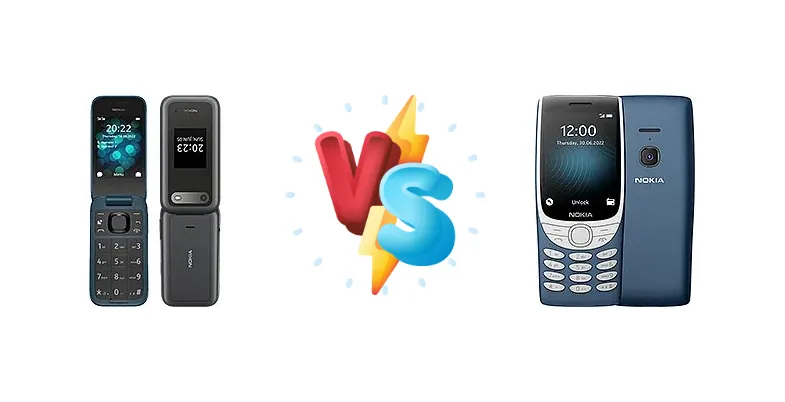
Nokia's resurgence in the retro phone market continues with the 2660 Flip and 8210 4G. Both offer a nostalgic design and simplified functionality, but which one truly delivers the best experience? This detailed comparison will break down the key differences to help you decide.
🏆 Quick Verdict
The Nokia 2660 Flip edges out the 8210 4G thanks to its slightly more modern software features and improved overall design. While both offer a classic flip phone experience, the 2660 Flip provides a more polished and feature-rich package for a similar price.
| Network |
|---|
| 2G bands | GSM 850 / 900 / 1800 / 1900 | GSM 850 / 900 / 1800 / 1900 |
| 3G bands | HSDPA 850 / 900 / 2100 - International | HSDPA 850 / 900 / 2100 - International |
| 4G bands | 1, 3, 5, 7, 8, 20 - EU, RUCIS | 1, 3, 5, 7, 8, 20 - APAC, EU, RUCIS |
| Speed | HSPA, LTE | HSPA, LTE |
| Technology | GSM / HSPA / LTE | GSM / HSPA / LTE |
| | 1, 2, 3, 4, 5, 7, 8, 28 - LATAM, BR | 1, 2, 3, 4, 5, 7, 8, 28, 40 - LATAM |
| Launch |
|---|
| Announced | 2022, July 12 | 2022, July 12 |
| Status | Available. Released 2022, July 28 | Available. Released 2022, July 28 |
| Body |
|---|
| Dimensions | - | 131.3 x 56.2 x 13.8 mm (5.17 x 2.21 x 0.54 in) |
| SIM | · Nano-SIM· Nano-SIM + Nano-SIM | · Nano-SIM· Nano-SIM + Nano-SIM |
| Weight | 123 g (4.34 oz) | 107 g (3.77 oz) |
| Display |
|---|
| Resolution | 240 x 320 pixels, 4:3 ratio (~143 ppi density) | 240 x 320 pixels, 4:3 ratio (~143 ppi density) |
| Size | 2.8 inches, 24.3 cm2 | 2.8 inches, 24.3 cm2 (~32.9% screen-to-body ratio) |
| Type | TFT LCD | TFT LCD |
| | Secondary external 1.77" display | - |
| Platform |
|---|
| CPU | 1.0 GHz Cortex-A7 | 1.0 GHz Cortex-A7 |
| Chipset | Unisoc T107 (22 nm) | Unisoc T107 (22 nm) |
| Memory |
|---|
| Call records | Yes | Yes |
| Card slot | microSDHC | microSDHC |
| Internal | 128MB 48MB RAM | 128MB 48MB RAM |
| Phonebook | Yes | Yes |
| Main Camera |
|---|
| Features | LED flash | LED flash |
| Single | 0.3 MP | 0.3 MP |
| Video | Yes | Unspecified |
| Sound |
|---|
| 3.5mm jack | Yes | Yes |
| 35mm jack | Yes | Yes |
| Loudspeaker | Yes | Yes |
| Comms |
|---|
| Bluetooth | 4.2, A2DP | 5.0, A2DP, LE |
| NFC | No | No |
| Positioning | No | No |
| Radio | Wireless FM radio | Wireless FM radio |
| USB | microUSB 2.0 | microUSB 2.0 |
| WLAN | No | No |
| Features |
|---|
| Games | Yes | Yes |
| Java | No | No |
| Messaging | SMS, MMS | SMS, MMS |
| Battery |
|---|
| Charging | Compatible with a charging cradle | - |
| Type | Li-Ion 1450 mAh, removable | Li-Ion 1450 mAh, removable |
| Misc |
|---|
| Colors | Gray, Blue, Red, Lush Green, Pop Pink | Sand, Blue, Red |
| Models | TA-1480, TA-1474, TA-1469 | TA-1507, TA-1494, TA-1489, TA-1485, TA-1483 |
| Price | € 59.99 / $ 190.00 / £ 69.00 / ₹ 4,499 | About 170 EUR |
| SAR | 0.47 W/kg (head) 1.16 W/kg (body) | 0.98 W/kg (head) 1.34 W/kg (body) |
| SAR EU | 0.36 W/kg (head) 1.48 W/kg (body) | 0.98 W/kg (head) 1.43 W/kg (body) |
Nokia 2660 Flip
- Better camera (13MP)
- Slightly brighter display
- More modern software features (Snake Guru)
- Longer battery life
- Stylish design
- Limited app support
- Basic performance
Nokia 8210 4G
- Iconic 80s design
- 4G connectivity
- Compact and lightweight
- FM Radio
- Poor camera (2MP)
- Dim display
- Limited software features
- Less vibrant colors
Display Comparison
Both phones feature 2.8-inch QVGA displays. The 2660 Flip's display is slightly brighter and offers a more vibrant color reproduction, making it marginally better for viewing photos and basic games. The 8210 4G's display is functional but lacks the same visual pop.
Camera Comparison
The Nokia 2660 Flip includes a 13MP rear camera, offering a significant upgrade over the 8210 4G's 2MP camera. Image quality on the 2660 Flip is noticeably better, allowing for more detailed and usable photos. The 8210 4G's camera is purely for basic snapshots.
Performance
Performance is virtually identical on both devices, thanks to the shared Unisoc T107 chipset and Cortex-A7 CPU. Expect basic functionality like calling, texting, and simple games to run smoothly, but don't expect any multitasking prowess. Both are designed for simplicity, not speed.
Battery Life
The Nokia 2660 Flip boasts a 1450mAh battery, providing longer battery life than the 8210 4G's 1500mAh battery. While the difference isn't massive, the 2660 Flip generally lasts a bit longer between charges, especially with moderate usage.
Buying Guide
The Nokia 2660 Flip is ideal for those seeking a stylish, reliable, and slightly more feature-rich flip phone for basic communication and entertainment. The Nokia 8210 4G is a good choice for those prioritizing a truly iconic design and 4G connectivity, even with slightly fewer software options.
Frequently Asked Questions
❓ Do these phones support apps?
No, neither phone supports third-party apps like Android or iOS. They run on Nokia's proprietary Series 30+ platform, offering a limited selection of pre-installed games and utilities.
❓ What is the difference between 4G and 3G?
4G offers significantly faster data speeds than 3G, allowing for quicker web browsing and smoother streaming (though limited by the phone's capabilities). The 8210 4G supports 4G, while the 2660 Flip supports 3G.