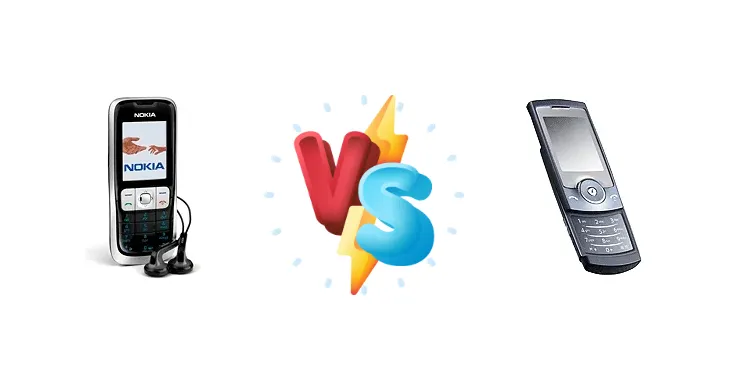
In a world dominated by smartphones, the appeal of a simple, reliable feature phone is experiencing a resurgence. The Nokia 2630 and Samsung U600 represent two distinct approaches to this market segment – the Nokia prioritizing robust functionality and longevity, while the Samsung U600 aimed for a more stylish and multimedia-focused experience. This comparison dissects their strengths and weaknesses, helping you determine which best suits your needs.
🏆 Quick Verdict
For the user seeking ultimate simplicity and battery life, the Nokia 2630 is the clear winner. Its focus on core functionality and Nokia’s reputation for durability make it a dependable choice. However, the Samsung U600 offers a more visually appealing design and potentially more multimedia features, appealing to those wanting a touch of style.
| Network |
|---|
| 2G bands | GSM 900 / 1800 | GSM 850 / 900 / 1800 / 1900 |
| EDGE | Class 6 | Class 10 |
| GPRS | Class 10 | Class 10 |
| Technology | GSM | GSM |
| | GSM 850 / 1900 - US version | - |
| Launch |
|---|
| Announced | 2007, May | 2007, February. Released 2007, April |
| Status | Discontinued | Discontinued |
| Body |
|---|
| Dimensions | 105 x 45 x 9.9 mm, 45 cc (4.13 x 1.77 x 0.39 in) | 103.5 x 49.3 x 10.9 mm (4.07 x 1.94 x 0.43 in) |
| SIM | Mini-SIM | Mini-SIM |
| Weight | 66 g (2.33 oz) | 81 g (2.86 oz) |
| Display |
|---|
| Resolution | 128 x 160 pixels (~114 ppi density) | 240 x 320 pixels, 4:3 ratio (~182 ppi density) |
| Size | 1.8 inches, 10.2 cm2 (~21.6% screen-to-body ratio) | 2.2 inches, 34 x 44 mm, 15.0 cm2 (~29.4% screen-to-body ratio) |
| Type | TFT, 65K colors | TFT, 256K colors |
| | 4-way scrolling
Screensavers, themes and wallpapers | - |
| Memory |
|---|
| Call records | 20 dialed, 20 received, 20 missed calls | 30 dialed, 30 received, 30 missed calls |
| Card slot | No | microSD (dedicated slot) |
| Internal | 11MB | 60MB |
| Phonebook | 1000 entries, Photocall | 1000 entries, Photocall |
| Main Camera |
|---|
| Features | - | LED flash |
| Single | VGA | 3.15 MP, AF |
| Video | SQCIF | CIF |
| Sound |
|---|
| 3.5mm jack | No | No |
| 35mm jack | No | No |
| Alert types | Vibration; Downloadable polyphonic, MP3 ringtones | Vibration; Downloadable polyphonic, MP3 ringtones |
| Loudspeaker | Yes | Yes |
| Comms |
|---|
| Bluetooth | 2.0 | 2.0, A2DP |
| Positioning | No | No |
| Radio | FM radio | Stereo FM radio, RDS |
| USB | No | 2.0 |
| WLAN | No | No |
| Features |
|---|
| Browser | WAP 2.0/xHTML | WAP 2.0/xHTML |
| Games | Yes + downloadable | Yes + downloadable |
| Java | Yes, MIDP 2.0 | Yes, MIDP 2.0 |
| Messaging | SMS, MMS, Email, Instant Messaging | SMS, MMS, Email |
| | Predictive text input
Organizer
Voice memo | MP3/AAC/eACC/WMA player
Predictive text input
Yahoo search
Organizer
Business card scanner
Document viewer (Word, Excel, PowerPoint, PDF)
Voice memo
TV-out |
| Battery |
|---|
| Stand-by | Up to 310 h | Up to 250 h |
| Talk time | Up to 6 h | Up to 3 h 30 min |
| Type | Removable Li-Ion 700 mAh battery (BL-4B) | Removable Li-Ion 690 mAh battery |
| Misc |
|---|
| Colors | Black | Sapphire Blue, Crystal Blue, Platinum Silver, Copper Gold, Garnet Red, Neutral White, Soft Black |
| Price | About 60 EUR | About 90 EUR |
| SAR | 1.04 W/kg (head) 0.60 W/kg (body) | 0.63 W/kg (head) 0.49 W/kg (body) |
| SAR EU | 0.63 W/kg (head) | 0.48 W/kg (head) |
| Tests |
|---|
| Audio quality | - |
Noise -89.2dB / Crosstalk -86.9dB |
| Loudspeaker | - |
Voice 66dB / Noise 66dB / Ring 75dB |
Nokia 2630
- Exceptional battery life
- Robust and durable build quality
- Simple and intuitive interface
- No camera
- Limited features compared to U600
- Basic display
Samsung U600
- More stylish design
- Includes a basic camera
- Potential for basic multimedia features
- Shorter battery life than Nokia 2630
- Less durable build quality
- Camera quality is very limited
Display Comparison
Given the era, both the Nokia 2630 and Samsung U600 feature small, color LCD screens. The U600 likely benefits from a slightly higher resolution display, aiming for sharper text and images, reflecting Samsung’s focus on visual presentation. However, neither display will offer the brightness or viewing angles of modern smartphone panels. The Nokia 2630’s display is likely optimized for readability under direct sunlight, prioritizing functionality over aesthetics. The U600’s screen, while potentially sharper, may suffer more in bright outdoor conditions.
Camera Comparison
The Samsung U600, being positioned as a slightly more premium feature phone, likely includes a basic camera – a feature absent in the Nokia 2630. While image quality will be extremely limited by today’s standards, the U600’s camera allows for capturing simple photos for personal use. The resolution is likely very low (VGA or below), and image quality will be poor in low light. The Nokia 2630’s omission of a camera reinforces its focus on core communication functions and maximizing battery life.
Performance
Performance on both devices is dictated by their basic feature phone chipsets. The Nokia 2630, built on a platform prioritizing efficiency, likely offers longer standby and talk times. The Samsung U600, potentially incorporating more features like music playback, may experience slightly more strain on its processor, impacting battery life. Neither phone will exhibit performance bottlenecks in the way a smartphone might; the focus is on reliably handling calls and texts. The U600’s inclusion of more features suggests a slightly more complex chipset, but not necessarily a faster one.
Battery Life
Battery life is a key differentiator. The Nokia 2630, with its emphasis on simplicity and efficiency, is expected to deliver significantly longer standby and talk times than the Samsung U600. The U600’s potential inclusion of a camera, music player, and slightly more complex chipset will draw more power. While both phones will offer days of use on a single charge, the Nokia 2630 is likely to stretch that to weeks, making it ideal for users who prioritize minimal charging.
Buying Guide
Buy the Nokia 2630 if you need a phone primarily for calls and texts, value exceptional battery life, and require a device known for its ruggedness. It’s ideal for emergency use, travel, or users who intentionally avoid smartphones. Buy the Samsung U600 if you prefer a more aesthetically pleasing design, potentially desire basic multimedia capabilities like music playback, and appreciate a slightly more modern feature phone experience, understanding that battery life may be comparatively shorter.
Frequently Asked Questions
❓ Is the camera on the Samsung U600 actually useful for anything beyond a quick snapshot?
The camera on the Samsung U600 is a very basic VGA camera. It's suitable for extremely low-resolution snapshots in good lighting conditions, but image quality will be poor by modern standards. It's more of a novelty feature than a practical tool for serious photography.
❓ How long can I realistically expect the Nokia 2630 to hold a charge on standby?
The Nokia 2630 is renowned for its exceptional battery life. In standby mode, you can realistically expect it to hold a charge for several weeks, potentially even a month or more, depending on network conditions and usage. This makes it ideal for emergency use or situations where access to a charger is limited.
❓ Are either of these phones compatible with modern 4G/5G networks?
No, neither the Nokia 2630 nor the Samsung U600 support 4G or 5G networks. They are 2G/2.5G devices, meaning they rely on older cellular technology. While they will still function on 2G networks in many parts of the world, coverage is diminishing as carriers transition to newer technologies.