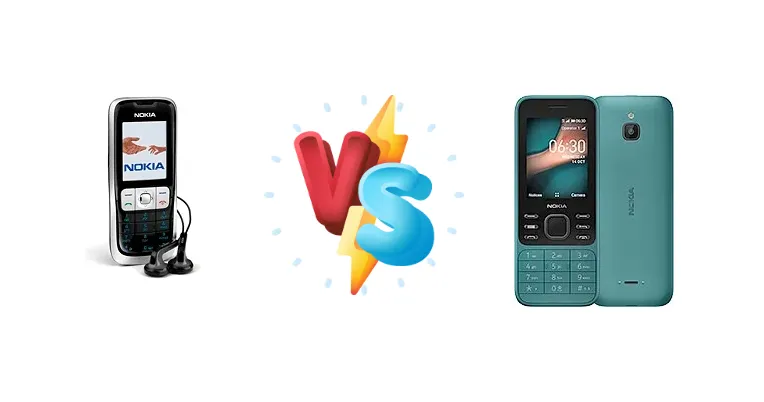
The mobile landscape has drastically changed, but a need remains for simple, reliable communication. We pit the Nokia 2630, a modern take on the classic feature phone, against the Nokia 6300 4G, a smartphone-lite offering basic connectivity and app support. This comparison isn't about raw power; it's about understanding which device best fits a specific, pared-down lifestyle.
🏆 Quick Verdict
For users prioritizing extreme simplicity, long battery life, and ruggedness, the Nokia 2630 is the clear winner. However, the Nokia 6300 4G, powered by the Qualcomm Snapdragon 210, offers the convenience of 4G connectivity and access to essential apps like WhatsApp, making it the better choice for those needing basic smartphone functionality.
| Network |
|---|
| 2G bands | GSM 900 / 1800 | GSM 850 / 900 / 1800 / 1900 |
| 3G bands | - | HSDPA 850 / 900 / 2100 - International |
| 4G bands | - | 1, 3, 5, 7, 8, 20, 28, 38, 40 - ROW |
| EDGE | Class 6 | - |
| GPRS | Class 10 | - |
| Speed | - | HSPA, LTE Cat4 150/50 Mbps |
| Technology | GSM | GSM / HSPA / LTE |
| | GSM 850 / 1900 - US version | 2, 3, 4, 5, 7, 12, 17, 28, 66, 71 - Americas |
| Launch |
|---|
| Announced | 2007, May | 2020, November 13. Released 2021, January 06 |
| Status | Discontinued | Discontinued |
| Body |
|---|
| Build | - | Plastic frame, plastic back |
| Dimensions | 105 x 45 x 9.9 mm, 45 cc (4.13 x 1.77 x 0.39 in) | 131.4 x 53 x 13.7 mm (5.17 x 2.09 x 0.54 in) |
| SIM | Mini-SIM | · Nano-SIM· Nano-SIM + Nano-SIM |
| Weight | 66 g (2.33 oz) | 104.7 g (3.70 oz) |
| Display |
|---|
| Resolution | 128 x 160 pixels (~114 ppi density) | 240 x 320 pixels, 4:3 ratio (~167 ppi density) |
| Size | 1.8 inches, 10.2 cm2 (~21.6% screen-to-body ratio) | 2.4 inches, 17.8 cm2 (~25.6% screen-to-body ratio) |
| Type | TFT, 65K colors | TFT LCD, 16M colors |
| | 4-way scrolling
Screensavers, themes and wallpapers | - |
| Platform |
|---|
| CPU | - | Quad-core 1.1 GHz Cortex-A7 |
| Chipset | - | Qualcomm QC8909 Snapdragon 210 (28 nm) |
| GPU | - | Adreno 304 |
| OS | - | KaiOS 2.5 |
| Memory |
|---|
| Call records | 20 dialed, 20 received, 20 missed calls | - |
| Card slot | No | microSDHC |
| Internal | 11MB | 4GB 512MB RAM |
| Phonebook | 1000 entries, Photocall | - |
| Main Camera |
|---|
| Features | - | LED flash |
| Single | VGA | VGA |
| Video | SQCIF | - |
| Sound |
|---|
| 3.5mm jack | No | Yes |
| 35mm jack | No | Yes |
| Alert types | Vibration; Downloadable polyphonic, MP3 ringtones | - |
| Loudspeaker | Yes | Yes |
| Comms |
|---|
| Bluetooth | 2.0 | 4.0, A2DP |
| Positioning | No | GPS, GLONASS |
| Radio | FM radio | FM radio |
| USB | No | microUSB 2.0 |
| WLAN | No | Wi-Fi 802.11 b/g/n, hotspot |
| Features |
|---|
| Browser | WAP 2.0/xHTML | - |
| Games | Yes + downloadable | - |
| Java | Yes, MIDP 2.0 | - |
| Messaging | SMS, MMS, Email, Instant Messaging | - |
| | Predictive text input
Organizer
Voice memo | - |
| Battery |
|---|
| Stand-by | Up to 310 h | - |
| Talk time | Up to 6 h | - |
| Type | Removable Li-Ion 700 mAh battery (BL-4B) | Removable Li-Ion 1500 mAh battery |
| Misc |
|---|
| Colors | Black | Light Charcoal, White, Cyan Green |
| Models | - | TA-1294, TA-1291, TA-1287, TA-1286 |
| Price | About 60 EUR | About 80 EUR |
| SAR | 1.04 W/kg (head) 0.60 W/kg (body) | - |
| SAR EU | 0.63 W/kg (head) | 1.09 W/kg (head) 1.77 W/kg (body) |
Nokia 2630
- Exceptional battery life (weeks)
- Highly durable and rugged design
- Extremely simple and easy to use
- Limited functionality (no apps)
- Basic display quality
- No 4G connectivity
Nokia 6300 4G
- 4G connectivity for faster data speeds
- Access to essential apps (WhatsApp, Facebook)
- Larger, more usable display
- Shorter battery life (days)
- Less durable than the 2630
- Performance limitations with demanding apps
Display Comparison
The Nokia 2630, consistent with its market segment, likely features a basic color LCD display with a resolution optimized for text readability rather than multimedia. In contrast, the Nokia 6300 4G boasts a larger display, though specifics like panel type (likely TFT) and resolution are not provided. The 6300 4G’s larger screen is beneficial for app usage and web browsing, while the 2630 prioritizes power efficiency through a smaller, simpler display.
Camera Comparison
Given the Nokia 2630’s focus on core functionality, it likely includes a very basic camera, primarily for quick snapshots. The Nokia 6300 4G, while not a photography powerhouse, likely features a more capable camera system, though details are unavailable. The Snapdragon 210’s ISP (Image Signal Processor) provides some level of image processing, but users shouldn’t expect high-quality photos from either device. The 6300 4G’s camera is likely intended for occasional use, while the 2630’s is purely functional.
Performance
The Nokia 6300 4G’s Qualcomm QC8909 Snapdragon 210, a quad-core 1.1 GHz Cortex-A7 processor built on a 28nm process, represents a significant leap in processing capability compared to the Nokia 2630. While the 2630 is designed for basic call and text functions, the Snapdragon 210 enables the 6300 4G to run apps, handle web browsing, and support 4G connectivity. The 28nm node, while older, is optimized for power efficiency in this class of device, but will still draw more power than the 2630’s simpler chipset.
Battery Life
The Nokia 2630’s strength lies in its exceptional battery life, a direct result of its low-power components and simple feature set. It’s reasonable to expect weeks of standby time and days of talk time. The Nokia 6300 4G, with its 4G connectivity and more demanding processor, will have a significantly shorter battery life, likely lasting a day or two with moderate use. While the 6300 4G may have a larger capacity battery, the Snapdragon 210’s power draw will offset some of that advantage.
Buying Guide
Buy the Nokia 2630 if you need a phone primarily for calls and texts, demand exceptional battery life (potentially weeks on a single charge), and value a durable, no-frills device. Buy the Nokia 6300 4G if you prefer the convenience of 4G data for occasional browsing, require access to apps like WhatsApp for staying connected, and still want a relatively simple user experience.
Frequently Asked Questions
❓ Will the Nokia 6300 4G struggle with modern WhatsApp features like video calls?
The Snapdragon 210 is a low-end processor, and while it can handle basic WhatsApp functionality, video calls may experience lag or reduced quality, especially in areas with weak 4G signal. It's best suited for text-based communication.
❓ Is the Nokia 2630 a good option for someone who frequently travels to areas with unreliable power?
Absolutely. The Nokia 2630’s exceptional battery life makes it ideal for travelers or individuals in areas with limited access to electricity. You can expect days, even weeks, of use on a single charge.
❓ Can I easily transfer contacts from my smartphone to the Nokia 6300 4G?
Transferring contacts can be done via Bluetooth from compatible smartphones, or by syncing with a cloud service like Google Contacts if you have a Google account set up on the 6300 4G. The process isn't as seamless as with modern smartphones, but it's manageable.