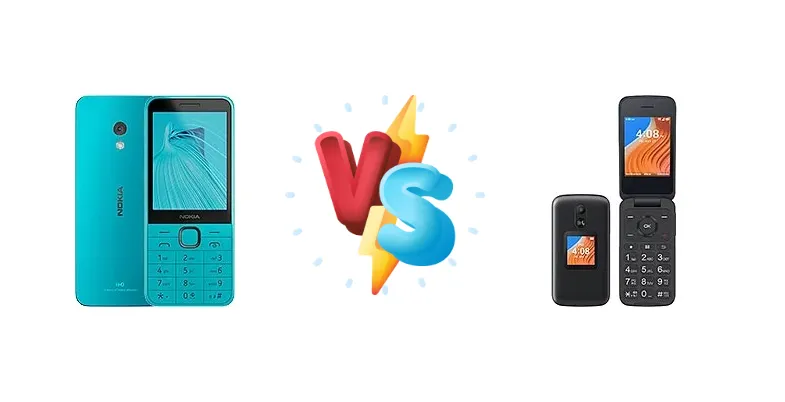
The resurgence of flip phones continues, driven by a desire for simplicity, long battery life, and affordability. The Nokia 235 4G (2024) and TCL Flip 2 represent two of the most accessible options currently available. This comparison dives deep into their specifications to determine which device offers the best value for users seeking a no-frills mobile experience.
🏆 Quick Verdict
For the average user prioritizing basic connectivity and potentially slightly smoother performance, the TCL Flip 2 emerges as the better choice. Its quad-core 1.5 GHz processor, despite being on a larger 28nm node, offers a noticeable advantage over the Nokia 235 4G’s single-core 1.0 GHz processor, making app loading and web browsing less sluggish.
| Network |
|---|
| 2G bands | GSM 850 / 900 / 1800 / 1900 | GSM 850 / 900 / 1800 / 1900 |
| 3G bands | HSDPA 850 / 900 / 2100 | HSDPA 850 / 1700(AWS) / 1900 |
| 4G bands | 1, 3, 5, 7, 8, 20, 28, 38, 40, 41 - EU, EMEA, APAC | 2, 4, 5, 12, 25, 26, 41, 66, 71 |
| Speed | HSPA, LTE | HSPA, LTE |
| Technology | GSM / HSPA / LTE | GSM / HSPA / LTE |
| Launch |
|---|
| Announced | 2024, April 30 | 2024 |
| Status | Available. Released 2024, May | Available. Released 2024 |
| Body |
|---|
| Dimensions | 127.3 x 54.2 x 11.6 mm (5.01 x 2.13 x 0.46 in) | 107.3 x 55.6 x 19.9 mm (4.22 x 2.19 x 0.78 in) |
| SIM | Nano-SIM + Nano-SIM | Nano-SIM |
| Weight | - | 140 g (4.94 oz) |
| Display |
|---|
| Resolution | 240 x 320 pixels, 4:3 ratio (~143 ppi density) | 240 x 320 pixels, 4:3 ratio (~143 ppi density) |
| Size | 2.8 inches, 24.3 cm2 (~35.2% screen-to-body ratio) | 2.8 inches, 24.3 cm2 (~40.7% screen-to-body ratio) |
| Type | TFT LCD | TFT LCD |
| Platform |
|---|
| CPU | 1.0 GHz Cortex-A7 | Quad-core 1.5 GHz Cortex-A53 |
| Chipset | Unisoc T107 (22 nm) | Mediatek MT6739-CH (28 nm) |
| GPU | - | PowerVR GE8100 |
| Memory |
|---|
| Call records | Yes | Yes |
| Card slot | microSDHC | microSDHC (dedicated slot) |
| Internal | 128MB 64MB RAM | 4GB 1GB RAM |
| Phonebook | Yes | Yes |
| Main Camera |
|---|
| Features | LED flash | LED flash |
| Single | 2 MP | 2 MP |
| Video | Yes | 480p@30fps |
| Sound |
|---|
| 35mm jack | Yes | Yes |
| Loudspeaker | Yes | Yes |
| Comms |
|---|
| Bluetooth | 5.0, A2DP, LE | 4.2, A2DP |
| NFC | No | No |
| Positioning | No | GPS |
| Radio | Wireless FM radio | FM radio |
| USB | USB Type-C | USB Type-C |
| WLAN | No | Wi-Fi 802.11 b/g/n |
| Features |
|---|
| Games | Yes | Yes |
| Java | No | No |
| Messaging | SMS | SMS, MMS |
| Sensors | No | Barometer |
| Battery |
|---|
| Charging | - | 5W wired |
| Type | Li-Ion 1450 mAh, removable | 1850 mAh |
| Misc |
|---|
| Colors | Black, Blue, Purple | Black, Blue |
| Models | - | 4058G, 4058W |
| Price | - | About 70 EUR |
| SAR | - | 0.86 W/kg (head) 1.29 W/kg (body) |
Nokia 235 4G (2024)
- Potentially better standby battery life due to 22nm chipset.
- Simple and straightforward user interface.
- Reliable Nokia brand reputation.
- Significantly slower processor compared to the TCL Flip 2.
- Limited multitasking capabilities.
- Likely slower app loading times.
TCL Flip 2
- Faster quad-core processor for smoother performance.
- More responsive user experience.
- 5W wired charging for convenient top-ups.
- Larger 28nm process may lead to slightly higher power consumption.
- Potentially shorter standby battery life compared to Nokia.
- TCL's brand recognition is lower than Nokia's.
Display Comparison
Neither device boasts a particularly impressive display. Both are likely to utilize basic TFT panels, common in this price segment. Detailed specifications regarding brightness nits, color accuracy, or resolution are unavailable, but expectations should be set accordingly – these are designed for basic visibility, not media consumption. The focus is on functionality, not fidelity.
Camera Comparison
Camera capabilities are minimal on both devices, and detailed sensor information is lacking. It’s safe to assume both feature basic cameras suitable for occasional snapshots. Focusing on megapixel counts would be misleading; image quality will be heavily dependent on software processing and lens quality, neither of which are likely to be strong points. The cameras are primarily for functional use, not photography enthusiasts.
Performance
The core difference lies in the chipsets. The TCL Flip 2’s Mediatek MT6739-CH, fabricated on a 28nm process, features a quad-core Cortex-A53 processor clocked at 1.5 GHz. This configuration provides a significant advantage in multi-tasking and responsiveness compared to the Nokia 235 4G’s Unisoc T107. The Unisoc T107, while more modern in its fabrication (22nm), only has a single 1.0 GHz Cortex-A7 core. This means the TCL Flip 2 will handle web browsing and app loading with noticeably less lag. The 28nm process of the Mediatek chip will likely result in higher power consumption under load, but the faster processing may offset this in typical usage scenarios.
Battery Life
Battery capacity details are unavailable for both devices. However, the Unisoc T107’s 22nm process *could* translate to slightly better standby battery life for the Nokia 235 4G, even with a potentially smaller battery. The TCL Flip 2’s 5W wired charging is standard for this segment, and charge times will likely be several hours. Real-world battery performance will depend heavily on network conditions and usage patterns, but both phones are designed to last for days on a single charge with minimal use.
Buying Guide
Buy the Nokia 235 4G (2024) if you prioritize a potentially more power-efficient chipset due to its 22nm manufacturing process, and are comfortable with a simpler user experience. Buy the TCL Flip 2 if you prefer a more responsive interface for basic tasks like calling, texting, and occasional web browsing, and value the convenience of slightly faster processing speeds.
Frequently Asked Questions
❓ Will the TCL Flip 2 struggle with modern websites due to its processor?
While the Mediatek MT6739-CH is not a powerhouse, it's sufficient for basic web browsing. Expect slower loading times and limited functionality on complex websites. It's best suited for text-based sites and simple online tasks.
❓ Is the Nokia 235 4G (2024) a good choice for someone who primarily needs a phone for calls and texts?
Absolutely. The Nokia 235 4G excels at core phone functions – making calls and sending texts. Its simpler processor and potentially better standby time make it a reliable option for users who prioritize basic connectivity and long battery life.
❓ Can either of these phones run WhatsApp or Facebook?
Both phones *can* run lightweight versions of WhatsApp and Facebook, but the experience will be slow and limited. Expect significant lag and potential crashes, especially with multiple apps open. These phones are not designed for heavy app usage.