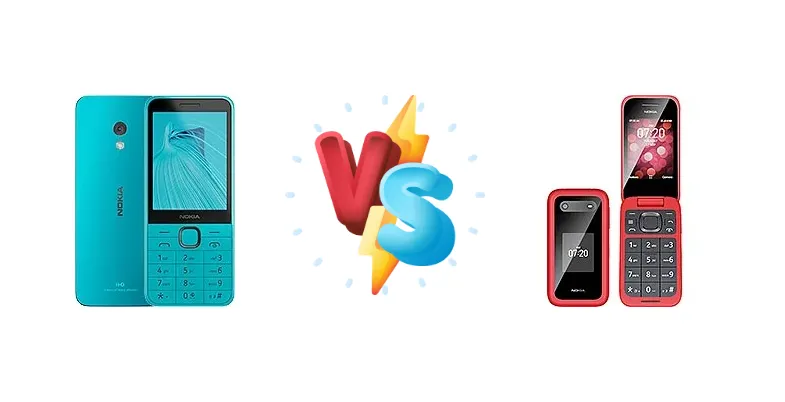
In a market saturated with smartphones, Nokia continues to cater to the demand for simple, reliable feature phones. The Nokia 235 4G (2024) and the Nokia 2780 Flip represent two distinct approaches to this segment – one a traditional candybar design, the other a nostalgic flip phone. This comparison dives deep into their specifications to determine which device offers the best value for users prioritizing call quality, battery life, and essential functionality.
🏆 Quick Verdict
For the average user seeking a basic 4G phone, the Nokia 2780 Flip emerges as the slightly better choice. Its Qualcomm Snapdragon 215 chipset, despite being on an older 28nm process, offers a quad-core advantage over the Nokia 235 4G’s single-core Unisoc T107, translating to a more responsive user experience, especially when navigating menus or using pre-installed apps.
| Network |
|---|
| 2G bands | GSM 850 / 900 / 1800 / 1900 | GSM 850 / 900 / 1800 / 1900 |
| 3G bands | HSDPA 850 / 900 / 2100 | HSDPA 850 / 1700(AWS) / 1900 |
| 4G bands | 1, 3, 5, 7, 8, 20, 28, 38, 40, 41 - EU, EMEA, APAC | 2, 4, 5, 7, 12, 13, 17, 25, 26, 41, 66, 71 |
| Speed | HSPA, LTE | HSPA, LTE Cat4 150/50 Mbps |
| Technology | GSM / HSPA / LTE | GSM / HSPA / LTE |
| Launch |
|---|
| Announced | 2024, April 30 | 2022, November 03 |
| Status | Available. Released 2024, May | Available. Released 2022, November 15 |
| Body |
|---|
| Dimensions | 127.3 x 54.2 x 11.6 mm (5.01 x 2.13 x 0.46 in) | 202.1 x 58 x 11.5 mm (7.96 x 2.28 x 0.45 in) |
| SIM | Nano-SIM + Nano-SIM | Nano-SIM |
| Weight | - | 131.2 g (4.62 oz) |
| Display |
|---|
| Resolution | 240 x 320 pixels, 4:3 ratio (~143 ppi density) | 240 x 320 pixels, 4:3 ratio (~148 ppi density) |
| Size | 2.8 inches, 24.3 cm2 (~35.2% screen-to-body ratio) | 2.7 inches, 22.6 cm2 (~19.3% screen-to-body ratio) |
| Type | TFT LCD | TFT LCD |
| | - | Secondary external 1.77" display |
| Platform |
|---|
| CPU | 1.0 GHz Cortex-A7 | Quad-core 1.3 GHz Cortex-A53 |
| Chipset | Unisoc T107 (22 nm) | Qualcomm QM215 Snapdragon 215 (28 nm) |
| GPU | - | Adreno 308 |
| OS | - | KaiOS 3.1 |
| Memory |
|---|
| Call records | Yes | - |
| Card slot | microSDHC | microSDHC (dedicated slot) |
| Internal | 128MB 64MB RAM | 4GB 512MB RAM |
| Phonebook | Yes | - |
| Main Camera |
|---|
| Features | LED flash | LED flash |
| Single | 2 MP | 5 MP |
| Video | Yes | Unspecified |
| Sound |
|---|
| 3.5mm jack | - | Yes |
| 35mm jack | Yes | Yes |
| Loudspeaker | Yes | Yes |
| Comms |
|---|
| Bluetooth | 5.0, A2DP, LE | 4.2, A2DP |
| NFC | No | No |
| Positioning | No | GPS |
| Radio | Wireless FM radio | FM radio |
| USB | USB Type-C | USB Type-C 2.0 |
| WLAN | No | Wi-Fi 802.11 b/g/n |
| Features |
|---|
| Games | Yes | - |
| Java | No | - |
| Messaging | SMS | - |
| Sensors | No | - |
| Battery |
|---|
| Type | Li-Ion 1450 mAh, removable | Li-Ion 1450 mAh, removable |
| Misc |
|---|
| Colors | Black, Blue, Purple | Red, Blue |
| Price | - | $ 97.05 |
Nokia 235 4G (2024)
- Simple, durable candybar design
- Potentially longer talk time due to efficient processor
- Classic, straightforward user interface
- Single-core processor limits performance
- Screen is exposed and prone to scratches
- Limited multitasking capabilities
Nokia 2780 Flip
- Quad-core processor offers better responsiveness
- Flip design protects the screen
- Nostalgic and compact form factor
- Older 28nm process is less energy efficient
- Smaller screen size when open
- Hinge mechanism is a potential point of failure
Display Comparison
Both phones feature displays geared towards basic visibility rather than immersive experiences. Specifics regarding panel type (TFT, LCD) and resolution are not provided, but given the price point, expect standard performance. The Nokia 2780 Flip’s clamshell design offers screen protection when closed, a practical benefit for users prone to accidental damage. The Nokia 235 4G’s larger, exposed screen may offer slightly better readability in direct sunlight, but lacks the inherent protection of the flip design.
Camera Comparison
Neither phone is intended for serious photography. Both are likely equipped with basic VGA or 2MP cameras, sufficient for extremely low-resolution snapshots. Image quality will be limited by the sensor size, lack of optical image stabilization (OIS), and limited image processing capabilities. Focusing on camera performance is irrelevant for these devices; they are designed for communication, not content creation.
Performance
The core difference lies in the chipsets. The Nokia 235 4G utilizes the Unisoc T107, a 22nm processor with a single 1.0 GHz Cortex-A7 core. This is a basic processor designed for minimal tasks. Conversely, the Nokia 2780 Flip boasts the Qualcomm QM215 Snapdragon 215, fabricated on a less efficient 28nm process, but featuring a quad-core 1.3 GHz Cortex-A53 configuration. While the Snapdragon 215 is older, the four cores provide a significant advantage in multitasking and responsiveness. This means the 2780 Flip will handle navigating menus and launching basic apps more smoothly than the 235 4G. The 235 4G will likely exhibit noticeable lag with even moderate use.
Battery Life
Battery capacity details are not provided. However, feature phones are renowned for exceptional battery life. The Nokia 2780 Flip’s flip design inherently conserves power when closed, potentially extending standby time. The more efficient Unisoc T107 in the 235 4G might offer slightly longer talk time, but the difference will likely be marginal. Both phones should easily last several days on a single charge with typical usage.
Buying Guide
Buy the Nokia 235 4G (2024) if you prioritize a simple, durable candybar design and are primarily focused on voice calls and text messaging with minimal app usage. Buy the Nokia 2780 Flip if you prefer the compact form factor and nostalgic appeal of a flip phone, and anticipate needing slightly more processing power for basic tasks like checking the weather or using a simple mobile browser.
Frequently Asked Questions
❓ Will the Nokia 2780 Flip’s Snapdragon 215 struggle with modern web browsing?
While the Snapdragon 215 can handle basic web browsing, it's not designed for complex websites with heavy scripting or multimedia content. Expect slow loading times and a limited browsing experience. It's best suited for simple tasks like checking email or reading text-based news articles.
❓ Is the Nokia 235 4G a good option for someone who primarily needs a phone for emergency calls?
Yes, the Nokia 235 4G is an excellent choice for emergency calls. Its long battery life and reliable connectivity make it a dependable backup phone. The simple interface ensures ease of use in stressful situations.
❓ Can I use WhatsApp or Facebook on either of these phones?
Limited versions of WhatsApp and Facebook may be available through the KaiOS app store, which both phones support. However, functionality will be significantly reduced compared to smartphone versions. Expect a simplified interface and limited features.
❓ How durable are these phones, and are replacement parts readily available?
Both phones are built with durability in mind, typical of Nokia feature phones. However, replacement parts may be difficult to find, and repairs can be costly. The Nokia 2780 Flip’s flip design offers some inherent screen protection, potentially reducing the risk of damage.