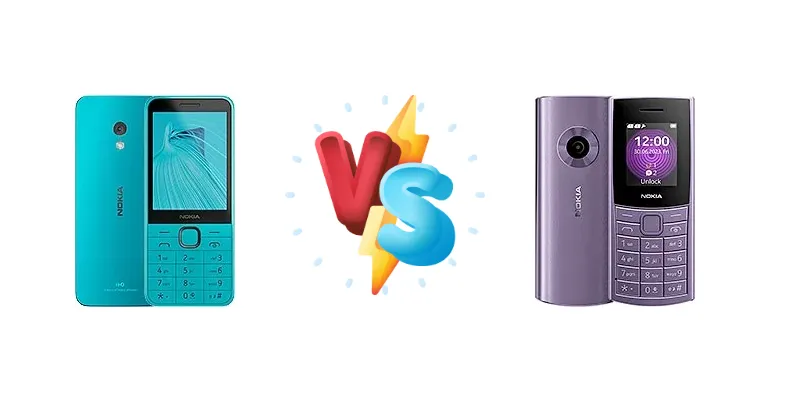
The Nokia 235 4G (2024) and Nokia 110 4G (2023) represent the continuing demand for simple, reliable mobile connectivity. While both offer 4G capabilities in an affordable package, the newer 235 4G introduces a chipset upgrade that warrants a closer look. This comparison dissects the differences, helping you determine which device best suits your needs for basic communication and essential features.
🏆 Quick Verdict
For users prioritizing even a slight performance edge and future-proofing, the Nokia 235 4G (2024) is the better choice. Its Unisoc T107 chipset, while still entry-level, offers a demonstrable improvement over the likely older hardware in the Nokia 110 4G (2023), making it more responsive for basic tasks.
| Network |
|---|
| 2G bands | GSM 850 / 900 / 1800 / 1900 | GSM 900 / 1800 |
| 3G bands | HSDPA 850 / 900 / 2100 | HSDPA 850 / 900 / 1700(AWS) / 1900 / 2100 |
| 4G bands | 1, 3, 5, 7, 8, 20, 28, 38, 40, 41 - EU, EMEA, APAC | LTE |
| Speed | HSPA, LTE | HSPA, LTE |
| Technology | GSM / HSPA / LTE | GSM / HSPA / LTE |
| Launch |
|---|
| Announced | 2024, April 30 | 2023, May 18 |
| Status | Available. Released 2024, May | Available. Released 2023, June |
| Body |
|---|
| Dimensions | 127.3 x 54.2 x 11.6 mm (5.01 x 2.13 x 0.46 in) | 121.5 x 50 x 14.4 mm (4.78 x 1.97 x 0.57 in) |
| SIM | Nano-SIM + Nano-SIM | · Nano-SIM· Nano-SIM + Nano-SIM |
| Weight | - | 94.5 g (3.35 oz) |
| | - | Flashlight
Splash resistant |
| Display |
|---|
| Resolution | 240 x 320 pixels, 4:3 ratio (~143 ppi density) | 120 x 160 pixels, 4:3 ratio (~111 ppi density) |
| Size | 2.8 inches, 24.3 cm2 (~35.2% screen-to-body ratio) | 1.8 inches, 10.0 cm2 (~16.5% screen-to-body ratio) |
| Type | TFT LCD | TFT LCD, 65K colors |
| Platform |
|---|
| CPU | 1.0 GHz Cortex-A7 | - |
| Chipset | Unisoc T107 (22 nm) | - |
| Memory |
|---|
| Call records | Yes | Yes |
| Card slot | microSDHC | microSDHC |
| Internal | 128MB 64MB RAM | Unspecified |
| Phonebook | Yes | Yes |
| Main Camera |
|---|
| Features | LED flash | - |
| Single | 2 MP | QVGA |
| Video | Yes | - |
| Sound |
|---|
| 3.5mm jack | - | Yes |
| 35mm jack | Yes | Yes |
| Loudspeaker | Yes | Yes |
| Comms |
|---|
| Bluetooth | 5.0, A2DP, LE | 5.0, A2DP |
| NFC | No | No |
| Positioning | No | No |
| Radio | Wireless FM radio | Wireless FM radio |
| USB | USB Type-C | microUSB 2.0 |
| WLAN | No | No |
| Features |
|---|
| Games | Yes | Yes |
| Java | No | No |
| Messaging | SMS | SMS |
| Sensors | No | - |
| | - | MP3 player |
| Battery |
|---|
| Type | Li-Ion 1450 mAh, removable | Li-Ion 1450 mAh |
| Misc |
|---|
| Colors | Black, Blue, Purple | Midnight Blue, Arctic Purple |
| Price | - | About 40 EUR |
Nokia 235 4G (2024)
- More powerful Unisoc T107 chipset
- Potentially longer software support
- Slightly improved responsiveness
- Still a basic feature phone
- Limited functionality compared to smartphones
Nokia 110 4G (2023)
- Lowest possible cost
- Extremely long battery life
- Simple and easy to use
- Outdated hardware
- Slow performance
- Limited software updates
Display Comparison
Detailed display specifications are unavailable for the Nokia 110 4G (2023). Given its market positioning, it likely features a basic color LCD with a low resolution. The Nokia 235 4G (2024) also utilizes a color LCD, but the newer model may benefit from slight improvements in color reproduction or viewing angles due to advancements in panel manufacturing. Both devices prioritize battery life over display quality, so expect limited brightness and narrow viewing angles on both.
Camera Comparison
Neither device is intended for serious photography. Both likely feature a basic VGA camera, sufficient only for extremely low-resolution snapshots. Any differences in image quality will be negligible and largely dependent on lighting conditions. Focusing on camera performance is irrelevant for these devices; their primary function is communication, not photography.
Performance
The Nokia 235 4G (2024) is powered by the Unisoc T107 (22nm) chipset with a 1.0 GHz Cortex-A7 CPU. This represents a clear advantage over the Nokia 110 4G (2023), which lacks publicly available chipset information but is almost certainly equipped with an older, less efficient processor. The 22nm fabrication process of the T107, while not cutting-edge, offers a balance of power efficiency and performance suitable for basic tasks. Users will notice a difference in app loading times and web browsing responsiveness on the 235 4G, particularly when compared to the likely slower performance of the 110 4G.
Battery Life
Battery capacity details are unavailable for both devices. However, given their feature phone nature and limited functionality, both the Nokia 235 4G (2024) and Nokia 110 4G (2023) are expected to offer excellent battery life – potentially several days on a single charge with moderate use. The more efficient Unisoc T107 in the 235 4G may contribute to slightly longer standby times, but the difference will likely be marginal.
Buying Guide
Buy the Nokia 235 4G (2024) if you need a slightly more responsive experience for web browsing or using basic apps, and value the potential for longer software support due to the newer chipset. Buy the Nokia 110 4G (2023) if you prioritize absolute lowest cost and are content with a purely functional device for calls and texts, accepting that performance will be minimal and software updates are unlikely.
Frequently Asked Questions
❓ Will the Nokia 235 4G (2024) run WhatsApp or Facebook?
While the Nokia 235 4G (2024) supports basic internet connectivity, running apps like WhatsApp or Facebook is possible but may be slow and limited. The Unisoc T107 chipset and limited RAM may struggle with the demands of these applications, resulting in a sluggish user experience. Expect basic functionality only.
❓ How much faster is the Nokia 235 4G (2024) compared to the Nokia 110 4G (2023)?
The Nokia 235 4G (2024) is noticeably faster due to its Unisoc T107 chipset. While neither phone is a performance powerhouse, the T107 provides a smoother experience for tasks like web browsing, accessing contacts, and sending messages. The Nokia 110 4G (2023), lacking a comparable chipset specification, will likely feel significantly slower and less responsive.
❓ Does the Nokia 235 4G (2024) support VoLTE calling?
Yes, the Nokia 235 4G (2024) supports VoLTE (Voice over LTE) calling, allowing for higher quality voice calls and faster connection times on 4G networks. This is a key benefit for users in areas where 3G networks are being phased out.