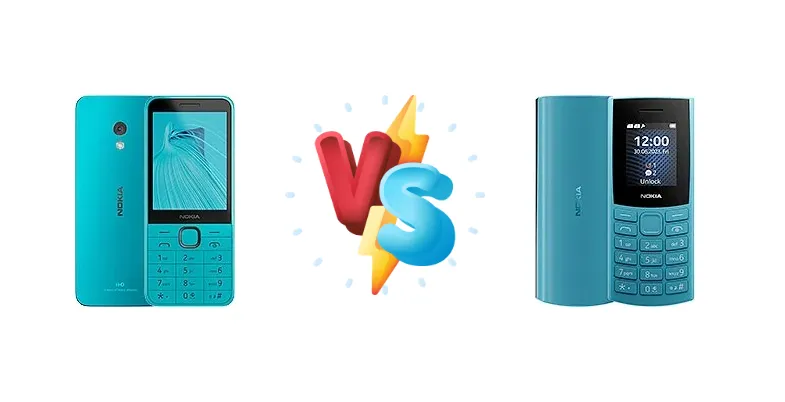
The Nokia 235 4G (2024) and Nokia 105 4G (2023) represent HMD Global’s continued commitment to the ultra-budget 4G feature phone market. While both offer essential connectivity, the 235 4G introduces a newer chipset, potentially offering a smoother user experience. This comparison dissects the differences to help you determine which device best suits your needs.
🏆 Quick Verdict
For most users, the Nokia 235 4G (2024) is the better choice. The inclusion of the Unisoc T107 chipset, even with its modest specifications, provides a performance edge over the Nokia 105 4G, which lacks detailed public specifications, suggesting a potentially older or less capable platform. This translates to a more responsive interface and better app compatibility.
| Network |
|---|
| 2G bands | GSM 850 / 900 / 1800 / 1900 | GSM 900 / 1800 |
| 3G bands | HSDPA 850 / 900 / 2100 | HSDPA 850 / 900 / 1700(AWS) / 1900 / 2100 |
| 4G bands | 1, 3, 5, 7, 8, 20, 28, 38, 40, 41 - EU, EMEA, APAC | LTE |
| Speed | HSPA, LTE | HSPA, LTE |
| Technology | GSM / HSPA / LTE | GSM / HSPA / LTE |
| | - | HSDPA 850 / 900 / 2100 |
| Launch |
|---|
| Announced | 2024, April 30 | 2023, May 18 |
| Status | Available. Released 2024, May | Available. Released 2023, June |
| Body |
|---|
| Dimensions | 127.3 x 54.2 x 11.6 mm (5.01 x 2.13 x 0.46 in) | 121.5 x 50 x 14.4 mm (4.78 x 1.97 x 0.57 in) |
| SIM | Nano-SIM + Nano-SIM | · Nano-SIM· Nano-SIM + Nano-SIM |
| Weight | - | 93 g (3.28 oz) |
| | - | Flashlight
Splash resistant |
| Display |
|---|
| Resolution | 240 x 320 pixels, 4:3 ratio (~143 ppi density) | 120 x 160 pixels, 4:3 ratio (~111 ppi density) |
| Size | 2.8 inches, 24.3 cm2 (~35.2% screen-to-body ratio) | 1.8 inches, 10.0 cm2 (~16.5% screen-to-body ratio) |
| Type | TFT LCD | IPS LCD |
| Platform |
|---|
| CPU | 1.0 GHz Cortex-A7 | - |
| Chipset | Unisoc T107 (22 nm) | - |
| Memory |
|---|
| Call records | Yes | Yes |
| Card slot | microSDHC | microSDHC |
| Internal | 128MB 64MB RAM | Unspecified |
| Phonebook | Yes | Yes |
| Main Camera |
|---|
| Features | LED flash | - |
| Single | 2 MP | - |
| Video | Yes | - |
| Sound |
|---|
| 3.5mm jack | - | Yes |
| 35mm jack | Yes | Yes |
| Loudspeaker | Yes | Yes |
| Comms |
|---|
| Bluetooth | 5.0, A2DP, LE | 5.0, A2DP |
| NFC | No | No |
| Positioning | No | No |
| Radio | Wireless FM radio | Wireless FM radio |
| USB | USB Type-C | microUSB 2.0 |
| WLAN | No | No |
| Features |
|---|
| Games | Yes | Yes |
| Java | No | No |
| Messaging | SMS | SMS |
| Sensors | No | - |
| | - | MP3 player |
| Battery |
|---|
| Type | Li-Ion 1450 mAh, removable | Li-Ion 1450 mAh, removable |
| Misc |
|---|
| Colors | Black, Blue, Purple | Charcoal, Ocean Blue |
| Price | - | About 40 EUR |
Nokia 235 4G (2024)
- More modern Unisoc T107 chipset
- Potentially better app compatibility
- Likely improved software support
- Still a basic feature phone
- Limited camera capabilities
Nokia 105 4G (2023)
- Extremely affordable
- Long battery life
- Simple and easy to use
- Potentially outdated chipset
- Limited performance
- Uncertain long-term software support
Display Comparison
Both devices likely feature similar low-resolution color displays, typical of feature phones. Given the price point, expect limited brightness and narrow viewing angles on both. The Nokia 235 4G’s newer release date *could* indicate a slightly improved panel, but detailed specifications are unavailable for either. Bezels will be substantial on both, prioritizing durability over aesthetics.
Camera Comparison
Neither device is intended for serious photography. Both likely feature a basic VGA camera, sufficient for occasional snapshots. Image quality will be limited by the low resolution and lack of features like autofocus or image stabilization. Comparing camera performance is largely irrelevant given the shared limitations.
Performance
The Nokia 235 4G’s Unisoc T107 (22nm) chipset with a 1.0 GHz Cortex-A7 CPU is the key differentiator. While not a powerhouse, this represents a clear upgrade over the Nokia 105 4G, which lacks publicly available chipset information. The 22nm process node suggests reasonable power efficiency, and the Cortex-A7 architecture, while dated, is capable of handling basic feature phone tasks like calls, texts, and simple apps. The Nokia 105 4G likely utilizes an older, less efficient chipset, resulting in slower app loading times and a less fluid user interface.
Battery Life
Both the Nokia 235 4G and Nokia 105 4G are designed for exceptional battery life. The lack of a power-hungry processor or high-resolution display means both can likely last for several days on a single charge. While specific battery capacities are not provided, the Unisoc T107’s 22nm process in the 235 4G *may* offer slightly improved efficiency, but the difference will likely be minimal in real-world usage.
Buying Guide
Buy the Nokia 235 4G (2024) if you prioritize a slightly more responsive user experience and potential future software updates, even within the feature phone ecosystem. Buy the Nokia 105 4G (2023) if you are seeking the absolute lowest price point and basic functionality is sufficient, accepting that performance may be limited and long-term support is uncertain given the lack of detailed specifications.
Frequently Asked Questions
❓ Will the Nokia 235 4G run WhatsApp smoothly?
While the Unisoc T107 chipset is not powerful, it should be capable of running WhatsApp, albeit with some potential lag when loading media or switching between chats. The experience will be significantly better than on older feature phones, but don't expect smartphone-level performance.
❓ Does the Nokia 105 4G support VoLTE calling?
Given its 4G connectivity, the Nokia 105 4G *likely* supports VoLTE (Voice over LTE) calling, but this depends on carrier compatibility. Confirm with your mobile provider to ensure VoLTE is supported on their network for this device.
❓ Can I expand the storage on either the Nokia 235 4G or Nokia 105 4G?
Both devices feature a microSD card slot for storage expansion, allowing you to add more space for contacts, messages, and media. The maximum supported microSD card capacity is typically 32GB, but check the device documentation for confirmation.