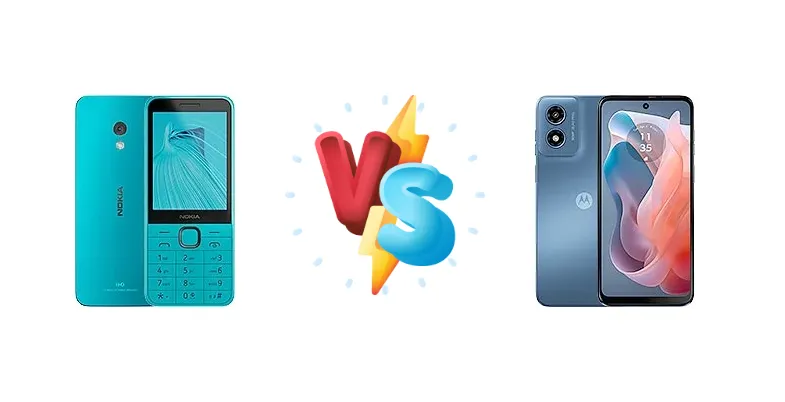
The ultra-budget smartphone market is fiercely competitive. The Nokia 235 4G (2024) represents a focus on basic connectivity and durability, while the Motorola Moto G Play (2024) aims to deliver a more modern smartphone experience at a still-affordable price. This comparison dissects the core differences between these two devices, focusing on the significant disparity in their underlying chipsets and how that translates to real-world performance.
🏆 Quick Verdict
For the average user prioritizing responsiveness and app performance, the Motorola Moto G Play (2024) is the clear winner. Its Snapdragon 680 chipset offers a substantial performance advantage over the Nokia 235 4G’s Unisoc T107, making it better suited for multitasking and running modern applications. However, the Nokia 235 4G remains a viable option for those needing a simple, reliable phone for calls and texts.
| Network |
|---|
| 2G bands | GSM 850 / 900 / 1800 / 1900 | GSM 850 / 900 / 1800 / 1900 |
| 3G bands | HSDPA 850 / 900 / 2100 | HSDPA 850 / 900 / 1700(AWS) / 1900 / 2100 |
| 4G bands | 1, 3, 5, 7, 8, 20, 28, 38, 40, 41 - EU, EMEA, APAC | 1, 2, 3, 4, 5, 7, 8, 12, 13, 17, 25, 26, 28, 38, 41, 66, 71 - USA |
| Speed | HSPA, LTE | HSPA, LTE |
| Technology | GSM / HSPA / LTE | GSM / HSPA / LTE |
| Launch |
|---|
| Announced | 2024, April 30 | 2024, January 16 |
| Status | Available. Released 2024, May | Available. Released 2024, January 26 |
| Body |
|---|
| Build | - | Glass front, plastic frame, plastic back |
| Dimensions | 127.3 x 54.2 x 11.6 mm (5.01 x 2.13 x 0.46 in) | 163.8 x 75 x 8.3 mm (6.45 x 2.95 x 0.33 in) |
| SIM | Nano-SIM + Nano-SIM | Nano-SIM |
| Weight | - | 185 g (6.53 oz) |
| Display |
|---|
| Protection | - | Corning Gorilla Glass 3 |
| Resolution | 240 x 320 pixels, 4:3 ratio (~143 ppi density) | 720 x 1600 pixels, 20:9 ratio (~270 ppi density) |
| Size | 2.8 inches, 24.3 cm2 (~35.2% screen-to-body ratio) | 6.5 inches, 102.0 cm2 (~83.0% screen-to-body ratio) |
| Type | TFT LCD | IPS LCD, 90Hz, 500 nits (typ) |
| Platform |
|---|
| CPU | 1.0 GHz Cortex-A7 | Octa-core (4x2.4 GHz Kryo 265 Gold & 4x1.9 GHz Kryo 265 Silver) |
| Chipset | Unisoc T107 (22 nm) | Qualcomm SM6225 Snapdragon 680 4G (6 nm) |
| GPU | - | Adreno 610 |
| OS | - | Android 13, upgradable to Android 14 |
| Memory |
|---|
| Call records | Yes | - |
| Card slot | microSDHC | microSDXC (dedicated slot) |
| Internal | 128MB 64MB RAM | 64GB 4GB RAM, 128GB 4GB RAM |
| Phonebook | Yes | - |
| Main Camera |
|---|
| Features | LED flash | LED flash, HDR, panorama |
| Single | 2 MP | 50 MP, f/1.8, (wide), 0.64µm, PDAF |
| Video | Yes | 1080p@30fps |
| Selfie camera |
|---|
| Features | - | HDR |
| Single | - | 8 MP, f/2.0, (wide), 1.12µm |
| Video | - | 1080p@30fps |
| Sound |
|---|
| 35mm jack | Yes | Yes |
| Loudspeaker | Yes | Yes, with stereo speakers |
| Comms |
|---|
| Bluetooth | 5.0, A2DP, LE | 5.1, A2DP, LE |
| NFC | No | No |
| Positioning | No | GPS, GALILEO, GLONASS |
| Radio | Wireless FM radio | No |
| USB | USB Type-C | USB Type-C 2.0 |
| WLAN | No | Wi-Fi 802.11 a/b/g/n/ac, dual-band |
| Features |
|---|
| Games | Yes | - |
| Java | No | - |
| Messaging | SMS | - |
| Sensors | No | Fingerprint (side-mounted), accelerometer, proximity, compass, barometer |
| Battery |
|---|
| Charging | - | 15W wired |
| Type | Li-Ion 1450 mAh, removable | 5000 mAh |
| Misc |
|---|
| Colors | Black, Blue, Purple | Sapphire Blue |
| Models | - | XT2413-1, XT2413 |
| Price | - | $ 55.00 |
Nokia 235 4G (2024)
- Potentially longer battery life due to the efficient Unisoc T107.
- Extremely affordable price point.
- Durable build quality (typical of Nokia feature phones).
- Significantly slower performance compared to the Motorola.
- Limited app compatibility and multitasking capabilities.
- Likely slower charging speeds.
Motorola Moto G Play (2024)
- Much faster and more responsive performance thanks to the Snapdragon 680.
- 15W wired charging for quicker top-ups.
- Better camera image processing capabilities.
- Potentially shorter battery life under heavy use.
- Slightly higher price point.
- May still exhibit some performance limitations with demanding apps.
Display Comparison
Neither device boasts a standout display. Given the context data focuses on processing power, we can infer both likely utilize basic LCD panels. The Motorola, being positioned slightly higher in the market, *may* have a slightly higher resolution, but this is speculative. The key difference will be in responsiveness; the Snapdragon 680’s GPU will contribute to smoother scrolling and transitions, even if the panel itself is similar. Bezels are likely substantial on both, reflecting their budget nature.
Camera Comparison
Without detailed camera specifications, a direct comparison is difficult. However, given the price points, both phones likely feature modest camera setups. The Motorola, benefiting from the Snapdragon 680’s image signal processor (ISP), will likely offer better image processing capabilities, resulting in sharper, more vibrant photos, especially in challenging lighting conditions. Any OIS (Optical Image Stabilization) would be exclusive to the Motorola, given its higher tier chipset. We can assume both will have a primary camera and potentially a secondary depth or macro sensor, but the quality of those secondary sensors will likely be minimal on both.
Performance
The performance gap is the defining characteristic of this comparison. The Unisoc T107 in the Nokia 235 4G, with its 1.0 GHz Cortex-A7 CPU, is a significantly older and less powerful architecture. In contrast, the Motorola Moto G Play’s Qualcomm Snapdragon 680 (6 nm) features an octa-core configuration with Kryo 265 Gold and Silver cores clocked up to 2.4 GHz. The 6nm manufacturing process of the Snapdragon 680 is also crucial; it’s far more efficient, generating less heat and allowing for sustained performance. This translates to noticeably faster app loading times, smoother multitasking, and a more responsive user experience on the Motorola. The Nokia will struggle with anything beyond basic tasks.
Battery Life
While the exact battery capacities are unknown, the Unisoc T107’s lower power consumption *could* translate to longer battery life on the Nokia 235 4G, despite potentially having a smaller battery. However, the Motorola Moto G Play’s 15W wired charging is a significant advantage. The Nokia likely charges at a much slower rate, meaning significantly longer times to reach a full charge. For users who value quick top-ups, the Motorola is the better choice. The Snapdragon 680’s power efficiency also means the Motorola won’t drain the battery as quickly under load.
Buying Guide
Buy the Nokia 235 4G (2024) if you need a supremely affordable, durable phone primarily for calls, texts, and basic features, and long battery life is paramount. Buy the Motorola Moto G Play (2024) if you prefer a more capable smartphone experience with smoother performance for apps, social media, and occasional gaming, and are willing to trade some battery longevity for that added power.
Frequently Asked Questions
❓ Will the Nokia 235 4G (2024) struggle with popular social media apps like Facebook and WhatsApp?
Yes, the Unisoc T107 chipset is likely to exhibit noticeable lag and slow loading times when running demanding apps like Facebook and WhatsApp. While they will function, the experience won't be smooth or enjoyable. The Motorola Moto G Play, with its Snapdragon 680, will handle these apps with significantly more ease.
❓ How long will it take to fully charge the Motorola Moto G Play (2024) with the 15W charger?
While a precise time requires testing, a full charge from 0% to 100% with the 15W charger is estimated to take around 2-3 hours. This is considerably faster than the Nokia 235 4G, which likely uses a much slower charging standard and could take upwards of 4-5 hours.
❓ Is the Snapdragon 680 in the Motorola Moto G Play (2024) capable of playing modern mobile games?
The Snapdragon 680 can handle many mobile games, but not at maximum settings. Expect to play titles like PUBG Mobile or Call of Duty Mobile at medium settings with reasonable frame rates. Demanding games may require lowering the graphics settings further to maintain a playable experience. The Nokia 235 4G is unlikely to run these games at all.