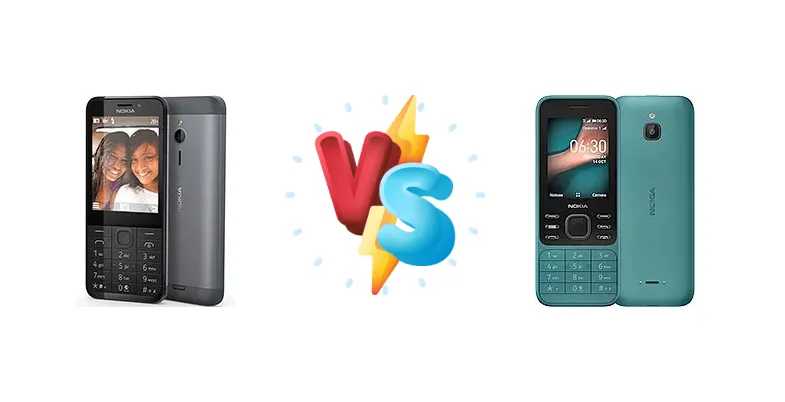
Feature phones are making a comeback, offering a simple and affordable alternative to smartphones. Today, we're pitting two contenders against each other: the classic Nokia 230 and the upgraded Nokia 6300 4G. Let's see which one comes out on top.
🏆 Quick Verdict
The Nokia 6300 4G is the clear winner. While the Nokia 230 offers basic functionality, the 6300 4G's 4G connectivity, faster processor, and improved camera make it a significantly more capable and modern device for a small price increase.
| Network |
|---|
| 2G bands | GSM 900 / 1800 | GSM 850 / 900 / 1800 / 1900 |
| 3G bands | - | HSDPA 850 / 900 / 2100 - International |
| 4G bands | - | 1, 3, 5, 7, 8, 20, 28, 38, 40 - ROW |
| EDGE | Up to 236.8 kbps | - |
| GPRS | Up to 85.6 kbps | - |
| Speed | - | HSPA, LTE Cat4 150/50 Mbps |
| Technology | GSM | GSM / HSPA / LTE |
| | - | 2, 3, 4, 5, 7, 12, 17, 28, 66, 71 - Americas |
| Launch |
|---|
| Announced | 2015, November. Released 2015, December | 2020, November 13. Released 2021, January 06 |
| Status | Discontinued | Discontinued |
| Body |
|---|
| Build | - | Plastic frame, plastic back |
| Dimensions | 124.6 x 53.4 x 10.9 mm (4.91 x 2.10 x 0.43 in) | 131.4 x 53 x 13.7 mm (5.17 x 2.09 x 0.54 in) |
| Keyboard | QWERTY | - |
| SIM | Mini-SIM | · Nano-SIM· Nano-SIM + Nano-SIM |
| Weight | 91.8 g (3.25 oz) | 104.7 g (3.70 oz) |
| Display |
|---|
| Resolution | 240 x 320 pixels, 4:3 ratio (~143 ppi density) | 240 x 320 pixels, 4:3 ratio (~167 ppi density) |
| Size | 2.8 inches, 24.3 cm2 (~36.5% screen-to-body ratio) | 2.4 inches, 17.8 cm2 (~25.6% screen-to-body ratio) |
| Type | TFT, 65K colors | TFT LCD, 16M colors |
| Platform |
|---|
| CPU | - | Quad-core 1.1 GHz Cortex-A7 |
| Chipset | - | Qualcomm QC8909 Snapdragon 210 (28 nm) |
| GPU | - | Adreno 304 |
| OS | Danger 3.0 | KaiOS 2.5 |
| Memory |
|---|
| Call records | Yes | - |
| Card slot | microSDHC (dedicated slot) | microSDHC |
| Internal | 16MB RAM | 4GB 512MB RAM |
| Phonebook | 1000 entries | - |
| Main Camera |
|---|
| Features | LED flash | LED flash |
| Single | 2 MP | VGA |
| Video | 240p@15fps | - |
| Selfie camera |
|---|
| Features | LED flash | - |
| Single | 2 MP | - |
| Video | 480p | - |
| | - | No |
| Sound |
|---|
| 3.5mm jack | Yes | Yes |
| 35mm jack | Yes | Yes |
| Loudspeaker | Yes | Yes |
| Comms |
|---|
| Bluetooth | 3.0, A2DP | 4.0, A2DP |
| NFC | No | - |
| Positioning | No | GPS, GLONASS |
| Radio | Stereo FM radio | FM radio |
| USB | microUSB 1.1 | microUSB 2.0 |
| WLAN | No | Wi-Fi 802.11 b/g/n, hotspot |
| Features |
|---|
| Browser | WAP 2.0/xHTML, HTML | - |
| Games | Yes | - |
| Java | No | - |
| Messaging | SMS(threaded view), MMS, IM | - |
| | SNS applications
MP4/H.264 player
MP3/WAV/AAC player
Organizer
Predictive text input | - |
| Battery |
|---|
| Music play | Up to 52 h | - |
| Stand-by | Up to 648 h | - |
| Talk time | Up to 23 h | - |
| Type | Li-Ion 1200 mAh, removable | Removable Li-Ion 1500 mAh battery |
| Misc |
|---|
| Colors | Black, White, Dark Blue, Light Gray | Light Charcoal, White, Cyan Green |
| Models | - | TA-1294, TA-1291, TA-1287, TA-1286 |
| Price | About 70 EUR | About 80 EUR |
| SAR EU | 0.79 W/kg (head) 1.46 W/kg (body) | 1.09 W/kg (head) 1.77 W/kg (body) |
Nokia 230
- Extremely affordable
- Long battery life
- Compact and lightweight
- FM Radio
- Very basic performance
- Low-resolution display
- Poor camera quality
- No 4G connectivity
Nokia 6300 4G
- 4G connectivity
- Improved performance
- Better camera (12MP + front)
- Larger display
- FM Radio
- Slightly more expensive than the 230
- Still a feature phone (limited app support)
Display Comparison
The Nokia 230 features a 2.4-inch QVGA display, while the Nokia 6300 4G boasts a larger 2.8-inch QVGA display. Both are TFT LCD panels, offering decent visibility in good lighting, but don't expect vibrant colors or high resolution. The 6300 4G's slightly larger screen provides a marginally better viewing experience.
Camera Comparison
The Nokia 230 has a basic 2MP rear camera. The Nokia 6300 4G steps up with a 12MP rear camera, offering significantly better image quality, especially in good lighting. The 6300 4G also includes a front-facing camera, a feature absent on the 230.
Performance
This is where the 6300 4G shines. Its Quad-core 1.1 GHz Cortex-A7 processor and Qualcomm QC8909 Snapdragon 210 chipset offer a noticeable performance boost compared to the 230's likely single-core processor. The 6300 4G handles basic apps and web browsing much more smoothly.
Battery Life
Both phones offer excellent battery life, typical of feature phones. The Nokia 230 likely has a slightly smaller battery, but both should easily last for several days on a single charge with moderate use. The 6300 4G's larger battery capacity gives it a slight edge.
Buying Guide
The Nokia 230 is ideal for users who need a basic, ultra-affordable phone primarily for calls and texts, and who don't need internet access. The Nokia 6300 4G is better suited for those who want a slightly more modern experience with 4G connectivity, a better camera, and improved performance for basic apps and browsing.
Frequently Asked Questions
❓ What is the main difference between the Nokia 230 and 6300 4G?
The primary difference is 4G connectivity and performance. The 6300 4G has a faster processor, a better camera, and supports 4G, while the 230 is a more basic and affordable option.
❓ Are these phones suitable for running apps?
Both are feature phones, so app support is limited. The 6300 4G handles basic apps slightly better due to its more powerful processor, but don't expect a smartphone-like experience.