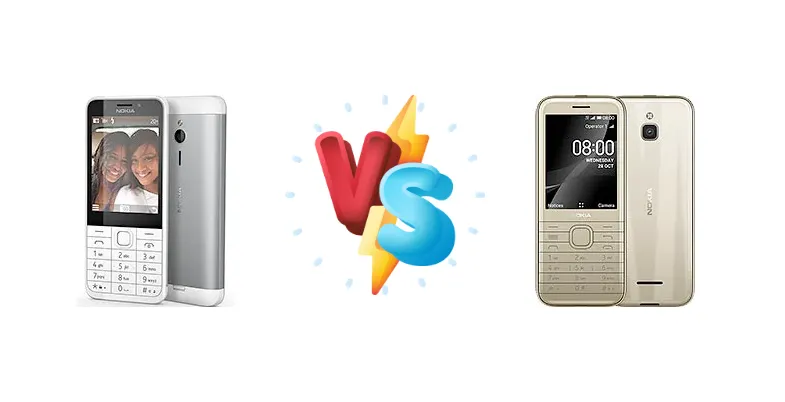
Nokia's resurgence continues with a focus on nostalgia. The Nokia 230 Dual SIM and the Nokia 8000 4G both offer a throwback design, but cater to different needs. Let's dive into a detailed comparison to see which phone is the better choice.
🏆 Quick Verdict
The Nokia 8000 4G is the clear winner for most users. While the 230 excels in extreme budget and basic calling, the 8000's 4G connectivity, faster processor, and improved features provide a significantly better overall experience, justifying its higher price.
| Network |
|---|
| 2G bands | GSM 900 / 1800 - SIM 1 & SIM 2 | GSM 850 / 900 / 1800 / 1900 |
| 3G bands | - | HSDPA 850 / 900 / 2100 |
| 4G bands | - | 1, 3, 5, 7, 8, 20, 28, 38, 40 - ROW |
| EDGE | Up to 236.8 kbps | - |
| GPRS | Up to 85.6 kbps | - |
| Speed | - | HSPA, LTE Cat4 150/50 Mbps |
| Technology | GSM | GSM / HSPA / LTE |
| | - | 1, 3, 5, 7, 8, 20, 28, 38, 39, 40, 41 - MENA, GCR |
| Launch |
|---|
| Announced | 2015, November. Released 2015, December | 2020, November 13. Released 2021, January 06 |
| Status | Discontinued | Discontinued |
| Body |
|---|
| Build | - | Plastic frame, plastic back |
| Dimensions | 124.6 x 53.4 x 10.9 mm (4.91 x 2.10 x 0.43 in) | 132.2 x 56.5 x 12.3 mm (5.20 x 2.22 x 0.48 in) |
| SIM | Dual SIM (Mini-SIM) | · Nano-SIM· Nano-SIM + Nano-SIM |
| Weight | 91.8 g (3.25 oz) | 110.2 g (3.88 oz) |
| Display |
|---|
| Resolution | 240 x 320 pixels, 4:3 ratio (~143 ppi density) | 240 x 320 pixels, 4:3 ratio (~143 ppi density) |
| Size | 2.8 inches, 24.3 cm2 (~36.5% screen-to-body ratio) | 2.8 inches, 24.3 cm2 (~32.5% screen-to-body ratio) |
| Type | TFT, 65K colors | TFT LCD, 16M colors |
| Platform |
|---|
| CPU | - | Quad-core 1.1 GHz Cortex-A7 |
| Chipset | - | Qualcomm MSM8909 Snapdragon 210 (28 nm) |
| GPU | - | Adreno 304 |
| OS | - | KaiOS 2.5 |
| Memory |
|---|
| Call records | Yes | - |
| Card slot | microSDHC (dedicated slot) | microSDHC |
| Internal | 16MB RAM | 4GB 512MB RAM |
| Phonebook | 1000 entries | - |
| Main Camera |
|---|
| Features | LED flash | LED flash |
| Single | 2 MP | 2 MP |
| Video | 240p@15fps | - |
| Selfie camera |
|---|
| Features | LED flash | - |
| Single | 2 MP | - |
| Video | 480p | - |
| | - | No |
| Sound |
|---|
| 3.5mm jack | Yes | Yes |
| 35mm jack | Yes | Yes |
| Loudspeaker | Yes | Yes |
| Comms |
|---|
| Bluetooth | 3.0, A2DP | Yes |
| NFC | No | - |
| Positioning | No | GPS |
| Radio | Stereo FM radio | FM radio |
| USB | microUSB 1.1 | microUSB |
| WLAN | No | Yes, hotspot |
| Features |
|---|
| Games | Yes | - |
| Java | No | - |
| Messaging | SMS(threaded view), MMS, IM | - |
| | SNS applications
MP4/H.264 player
MP3/WAV/AAC player
Organizer
Predictive text input | - |
| Battery |
|---|
| Music play | Up to 52 h | - |
| Stand-by | Up to 528 h | - |
| Talk time | Up to 23 h | - |
| Type | Li-Ion 1200 mAh, removable | Removable Li-Ion 1500 mAh battery |
| Misc |
|---|
| Colors | Black, White | Onyx/Black, Opal/White, Topaz/Blue, Cintrine/Gold |
| Models | - | TA-1303, TA-1311, TA-1305, TA-1300 |
| Price | About 70 EUR | About 110 EUR |
| SAR EU | 0.79 W/kg (head) 1.46 W/kg (body) | 0.99 W/kg (head) 1.56 W/kg (body) |
Nokia 230 Dual SIM
- Extremely affordable
- Dual SIM support
- Long battery life
- Simple and easy to use
- Very basic features
- Slow performance
- Low-resolution display
- Limited storage
Nokia 8000 4G
- Stylish retro design
- 4G connectivity
- Faster processor
- Improved display
- Better camera (estimated)
- Higher price point
- Still a feature phone (limited functionality)
- Battery life slightly less than 230 (estimated)
Display Comparison
The Nokia 8000 4G boasts a larger 2.4-inch QVGA display, offering a more comfortable viewing experience compared to the 230's likely smaller screen (estimated around 1.8 inches). While both are basic LCD panels, the 8000's size advantage is noticeable.
Camera Comparison
The Nokia 8000 4G likely features a slightly better camera (estimated 2MP) than the 230 (estimated 1.3MP). While neither phone is a photography powerhouse, the 8000's processing capabilities may result in marginally better image quality.
Performance
Here's where the 8000 4G shines. Its Quad-core 1.1 GHz Cortex-A7 processor and Snapdragon 210 chipset provide a significant performance boost over the 230's likely single-core processor. Expect smoother navigation, faster app loading (where applicable), and a more responsive user interface on the 8000.
Battery Life
Both phones are expected to offer excellent battery life, typical of feature phones. However, the Nokia 230, with its simpler hardware, might edge out the 8000 slightly in terms of longevity, though the difference is likely minimal.
Buying Guide
The Nokia 230 Dual SIM is ideal for users needing a secondary phone for calls and texts, those on a very tight budget, or those who prioritize simplicity and long battery life. The Nokia 8000 4G is for those who want a stylish retro device with modern features like 4G, a better camera, and a faster processor, without the complexity of a smartphone.
Frequently Asked Questions
❓ What is the main difference between the Nokia 230 and the Nokia 8000 4G?
The primary difference is performance and features. The 8000 4G has a faster processor, 4G connectivity, and a larger display, while the 230 is a more basic and affordable option.
❓ Are these phones smartphones?
No, both the Nokia 230 and the Nokia 8000 4G are feature phones. They offer basic calling, texting, and some limited features, but do not run a full smartphone operating system.