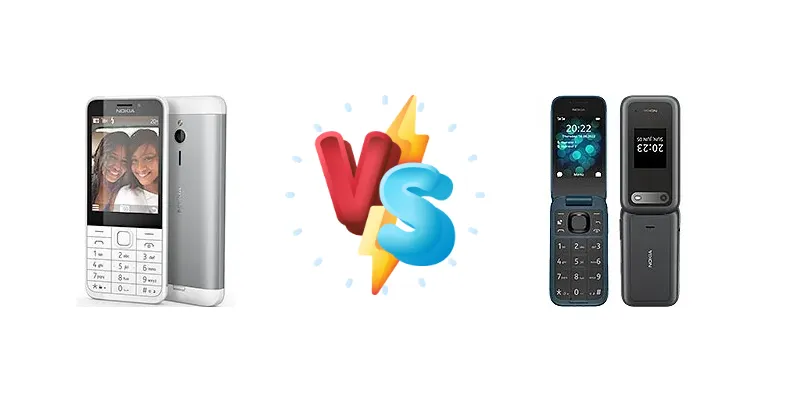
Nokia's resurgence in the feature phone market continues with the 230 Dual SIM and the 2660 Flip. Both offer a nostalgic return to simpler devices, but cater to slightly different needs. This comparison will break down their strengths and weaknesses to help you choose the right one.
🏆 Quick Verdict
The Nokia 2660 Flip edges out the 230 Dual SIM thanks to its Unisoc chipset, slightly improved performance, and the convenience of a charging cradle. While the 230 is a budget champion, the 2660's added features make it the more compelling choice for most users.
| Network |
|---|
| 2G bands | GSM 900 / 1800 - SIM 1 & SIM 2 | GSM 850 / 900 / 1800 / 1900 |
| 3G bands | - | HSDPA 850 / 900 / 2100 - International |
| 4G bands | - | 1, 3, 5, 7, 8, 20 - EU, RUCIS |
| EDGE | Up to 236.8 kbps | - |
| GPRS | Up to 85.6 kbps | - |
| Speed | - | HSPA, LTE |
| Technology | GSM | GSM / HSPA / LTE |
| | - | 1, 2, 3, 4, 5, 7, 8, 28 - LATAM, BR |
| Launch |
|---|
| Announced | 2015, November. Released 2015, December | 2022, July 12 |
| Status | Discontinued | Available. Released 2022, July 28 |
| Body |
|---|
| Dimensions | 124.6 x 53.4 x 10.9 mm (4.91 x 2.10 x 0.43 in) | - |
| SIM | Dual SIM (Mini-SIM) | · Nano-SIM· Nano-SIM + Nano-SIM |
| Weight | 91.8 g (3.25 oz) | 123 g (4.34 oz) |
| Display |
|---|
| Resolution | 240 x 320 pixels, 4:3 ratio (~143 ppi density) | 240 x 320 pixels, 4:3 ratio (~143 ppi density) |
| Size | 2.8 inches, 24.3 cm2 (~36.5% screen-to-body ratio) | 2.8 inches, 24.3 cm2 |
| Type | TFT, 65K colors | TFT LCD |
| | - | Secondary external 1.77" display |
| Platform |
|---|
| CPU | - | 1.0 GHz Cortex-A7 |
| Chipset | - | Unisoc T107 (22 nm) |
| Memory |
|---|
| Call records | Yes | Yes |
| Card slot | microSDHC (dedicated slot) | microSDHC |
| Internal | 16MB RAM | 128MB 48MB RAM |
| Phonebook | 1000 entries | Yes |
| Main Camera |
|---|
| Features | LED flash | LED flash |
| Single | 2 MP | 0.3 MP |
| Video | 240p@15fps | Yes |
| Selfie camera |
|---|
| Features | LED flash | - |
| Single | 2 MP | - |
| Video | 480p | - |
| | - | No |
| Sound |
|---|
| 3.5mm jack | Yes | Yes |
| 35mm jack | Yes | Yes |
| Loudspeaker | Yes | Yes |
| Comms |
|---|
| Bluetooth | 3.0, A2DP | 4.2, A2DP |
| NFC | No | No |
| Positioning | No | No |
| Radio | Stereo FM radio | Wireless FM radio |
| USB | microUSB 1.1 | microUSB 2.0 |
| WLAN | No | No |
| Features |
|---|
| Games | Yes | Yes |
| Java | No | No |
| Messaging | SMS(threaded view), MMS, IM | SMS, MMS |
| | SNS applications
MP4/H.264 player
MP3/WAV/AAC player
Organizer
Predictive text input | - |
| Battery |
|---|
| Charging | - | Compatible with a charging cradle |
| Music play | Up to 52 h | - |
| Stand-by | Up to 528 h | - |
| Talk time | Up to 23 h | - |
| Type | Li-Ion 1200 mAh, removable | Li-Ion 1450 mAh, removable |
| Misc |
|---|
| Colors | Black, White | Gray, Blue, Red, Lush Green, Pop Pink |
| Models | - | TA-1480, TA-1474, TA-1469 |
| Price | About 70 EUR | € 59.99 / $ 190.00 / £ 69.00 / ₹ 4,499 |
| SAR | - | 0.47 W/kg (head) 1.16 W/kg (body) |
| SAR EU | 0.79 W/kg (head) 1.46 W/kg (body) | 0.36 W/kg (head) 1.48 W/kg (body) |
Nokia 230 Dual SIM
- Extremely affordable
- Dual SIM support
- Compact and lightweight
- Decent battery life
- Basic performance
- Low-resolution display
- Limited features
- VGA camera quality
Nokia 2660 Flip
- Classic flip design
- Improved performance (Unisoc chipset)
- Charging cradle included
- Slightly larger display
- Dual SIM support
- Higher price than 230
- Still a feature phone (limited functionality)
- VGA camera quality
Display Comparison
The Nokia 230 Dual SIM likely features a smaller, basic QVGA display, typical for its price range. The Nokia 2660 Flip boasts a 2.8-inch QVGA display, offering a slightly larger viewing area and potentially better readability. Both are designed for simple text and icons, not multimedia consumption.
Camera Comparison
Both phones likely have a basic VGA camera. Image quality will be limited in both cases, suitable only for very casual snapshots. Don't expect high-resolution photos from either device.
Performance
The Nokia 230 Dual SIM's performance is expected to be basic, relying on a simpler chipset. The Nokia 2660 Flip, with its Unisoc T107 chipset and 1.0 GHz Cortex-A7 CPU, offers a noticeable performance boost, resulting in smoother navigation and app loading (within the limitations of a feature phone).
Battery Life
The Nokia 230 Dual SIM is expected to have a decent battery life, typical for a basic feature phone. The Nokia 2660 Flip, while potentially consuming slightly more power due to the chipset, should still offer respectable battery life, especially with the convenience of a charging cradle.
Buying Guide
The Nokia 230 Dual SIM is ideal for users seeking the absolute lowest price point and basic calling/texting functionality. The Nokia 2660 Flip is better suited for those who appreciate a classic flip design, slightly better performance, and the ease of a charging cradle, without needing smartphone features.
Frequently Asked Questions
❓ What is the difference between the Nokia 230 and 2660 Flip?
The 2660 Flip offers a flip design, a more powerful chipset (Unisoc T107), a slightly larger display, and a charging cradle. The 230 is a more basic, budget-friendly option.
❓ Are these phones smartphones?
No, both the Nokia 230 and 2660 Flip are feature phones. They offer basic calling, texting, and limited app functionality, but do not run a full smartphone operating system.