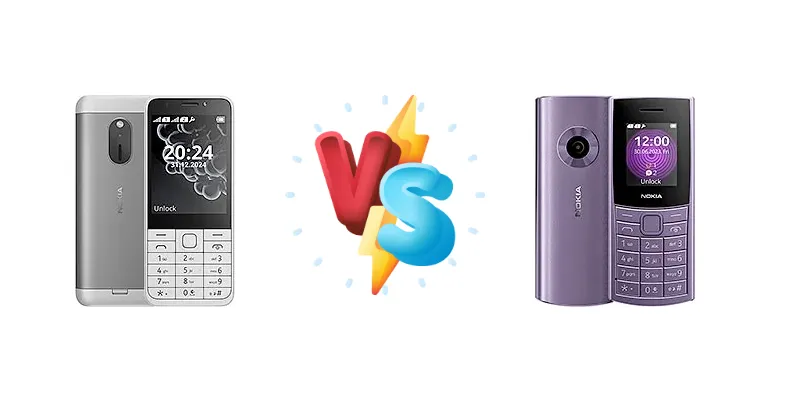
Nokia continues to refine its offering in the ultra-budget feature phone space. We're pitting the newly released Nokia 230 (2024) against the slightly older Nokia 110 4G (2023) to determine which provides the best blend of essential features and affordability. While both cater to users prioritizing call quality and long battery life, the 230 introduces a chipset upgrade that warrants closer examination.
🏆 Quick Verdict
For the average user seeking a reliable, no-frills 4G feature phone, the Nokia 230 (2024) is the better choice. The inclusion of the Unisoc 6531F chipset, while not a performance powerhouse, offers a noticeable improvement in responsiveness and potential for future software updates compared to the 110 4G.
| Network |
|---|
| 2G bands | GSM 900 / 1800 | GSM 900 / 1800 |
| 3G bands | - | HSDPA 850 / 900 / 1700(AWS) / 1900 / 2100 |
| 4G bands | - | LTE |
| EDGE | No | - |
| GPRS | Yes | - |
| Speed | - | HSPA, LTE |
| Technology | GSM | GSM / HSPA / LTE |
| Launch |
|---|
| Announced | 2024, April 11 | 2023, May 18 |
| Status | Available. Released 2024, April 26 | Available. Released 2023, June |
| Body |
|---|
| Build | Aluminum back cover | - |
| Dimensions | 124.6 x 53.4 x 10.9 mm (4.91 x 2.10 x 0.43 in) | 121.5 x 50 x 14.4 mm (4.78 x 1.97 x 0.57 in) |
| SIM | Nano-SIM + Nano-SIM | · Nano-SIM· Nano-SIM + Nano-SIM |
| Weight | - | 94.5 g (3.35 oz) |
| | - | Flashlight
Splash resistant |
| Display |
|---|
| Resolution | 240 x 320 pixels, 4:3 ratio (~143 ppi density) | 120 x 160 pixels, 4:3 ratio (~111 ppi density) |
| Size | 2.8 inches, 24.3 cm2 (~36.5% screen-to-body ratio) | 1.8 inches, 10.0 cm2 (~16.5% screen-to-body ratio) |
| Type | TFT LCD | TFT LCD, 65K colors |
| Platform |
|---|
| Chipset | Unisoc 6531F | - |
| Memory |
|---|
| Call records | Yes | Yes |
| Card slot | microSDHC | microSDHC |
| Internal | 16MB 8MB RAM | Unspecified |
| Phonebook | Yes | Yes |
| Main Camera |
|---|
| Features | LED flash | - |
| Single | 2 MP | QVGA |
| Video | Yes | - |
| Selfie camera |
|---|
| Features | LED flash | - |
| Single | 2 MP | - |
| Video | Yes | - |
| | - | No |
| Sound |
|---|
| 3.5mm jack | - | Yes |
| 35mm jack | Yes | Yes |
| Loudspeaker | Yes | Yes |
| Comms |
|---|
| Bluetooth | 5.0, A2DP, LE | 5.0, A2DP |
| NFC | No | No |
| Positioning | No | No |
| Radio | Wireless FM radio | Wireless FM radio |
| USB | USB Type-C | microUSB 2.0 |
| WLAN | No | No |
| Features |
|---|
| Games | Yes | Yes |
| Java | No | No |
| Messaging | SMS | SMS |
| Sensors | No | - |
| | - | MP3 player |
| Battery |
|---|
| Type | Li-Ion 1450 mAh, removable | Li-Ion 1450 mAh |
| Misc |
|---|
| Colors | Black, White | Midnight Blue, Arctic Purple |
| Price | About 70 EUR | About 40 EUR |
Nokia 230 (2024)
- More responsive user interface due to Unisoc 6531F chipset.
- Larger 1450mAh battery for extended usage.
- Potential for future software updates.
- Slightly higher price point compared to the 110 4G.
- Still limited in overall functionality compared to smartphones.
Nokia 110 4G (2023)
- Extremely affordable price.
- Simple and easy-to-use interface.
- Long standby time due to basic functionality.
- Older, less efficient chipset.
- Smaller battery capacity.
- Limited potential for software updates.
Display Comparison
Both the Nokia 230 (2024) and Nokia 110 4G (2023) feature relatively small displays, likely around 2.4 inches, given their market segment. Specific resolution details are unavailable for the 110 4G, but the 230’s display is optimized for readability of text and basic UI elements. Given the lack of detailed display specs for the 110 4G, it’s reasonable to assume similar color reproduction and viewing angles to the 230, prioritizing power efficiency over visual fidelity.
Camera Comparison
Both devices likely feature basic rear cameras, but detailed specifications are limited. It's safe to assume both cameras are intended for casual snapshots and not for high-quality photography. The Nokia 230 (2024) may offer slight improvements in image processing due to the more modern chipset, but the overall image quality will remain constrained by the sensor size and lens quality, which are likely similar across both models. Focusing on camera performance would be a misdirection given the target audience.
Performance
The key differentiator here is the Unisoc 6531F chipset powering the Nokia 230 (2024). While detailed specifications are scarce, Unisoc chipsets generally prioritize power efficiency, making them suitable for feature phones. The Nokia 110 4G (2023) lacks publicly available chipset information, suggesting a simpler, likely older, processor. This translates to a potentially snappier user interface and faster app loading times (for pre-installed apps) on the 230, even if both phones are limited in their overall processing capabilities. The 6531F’s architecture, though modest, allows for more efficient handling of 4G connectivity, potentially improving call quality and data speeds.
Battery Life
Both the Nokia 230 (2024) and Nokia 110 4G (2023) prioritize long battery life. The Nokia 230 (2024) is equipped with a 1450mAh battery, while the 110 4G (2023) has a 1000mAh battery. The larger capacity in the 230, coupled with the power efficiency of the Unisoc 6531F, should translate to extended talk time and standby duration. However, actual battery life will heavily depend on network conditions and usage patterns, particularly 4G data consumption.
Buying Guide
Buy the Nokia 230 (2024) if you need a slightly more responsive user experience and appreciate the potential for future software enhancements, even within the limited scope of a feature phone. Buy the Nokia 110 4G (2023) if you prioritize absolute lowest cost and are content with a basic, functional device focused solely on calls and texts.
Frequently Asked Questions
❓ Does the Unisoc 6531F chipset in the Nokia 230 (2024) allow for smoother web browsing compared to the Nokia 110 4G (2023)?
While both phones offer basic web browsing capabilities, the Unisoc 6531F in the Nokia 230 (2024) provides a more responsive experience. The chipset's improved processing power allows for faster page loading and smoother scrolling, though it's still limited by the small screen size and 4G data speeds.
❓ How does the battery life of the Nokia 230 (2024) compare to the Nokia 110 4G (2023) with typical usage (calls, texts, and occasional FM radio)?
The Nokia 230 (2024) with its 1450mAh battery should offer noticeably longer battery life than the Nokia 110 4G (2023) with its 1000mAh battery. Expect several days of standby time and extended talk time on the 230, even with moderate use of features like FM radio.
❓ Is the Nokia 230 (2024) a good option for someone needing a simple phone for emergency calls and texts?
Yes, the Nokia 230 (2024) is an excellent choice for this purpose. Its robust build quality, long battery life, and reliable 4G connectivity make it a dependable device for essential communication, even in areas with limited network coverage.