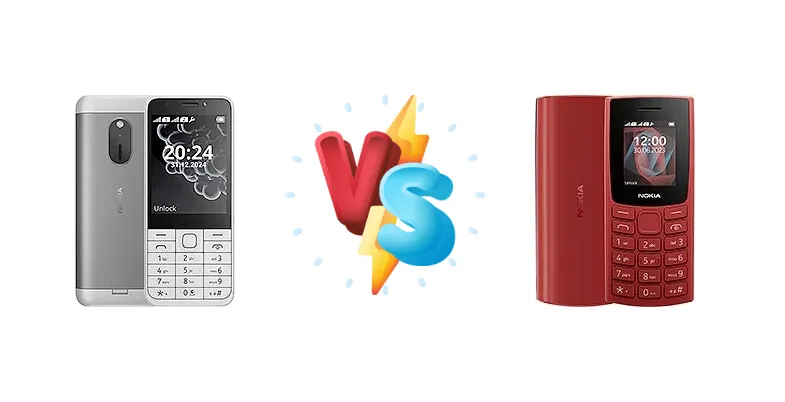
The Nokia 105 (2023) represents the enduring appeal of ultra-basic mobile communication. The Nokia 230 (2024), however, signals a subtle evolution, introducing a more modern chipset and hinting at expanded functionality within the feature phone space. This comparison dissects the differences, determining whether the newer model justifies the upgrade.
🏆 Quick Verdict
For users prioritizing basic call and text functionality with exceptional battery life, the Nokia 105 (2023) remains a compelling choice. However, the Nokia 230 (2024)'s Unisoc 6531F chipset offers a potential, albeit modest, improvement in responsiveness and feature support, making it the better option for those seeking a slightly more capable device.
| Network |
|---|
| 2G bands | GSM 900 / 1800 | GSM 900 / 1800 |
| EDGE | No | Yes |
| GPRS | Yes | Yes |
| Technology | GSM | GSM |
| Launch |
|---|
| Announced | 2024, April 11 | 2023, May 18 |
| Status | Available. Released 2024, April 26 | Available. Released 2023, May 18 |
| Body |
|---|
| Build | Aluminum back cover | - |
| Dimensions | 124.6 x 53.4 x 10.9 mm (4.91 x 2.10 x 0.43 in) | 115.1 x 49.4 x 14.5 mm (4.53 x 1.94 x 0.57 in) |
| SIM | Nano-SIM + Nano-SIM | Single SIM (Mini-SIM) or Dual SIM (Mini-SIM, dual stand-by) |
| Weight | - | 78.7 g (2.75 oz) |
| | - | Flashlight
Splash resistant |
| Display |
|---|
| Resolution | 240 x 320 pixels, 4:3 ratio (~143 ppi density) | 120 x 160 pixels, 4:3 ratio (~111 ppi density) |
| Size | 2.8 inches, 24.3 cm2 (~36.5% screen-to-body ratio) | 1.8 inches, 10.0 cm2 (~17.6% screen-to-body ratio) |
| Type | TFT LCD | TFT LCD, 65K colors |
| Platform |
|---|
| Chipset | Unisoc 6531F | - |
| Memory |
|---|
| Call records | Yes | Yes |
| Card slot | microSDHC | No |
| Internal | 16MB 8MB RAM | Unspecified |
| Phonebook | Yes | Yes |
| Main Camera |
|---|
| Features | LED flash | - |
| Single | 2 MP | - |
| Video | Yes | - |
| Selfie camera |
|---|
| Features | LED flash | - |
| Single | 2 MP | - |
| Video | Yes | - |
| Sound |
|---|
| 3.5mm jack | - | Yes |
| 35mm jack | Yes | Yes |
| Loudspeaker | Yes | Yes |
| Comms |
|---|
| Bluetooth | 5.0, A2DP, LE | No |
| NFC | No | No |
| Positioning | No | No |
| Radio | Wireless FM radio | Wireless FM radio |
| USB | USB Type-C | microUSB 1.1 |
| WLAN | No | No |
| Features |
|---|
| Games | Yes | Yes |
| Java | No | No |
| Messaging | SMS | SMS |
| Sensors | No | - |
| Battery |
|---|
| Type | Li-Ion 1450 mAh, removable | Li-Ion 1000 mAh |
| Misc |
|---|
| Colors | Black, White | Red Terracotta, Cyan, Charcoal |
| Price | About 70 EUR | About 50 EUR |
Nokia 230 (2024)
- Potentially faster performance with Unisoc 6531F
- May support more features via software updates
- Slightly more modern design (potentially)
- Likely a higher price point than the Nokia 105
- May have slightly reduced battery life compared to the 105
Nokia 105 (2023)
- Exceptional battery life
- Ultra-affordable price
- Proven reliability and simplicity
- Limited performance and features
- Older chipset technology
- May lack support for future software updates
Display Comparison
Given the lack of detailed display specifications for the Nokia 105 (2023), a direct comparison is limited. Both devices likely utilize low-resolution color displays typical of feature phones. The Nokia 230 (2024) may benefit from slightly improved color reproduction due to the newer chipset's image processing capabilities, but neither is expected to offer a visually stunning experience. Bezels are expected to be substantial on both models, prioritizing durability and simplicity over aesthetics.
Camera Comparison
Neither device is positioned as a photography powerhouse. While the Nokia 230 (2024) may include a camera, its resolution and image quality are expected to be basic. The Nokia 105 (2023) may or may not include a camera at all. Any camera present on either device should be considered for occasional snapshots only, not for serious photography. Image processing capabilities will be limited on both.
Performance
The core differentiator lies in the chipset. The Nokia 230 (2024) is powered by the Unisoc 6531F, a low-power processor designed for basic smartphone and feature phone applications. The Nokia 105 (2023) likely utilizes an older, less powerful chipset. While neither device is intended for demanding tasks, the Unisoc 6531F should provide a more responsive user interface, faster menu navigation, and potentially smoother operation of pre-installed applications like the FM radio. The impact on call quality is likely minimal, as both rely on 2G networks.
Battery Life
Both phones excel in battery life, a hallmark of feature phones. The Nokia 105 (2023) is renowned for its exceptional standby time, potentially lasting weeks on a single charge. The Nokia 230 (2024)'s Unisoc 6531F, while more powerful, is also designed for low power consumption. While the 230 may see slightly reduced standby time due to the more active processor, it should still offer days of use on a single charge. Charging times will likely be similar, utilizing micro-USB connectivity on both devices.
Buying Guide
Buy the Nokia 230 (2024) if you need a feature phone with a potentially smoother user experience and the possibility of supporting more advanced features through software updates. Buy the Nokia 105 (2023) if you prefer maximum simplicity, proven reliability, and the lowest possible cost for essential communication – a true 'dumbphone' experience.
Frequently Asked Questions
❓ Will the Nokia 230 (2024) support WhatsApp or other modern messaging apps?
While the Unisoc 6531F chipset *could* theoretically support some lightweight apps, compatibility with WhatsApp and similar applications is not guaranteed. These apps often require more processing power and memory than typical feature phones possess. Check the official Nokia documentation for confirmed app support.
❓ Is the Nokia 230 (2024) a 4G phone?
No, both the Nokia 230 (2024) and Nokia 105 (2023) are primarily 2G phones. They may offer limited 3G connectivity in some regions, but 4G is not supported. This means data speeds will be significantly slower than modern smartphones.
❓ How does the Unisoc 6531F chipset impact the user experience compared to older Nokia feature phones?
The Unisoc 6531F should provide a noticeably smoother and more responsive user interface. Expect faster menu navigation, quicker app loading times (for pre-installed apps), and a generally less laggy experience compared to older Nokia feature phones with less powerful chipsets.