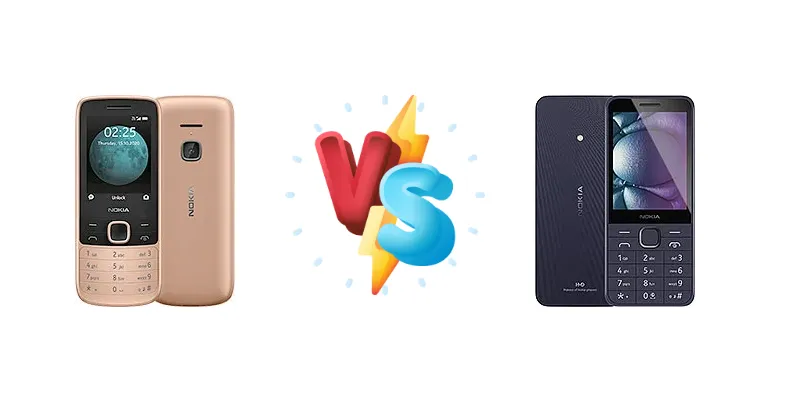
The Nokia 225 4G and the newer Nokia 215 4G (2024) represent HMD Global’s continued commitment to the feature phone market. While both offer essential connectivity and a familiar Nokia experience, a key difference lies under the hood: the chipset. This comparison dissects those differences and helps you determine which phone best suits your needs, focusing on performance and efficiency.
🏆 Quick Verdict
For the average user prioritizing basic functionality and long battery life, the Nokia 225 4G remains a solid choice. However, the Nokia 215 4G (2024) offers a slight performance advantage thanks to its Unisoc T107 chipset, making it better suited for light web browsing and app usage, albeit at a potentially reduced battery runtime.
| Network |
|---|
| 2G bands | GSM 850 / 900 / 1800 / 1900 | GSM 850 / 900 / 1800 / 1900 |
| 3G bands | HSDPA 850 / 900 / 2100 - International | HSDPA 850 / 900 / 2100 |
| 4G bands | 1, 3, 5, 7, 8, 20, 38, 40 - EU, APAC, SSA | 1, 3, 5, 7, 8, 20, 28, 38, 40, 41 - EU, EMEA, APAC |
| Speed | HSPA, LTE | HSPA, LTE |
| Technology | GSM / HSPA / LTE | GSM / HSPA / LTE |
| | 2, 3, 4, 5, 7, 12, 13, 17, 28 - NA, LATAM | - |
| Launch |
|---|
| Announced | 2020, October 10. Released 2020, October 17 | 2024, April 30 |
| Status | Discontinued | Available. Released 2024, May |
| Body |
|---|
| Dimensions | 124.7 x 51 x 13.7 mm (4.91 x 2.01 x 0.54 in) | 127.3 x 54.2 x 11.6 mm (5.01 x 2.13 x 0.46 in) |
| SIM | · Nano-SIM· Nano-SIM + Nano-SIM | Nano-SIM + Nano-SIM |
| Weight | 90.1 g (3.17 oz) | - |
| Display |
|---|
| Resolution | 240 x 320 pixels, 4:3 ratio (~167 ppi density) | 240 x 320 pixels, 4:3 ratio (~143 ppi density) |
| Size | 2.4 inches, 17.8 cm2 (~28.0% screen-to-body ratio) | 2.8 inches, 24.3 cm2 (~35.2% screen-to-body ratio) |
| Type | TFT LCD, 256K colors | TFT LCD |
| Platform |
|---|
| CPU | - | 1.0 GHz Cortex-A7 |
| Chipset | Unisoc UMS9117 | Unisoc T107 (22 nm) |
| Memory |
|---|
| Call records | Yes | Yes |
| Card slot | microSDHC | microSDHC |
| Internal | 128MB 64MB RAM | 128MB 64MB RAM |
| Phonebook | Yes | Yes |
| Sound |
|---|
| 3.5mm jack | Yes | - |
| 35mm jack | Yes | Yes |
| Loudspeaker | Yes | Yes |
| Comms |
|---|
| Bluetooth | 5.0 | 5.0, A2DP, LE |
| NFC | No | No |
| Positioning | No | No |
| Radio | FM radio, built-in antenna | Wireless FM radio |
| USB | microUSB 2.0 | USB Type-C |
| WLAN | No | No |
| Features |
|---|
| Games | Yes | Yes |
| Java | - | No |
| Messaging | SMS(threaded view), MMS, IM | SMS |
| Sensors | - | No |
| | MP3 player | - |
| Battery |
|---|
| Type | Li-Ion 1150 mAh, removable | Li-Ion 1450 mAh, removable |
| Misc |
|---|
| Colors | Black, Classic Blue, Metallic Sand | Peach, Black, Dark Blue |
| Models | TA-1321, TA-1296, TA-1279, TA-1276, TA-1282 | - |
| Price | About 60 EUR | - |
| SAR | 1.41 W/kg (head) 1.34 W/kg (body) | - |
| SAR EU | 1.63 W/kg (head) 1.79 W/kg (body) | - |
Nokia 225 4G
- Potentially longer battery life due to less powerful chipset.
- Proven reliability and simplicity.
- Lower price point (likely).
- Slower performance compared to the 215 4G.
- Less responsive user interface.
Nokia 215 4G (2024)
- Faster performance with the Unisoc T107 chipset.
- Improved responsiveness for basic apps and web browsing.
- More modern chipset architecture.
- Potentially shorter battery life.
- May be slightly more expensive.
Display Comparison
Both phones likely feature similar, low-resolution color displays typical of this market segment. Specifics like brightness nits and color accuracy are not provided, but we can assume they are optimized for readability in direct sunlight rather than color fidelity. Bezels are expected to be substantial on both models, prioritizing durability and ease of grip over a modern, edge-to-edge aesthetic.
Camera Comparison
Both phones are equipped with basic cameras, likely 2MP or less. Image quality will be limited, and these cameras are best suited for simple snapshots in good lighting conditions. Detailed analysis is hampered by the lack of sensor size or aperture information. The camera is primarily a convenience feature, not a selling point.
Performance
The core difference lies in the chipsets. The Nokia 225 4G utilizes the Unisoc UMS9117, a basic chipset designed for essential phone functions. The Nokia 215 4G (2024) steps up to the Unisoc T107, fabricated on a 22nm process and featuring a 1.0 GHz Cortex-A7 CPU. This represents a tangible, though modest, performance improvement. The T107’s Cortex-A7 architecture, while dated, is more capable than the UMS9117’s, resulting in snappier app loading and smoother web browsing. The 22nm process also suggests slightly improved power efficiency compared to older nodes, though the impact will be limited by the battery capacity.
Battery Life
Battery capacity details are unavailable for either device. However, given the low-power chipsets and basic displays, both phones should offer excellent battery life – potentially days on a single charge with moderate use. The Unisoc T107 in the 215 4G, while more powerful, will consume more energy, potentially reducing overall battery endurance compared to the 225 4G. Charging times will likely be similar, utilizing Micro-USB and taking several hours for a full charge.
Buying Guide
Buy the Nokia 225 4G if you need a supremely reliable, long-lasting feature phone for calls and texts, and prioritize maximum battery life above all else. Buy the Nokia 215 4G (2024) if you occasionally browse the web, use basic apps like WhatsApp, and appreciate a marginally faster user experience, understanding that this may come at the cost of some battery endurance.
Frequently Asked Questions
❓ Will the Nokia 215 4G (2024) run WhatsApp smoothly?
The Unisoc T107 chipset should provide a sufficient level of performance for basic WhatsApp functionality, including sending messages and making calls. However, expect some lag when loading media or participating in group chats with a large number of participants. It won't be a fluid experience like a smartphone, but it should be usable.
❓ How much faster is the Nokia 215 4G (2024) compared to the Nokia 225 4G in real-world use?
The performance difference is noticeable but not dramatic. The 215 4G will feel snappier when opening apps and browsing the web, with faster page loading times. However, both phones are limited by their low RAM and basic operating systems, so don't expect smartphone-level speed. The improvement is more about reducing frustration than achieving blazing-fast performance.
❓ Does the Nokia 215 4G (2024) support VoLTE and Wi-Fi calling?
Support for VoLTE (Voice over LTE) and Wi-Fi calling will depend on the carrier and region. While the 4G capability suggests VoLTE compatibility, it's crucial to check with your mobile provider to confirm. Wi-Fi calling support is less common on feature phones, but some carriers may offer it.