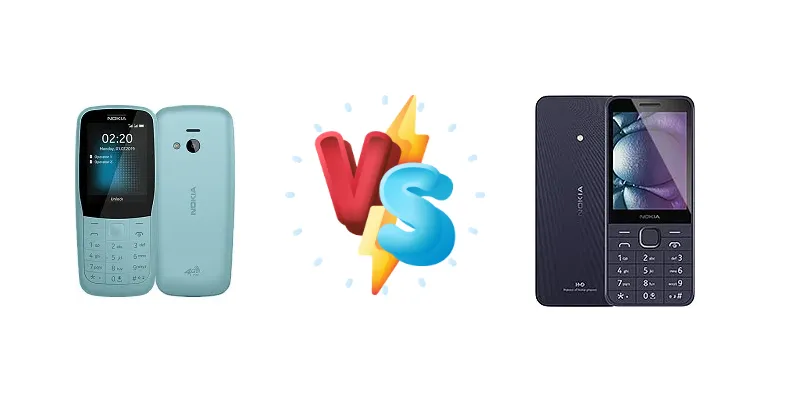
The Nokia 220 4G and the newer Nokia 215 4G (2024) represent HMD Global’s continued commitment to the feature phone market. While both offer essential 4G connectivity, the 215 4G introduces a chipset upgrade, raising the question of whether the added performance justifies a potential price premium. This comparison dissects the differences to help you choose the right device for your needs.
🏆 Quick Verdict
For most users, the Nokia 215 4G (2024) is the better choice. The inclusion of the Unisoc T107 chipset provides a noticeable performance improvement over the unspecified processor in the 220 4G, making web browsing and app usage smoother. However, if absolute cost is the primary concern, the 220 4G remains a viable option.
| Network |
|---|
| 2G bands | GSM 900 / 1800 | GSM 850 / 900 / 1800 / 1900 |
| 3G bands | - | HSDPA 850 / 900 / 2100 |
| 4G bands | 1, 3, 5, 7, 8, 20 | 1, 3, 5, 7, 8, 20, 28, 38, 40, 41 - EU, EMEA, APAC |
| EDGE | No | - |
| GPRS | Yes | - |
| Speed | HSPA, LTE | HSPA, LTE |
| Technology | GSM / LTE | GSM / HSPA / LTE |
| Launch |
|---|
| Announced | 2019, July 24. Released 2019, July 24 | 2024, April 30 |
| Status | Discontinued | Available. Released 2024, May |
| Body |
|---|
| Dimensions | 121.3 x 52.9 x 13.4 mm (4.78 x 2.08 x 0.53 in) | 127.3 x 54.2 x 11.6 mm (5.01 x 2.13 x 0.46 in) |
| SIM | · Nano-SIM· Mini-SIM + Mini-SIM | Nano-SIM + Nano-SIM |
| Weight | 86.5 g (3.03 oz) | - |
| Display |
|---|
| Resolution | 240 x 320 pixels, 4:3 ratio (~167 ppi density) | 240 x 320 pixels, 4:3 ratio (~143 ppi density) |
| Size | 2.4 inches, 17.8 cm2 (~27.8% screen-to-body ratio) | 2.8 inches, 24.3 cm2 (~35.2% screen-to-body ratio) |
| Type | TFT LCD, 256K colors | TFT LCD |
| Platform |
|---|
| CPU | - | 1.0 GHz Cortex-A7 |
| Chipset | - | Unisoc T107 (22 nm) |
| Memory |
|---|
| Call records | Yes | Yes |
| Card slot | microSDHC (dedicated slot) | microSDHC |
| Internal | 24MB 16MB RAM | 128MB 64MB RAM |
| Phonebook | Yes | Yes |
| Main Camera |
|---|
| Features | LED flash | - |
| Single | 0.3 MP | - |
| Video | 320p@15fps | - |
| Sound |
|---|
| 3.5mm jack | Yes | - |
| 35mm jack | Yes | Yes |
| Loudspeaker | Yes | Yes |
| Comms |
|---|
| Bluetooth | 4.2 | 5.0, A2DP, LE |
| NFC | No | No |
| Positioning | No | No |
| Radio | Stereo FM radio, RDS | Wireless FM radio |
| USB | microUSB 2.0 | USB Type-C |
| WLAN | No | No |
| Features |
|---|
| Games | Yes | Yes |
| Java | - | No |
| Messaging | SMS(threaded view), MMS, IM | SMS |
| Sensors | - | No |
| Battery |
|---|
| Type | Li-Ion 1200 mAh, removable | Li-Ion 1450 mAh, removable |
| Misc |
|---|
| Colors | Blue, Black | Peach, Black, Dark Blue |
| Models | TA-1155, TA-1171, TA-1148 | - |
| Price | About 40 EUR | - |
| SAR | 1.42 W/kg (head) 1.13 W/kg (body) | - |
| SAR EU | 1.39 W/kg (head) 1.75 W/kg (body) | - |
Nokia 220 4G
- Potentially lower price point
- Simple and easy to use interface
- Durable build quality (typical of Nokia feature phones)
- Significantly slower performance
- Limited functionality
- Lack of detailed specifications
Nokia 215 4G (2024)
- Improved performance with Unisoc T107
- Smoother web browsing experience
- More responsive user interface
- Potentially higher price
- Still limited in terms of advanced features
- Basic camera capabilities
Display Comparison
Detailed display specifications are unavailable for the Nokia 220 4G. The Nokia 215 4G (2024) also lacks detailed display information, but given the market segment, both likely feature similar low-resolution color displays. Bezels are expected to be substantial on both devices, prioritizing durability and cost reduction over immersive viewing. Color accuracy is unlikely to be a key consideration for either model, focusing instead on basic readability.
Camera Comparison
Neither the Nokia 220 4G nor the Nokia 215 4G (2024) are marketed for their camera capabilities. Both likely feature a basic VGA camera suitable for occasional snapshots. Detailed sensor size and aperture information are unavailable, and image quality is expected to be limited, particularly in low-light conditions. Focusing on camera performance is not a reasonable expectation for either device.
Performance
The Nokia 215 4G (2024) is equipped with the Unisoc T107 chipset, a 22nm processor featuring a 1.0 GHz Cortex-A7 CPU. This represents a significant upgrade over the Nokia 220 4G, which lacks publicly available chipset information. The Cortex-A7 architecture, while dated, provides a baseline level of performance suitable for basic tasks like calling, texting, and light web browsing. The 22nm process node suggests reasonable power efficiency, contributing to extended battery life. The 220 4G, lacking a specified chipset, likely relies on an even older and less powerful processor, resulting in slower response times and a less fluid user experience.
Battery Life
Battery capacity details are unavailable for the Nokia 220 4G. The Nokia 215 4G (2024) also lacks specific battery capacity information, but feature phones generally prioritize long standby times. The Unisoc T107’s 22nm process node contributes to power efficiency, potentially allowing the 215 4G to achieve comparable or even better battery life than the 220 4G, despite the performance increase. Charging times are expected to be slow on both devices, utilizing micro-USB connectivity.
Buying Guide
Buy the Nokia 220 4G if you need a truly bare-bones 4G phone for essential calls and texts, and are prioritizing the lowest possible price. Buy the Nokia 215 4G (2024) if you value a slightly more responsive user experience, particularly when accessing online services or using basic apps, and are willing to spend a little more for that added performance.
Frequently Asked Questions
❓ Will the Nokia 215 4G (2024) run WhatsApp smoothly?
The Unisoc T107 chipset should provide a sufficient level of performance to run WhatsApp, although it won't be a particularly fast experience. Expect some loading times and occasional lag, especially when sending media. The Nokia 220 4G will likely struggle significantly with WhatsApp due to its less powerful processor.
❓ What kind of SIM cards do these phones support?
Both the Nokia 215 4G (2024) and the Nokia 220 4G support dual SIM functionality, allowing you to use two SIM cards simultaneously. They both utilize standard micro-SIM cards.
❓ Can I use a microSD card to expand storage on either phone?
Yes, both the Nokia 215 4G (2024) and the Nokia 220 4G support microSD card expansion, allowing you to increase storage for contacts, messages, and other files. The maximum supported microSD card capacity is typically 32GB.