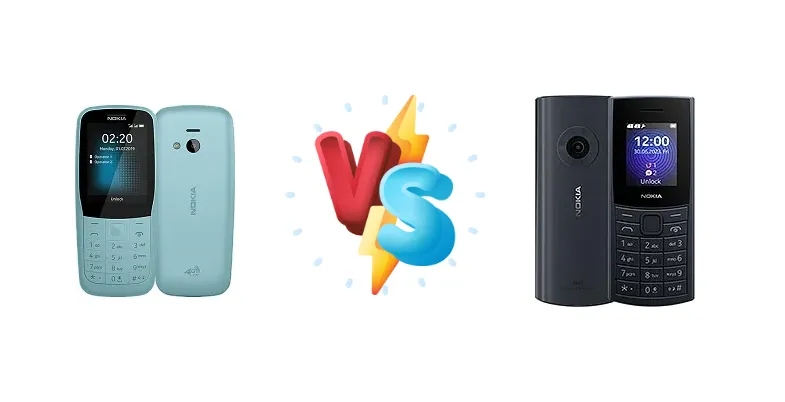
In a world dominated by smartphones, the feature phone persists, offering a compelling alternative for those prioritizing simplicity, affordability, and long battery life. The Nokia 220 4G and Nokia 110 4G 2nd Edition represent the latest iterations of this classic form factor, both offering 4G connectivity. This comparison dissects their nuances to determine which best suits users seeking a reliable, no-frills mobile experience.
🏆 Quick Verdict
For the average user needing a dependable secondary phone or a first mobile device, the Nokia 110 4G 2nd Edition likely offers a slightly better experience. Its likely focus on improved usability and potentially longer software support, given it's a 2nd Edition, outweighs the Nokia 220 4G's unknown advantages.
| Network |
|---|
| 2G bands | GSM 900 / 1800 | GSM 900 / 1800 |
| 3G bands | - | HSDPA 850 / 900 / 1700(AWS) / 1900 / 2100 |
| 4G bands | 1, 3, 5, 7, 8, 20 | LTE |
| EDGE | No | - |
| GPRS | Yes | - |
| Speed | HSPA, LTE | HSPA, LTE |
| Technology | GSM / LTE | GSM / HSPA / LTE |
| Launch |
|---|
| Announced | 2019, July 24. Released 2019, July 24 | 2024, December |
| Status | Discontinued | Available. Released 2024, December |
| Body |
|---|
| Dimensions | 121.3 x 52.9 x 13.4 mm (4.78 x 2.08 x 0.53 in) | 121.5 x 50 x 14.4 mm (4.78 x 1.97 x 0.57 in) |
| SIM | · Nano-SIM· Mini-SIM + Mini-SIM | · Nano-SIM· Nano-SIM + Nano-SIM |
| Weight | 86.5 g (3.03 oz) | 94.5 g (3.35 oz) |
| Display |
|---|
| Resolution | 240 x 320 pixels, 4:3 ratio (~167 ppi density) | 120 x 160 pixels, 4:3 ratio (~111 ppi density) |
| Size | 2.4 inches, 17.8 cm2 (~27.8% screen-to-body ratio) | 1.8 inches, 10.0 cm2 (~16.5% screen-to-body ratio) |
| Type | TFT LCD, 256K colors | IPS LCD |
| Memory |
|---|
| Call records | Yes | Yes |
| Card slot | microSDHC (dedicated slot) | microSDHC |
| Internal | 24MB 16MB RAM | 48MB 128MB RAM |
| Phonebook | Yes | Yes |
| Main Camera |
|---|
| Features | LED flash | - |
| Single | 0.3 MP | QVGA |
| Video | 320p@15fps | Yes |
| Sound |
|---|
| 3.5mm jack | Yes | - |
| 35mm jack | Yes | Yes |
| Loudspeaker | Yes | Yes |
| Comms |
|---|
| Bluetooth | 4.2 | 5.0, A2DP |
| NFC | No | No |
| Positioning | No | No |
| Radio | Stereo FM radio, RDS | Wireless FM radio |
| USB | microUSB 2.0 | USB Type-C |
| WLAN | No | No |
| Features |
|---|
| Games | Yes | Yes |
| Java | - | No |
| Messaging | SMS(threaded view), MMS, IM | SMS |
| Battery |
|---|
| Type | Li-Ion 1200 mAh, removable | Li-Ion 1450 mAh, removable |
| Misc |
|---|
| Colors | Blue, Black | Midnight Blue, Arctic Purple |
| Models | TA-1155, TA-1171, TA-1148 | - |
| Price | About 40 EUR | About 60 EUR |
| SAR | 1.42 W/kg (head) 1.13 W/kg (body) | - |
| SAR EU | 1.39 W/kg (head) 1.75 W/kg (body) | - |
Nokia 220 4G
- Potentially lower price point.
- Extreme simplicity for basic users.
- Durable build quality expected from Nokia.
- Likely older software version.
- Limited feature set.
- Unknown battery performance compared to the 2nd Edition.
Nokia 110 4G 2nd Edition
- Likely improved software and usability.
- Potential for longer battery life due to optimizations.
- Benefit of being a 2nd Edition product with potential bug fixes.
- May be slightly more expensive.
- Still a very basic feature phone.
- Camera quality will be limited.
Display Comparison
Given both phones target the ultra-budget segment, display technology is likely basic TFT LCD. The Nokia 110 4G 2nd Edition, being a later iteration, *may* benefit from slightly improved color reproduction or viewing angles, though this is speculative. Bezels are expected to be substantial on both devices, prioritizing durability and cost reduction over immersive viewing. Screen size is likely similar, around 2.4 inches, optimized for text readability rather than media consumption.
Camera Comparison
Both phones likely feature a VGA camera, primarily for basic image capture. Image quality will be extremely limited, suitable only for quick snapshots in well-lit conditions. The camera is more of a novelty feature than a practical imaging tool. Any differences in sensor size or lens aperture are unlikely to be significant enough to impact image quality noticeably.
Performance
Both devices utilize Series 30+ operating system, a platform designed for extremely limited resource usage. Performance differences will be minimal, dictated more by RAM allocation (likely in the single-digit megabyte range) than processing power. The inclusion of 4G connectivity on both models suggests a similar modem chipset, prioritizing voice and SMS functionality over data-intensive tasks. Thermal management is not a concern given the low power consumption.
Battery Life
Battery life is a key strength of both devices. The Nokia 110 4G 2nd Edition, benefiting from potential software optimizations and a slightly newer design, *may* offer marginally longer standby and talk time. Both phones are expected to deliver several days of use on a single charge, a significant advantage over smartphones. Charging is likely via Micro-USB, with charging times measured in hours rather than minutes.
Buying Guide
Buy the Nokia 220 4G if you need a truly minimal device, potentially for emergency use or specific, limited communication needs where absolute simplicity is paramount. Buy the Nokia 110 4G 2nd Edition if you prefer a slightly more refined user experience, potentially with access to more apps or services through its likely updated software, and value the benefits of a second edition product.
Frequently Asked Questions
❓ Is the Nokia 110 4G 2nd Edition compatible with VoLTE carriers?
Given both phones support 4G, they are likely compatible with VoLTE carriers, but compatibility depends on the specific carrier and region. It's crucial to check with your carrier to confirm VoLTE support before purchasing.
❓ Can I use WhatsApp or Facebook on either of these phones?
While the Series 30+ operating system supports a limited number of apps, WhatsApp and Facebook may be available through their 'Lite' versions, if supported by the phone's software. However, functionality will be significantly restricted compared to smartphone versions.
❓ How easy is it to transfer contacts from a smartphone to either of these Nokia phones?
Contact transfer can be achieved via Bluetooth or by saving contacts to a SIM card. The process is relatively straightforward, but may require some manual input depending on the number of contacts.