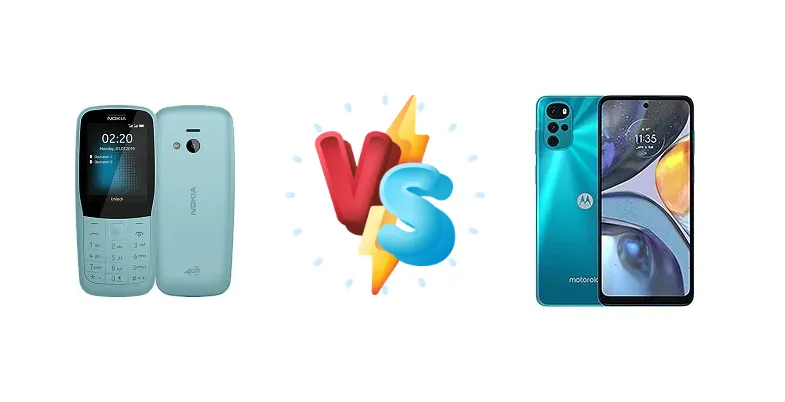
The mobile landscape is diverse. While smartphones dominate, the need for simple, reliable communication persists. We pit the Nokia 220 4G, a modern feature phone, against the Motorola Moto G22, an entry-level smartphone, to determine which best suits different user needs and priorities. This isn't about raw power; it's about functionality and value.
🏆 Quick Verdict
For users prioritizing call quality, extended battery life, and affordability above all else, the Nokia 220 4G is the clear winner. However, the Motorola Moto G22 provides smartphone functionality – app access, internet browsing, and a camera – making it the better choice for those needing more than basic communication.
| Network |
|---|
| 2G bands | GSM 900 / 1800 | GSM 850 / 900 / 1800 / 1900 |
| 3G bands | - | HSDPA 850 / 900 / 1900 / 2100 |
| 4G bands | 1, 3, 5, 7, 8, 20 | 1, 3, 5, 7, 8, 20, 38, 40, 41 |
| EDGE | No | - |
| GPRS | Yes | - |
| Speed | HSPA, LTE | HSPA 42.2/5.76 Mbps, LTE Cat4 150/50 Mbps |
| Technology | GSM / LTE | GSM / HSPA / LTE |
| Launch |
|---|
| Announced | 2019, July 24. Released 2019, July 24 | 2022, March 04 |
| Status | Discontinued | Available. Released 2022, March 04 |
| Body |
|---|
| Build | - | Glass front, plastic frame, plastic back |
| Dimensions | 121.3 x 52.9 x 13.4 mm (4.78 x 2.08 x 0.53 in) | 164 x 75 x 8.5 mm (6.46 x 2.95 x 0.33 in) |
| SIM | · Nano-SIM· Mini-SIM + Mini-SIM | · Nano-SIM· Nano-SIM + Nano-SIM |
| Weight | 86.5 g (3.03 oz) | 185 g (6.53 oz) |
| | - | Water-repellent design |
| Display |
|---|
| Resolution | 240 x 320 pixels, 4:3 ratio (~167 ppi density) | 720 x 1600 pixels, 20:9 ratio (~268 ppi density) |
| Size | 2.4 inches, 17.8 cm2 (~27.8% screen-to-body ratio) | 6.5 inches, 103.5 cm2 (~84.2% screen-to-body ratio) |
| Type | TFT LCD, 256K colors | IPS LCD, 90Hz |
| Platform |
|---|
| CPU | - | Octa-core (4x2.3 GHz Cortex-A53 & 4x1.8 GHz Cortex-A53) |
| Chipset | - | Mediatek MT6765V/CB Helio G37 (12 nm) |
| GPU | - | PowerVR GE8320 |
| OS | - | Android 12 |
| Memory |
|---|
| Call records | Yes | - |
| Card slot | microSDHC (dedicated slot) | microSDXC (dedicated slot) |
| Internal | 24MB 16MB RAM | 64GB 4GB RAM, 128GB 4GB RAM |
| Phonebook | Yes | - |
| Main Camera |
|---|
| Features | LED flash | LED flash, HDR, panorama |
| Quad | - | 50 MP, f/1.8, (wide), 0.64µm, PDAF
8 MP, f/2.2, 118˚ (ultrawide), 1/4.0", 1.12µm
2 MP (macro)
Auxiliary lens |
| Single | 0.3 MP | - |
| Video | 320p@15fps | 1080p@30fps |
| Selfie camera |
|---|
| Features | - | HDR |
| Single | - | 16 MP, f/2.5, (wide), 1.0µm |
| Video | - | 1080p@30fps |
| | No | - |
| Sound |
|---|
| 3.5mm jack | Yes | Yes |
| 35mm jack | Yes | Yes |
| Loudspeaker | Yes | Yes |
| Comms |
|---|
| Bluetooth | 4.2 | 5.0, A2DP, LE |
| NFC | No | Yes (market/region dependent) |
| Positioning | No | GPS, GLONASS, GALILEO |
| Radio | Stereo FM radio, RDS | Unspecified |
| USB | microUSB 2.0 | USB Type-C 2.0 |
| WLAN | No | Wi-Fi 802.11 a/b/g/n/ac, dual-band, Wi-Fi Direct |
| Features |
|---|
| Games | Yes | - |
| Messaging | SMS(threaded view), MMS, IM | - |
| Sensors | - | Fingerprint (side-mounted), accelerometer, gyro, proximity, compass |
| Battery |
|---|
| Charging | - | 20W wired (India)
15W wired (Global) |
| Type | Li-Ion 1200 mAh, removable | Li-Po 5000 mAh |
| Misc |
|---|
| Colors | Blue, Black | Pearl White, Iceberg Blue, Cosmic Black, Mint Green |
| Models | TA-1155, TA-1171, TA-1148 | XT2231-1, XT2231-2, XT2231-5 |
| Price | About 40 EUR | About 120 EUR |
| SAR | 1.42 W/kg (head) 1.13 W/kg (body) | - |
| SAR EU | 1.39 W/kg (head) 1.75 W/kg (body) | - |
Nokia 220 4G
- Exceptional battery life (weeks on a single charge)
- Highly affordable
- Durable and reliable
- Limited functionality (no apps)
- Basic camera capabilities
- Small screen
Motorola Moto G22
- Smartphone functionality (apps, internet)
- Larger display for media consumption
- Camera for photos and videos
- Shorter battery life (daily charging)
- Lower performance compared to flagship phones
- More complex operating system
Display Comparison
The Nokia 220 4G, being a feature phone, likely utilizes a basic LCD panel with a focus on readability in direct sunlight rather than vibrant colors or high resolution. Conversely, the Motorola Moto G22 features a larger display, though specifics regarding panel type (IPS LCD is expected) and resolution are not provided. The Moto G22’s larger screen size is geared towards media consumption and app usability, a feature absent on the Nokia 220 4G. The Nokia’s display prioritizes power efficiency, contributing to its extended battery life.
Camera Comparison
The Motorola Moto G22 includes a camera system, though the sensor details are not provided in the context data. It's reasonable to assume a primary sensor for basic photography, potentially accompanied by auxiliary lenses. The Nokia 220 4G likely features a very basic camera, primarily for capturing simple snapshots. The Moto G22’s camera offers the ability to capture and share photos and videos, a feature entirely absent or extremely limited on the Nokia 220 4G. Image processing capabilities on the Moto G22 will be far more advanced, offering features like HDR and scene detection.
Performance
The Motorola Moto G22’s Mediatek Helio G37 chipset, with its octa-core CPU (4x2.3 GHz Cortex-A53 & 4x1.8 GHz Cortex-A53), represents a significant leap in processing power compared to the Nokia 220 4G, which is designed for basic call and text functions. The G37 allows for running apps, browsing the web, and handling light multitasking. The Nokia 220 4G’s processor is optimized for minimal power consumption, not performance. The 12nm fabrication process of the Helio G37 offers a balance between performance and efficiency, but it won't compete with flagship-level chips. The Nokia 220 4G’s architecture is fundamentally different, prioritizing longevity and reliability over speed.
Battery Life
The Nokia 220 4G is renowned for its exceptional battery life, potentially lasting weeks on a single charge due to its minimal power requirements. The Motorola Moto G22, while offering a respectable battery capacity, will require daily or near-daily charging due to the power demands of its smartphone operating system and applications. The Moto G22 supports 20W (India) / 15W (Global) wired charging, allowing for relatively quick top-ups, but the Nokia 220 4G’s longevity is its primary battery advantage. The trade-off is clear: convenience and features versus extended uptime.
Buying Guide
Buy the Nokia 220 4G if you need a dependable secondary phone for emergencies, travel, or simply prefer a distraction-free experience with exceptional battery life. Buy the Motorola Moto G22 if you require smartphone features like WhatsApp, Google Maps, and a camera for everyday use, and are willing to trade some battery life for that functionality.
Frequently Asked Questions
❓ Is the Motorola Moto G22 suitable for playing demanding mobile games?
The Mediatek Helio G37 in the Moto G22 is capable of handling some mobile games, but it's not a gaming powerhouse. Expect to play less graphically intensive titles at medium settings. Demanding games will likely require reduced graphics settings and may still experience some lag.
❓ Can I use WhatsApp on the Nokia 220 4G?
No, the Nokia 220 4G does not support applications like WhatsApp. It's a feature phone designed for basic calling and texting, and lacks the operating system and processing power required to run modern apps.
❓ How does the charging speed of the Motorola Moto G22 compare to other smartphones in its price range?
The Moto G22’s 20W (India) / 15W (Global) charging is fairly standard for its price bracket. While not the fastest charging available, it’s sufficient for topping up the battery in a reasonable timeframe, typically around 2 hours for a full charge.
❓ What kind of SIM cards does the Nokia 220 4G support?
The Nokia 220 4G supports single SIM (Nano-SIM) or dual SIM (Nano-SIM, dual stand-by). This allows you to use two different phone numbers on the same device, or use one SIM for calls and another for data.