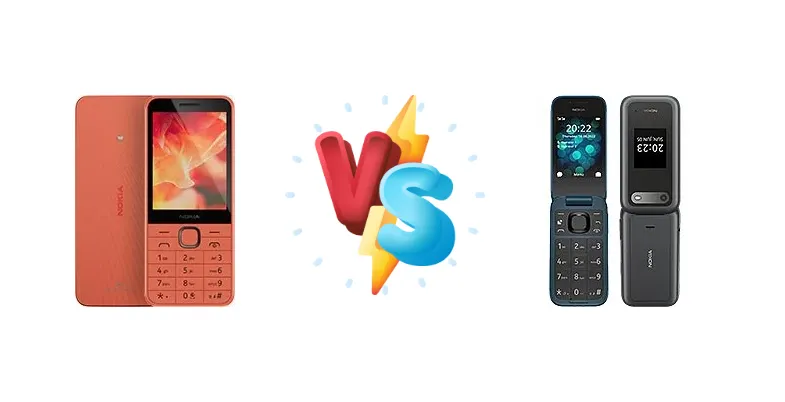
In a world dominated by smartphones, Nokia continues to cater to a segment seeking simplicity and reliability with its feature phones. The Nokia 220 4G (2024) and the Nokia 2660 Flip represent two distinct approaches to this market – a classic candybar design versus the nostalgic appeal of a flip phone. This comparison dissects their similarities and differences to determine which best suits your needs.
🏆 Quick Verdict
For the average user prioritizing ease of use and a familiar form factor, the Nokia 2660 Flip emerges as the slightly better choice. The inclusion of a charging cradle adds convenience, and the flip design offers screen protection when not in use. However, the Nokia 220 4G (2024) remains a solid option for those preferring a traditional candybar phone.
| Network |
|---|
| 2G bands | GSM 850 / 900 / 1800 / 1900 | GSM 850 / 900 / 1800 / 1900 |
| 3G bands | HSDPA 850 / 900 / 2100 | HSDPA 850 / 900 / 2100 - International |
| 4G bands | 1, 3, 5, 8, 28, 38, 39, 40, 41 - IN, CN | 1, 3, 5, 7, 8, 20 - EU, RUCIS |
| Speed | HSPA, LTE | HSPA, LTE |
| Technology | GSM / HSPA / LTE | GSM / HSPA / LTE |
| | - | 1, 2, 3, 4, 5, 7, 8, 28 - LATAM, BR |
| Launch |
|---|
| Announced | 2024, June 25 | 2022, July 12 |
| Status | Available. Released 2024, June 25 | Available. Released 2022, July 28 |
| Body |
|---|
| Dimensions | 127.3 x 54.2 x 11.6 mm (5.01 x 2.13 x 0.46 in) | - |
| SIM | Nano-SIM + Nano-SIM | · Nano-SIM· Nano-SIM + Nano-SIM |
| Weight | - | 123 g (4.34 oz) |
| Display |
|---|
| Resolution | 240 x 320 pixels, 4:3 ratio (~143 ppi density) | 240 x 320 pixels, 4:3 ratio (~143 ppi density) |
| Size | 2.8 inches, 24.3 cm2 (~35.2% screen-to-body ratio) | 2.8 inches, 24.3 cm2 |
| Type | TFT LCD | TFT LCD |
| | - | Secondary external 1.77" display |
| Platform |
|---|
| CPU | 1.0 GHz Cortex-A7 | 1.0 GHz Cortex-A7 |
| Chipset | Unisoc T107 (22 nm) | Unisoc T107 (22 nm) |
| Memory |
|---|
| Call records | Yes | Yes |
| Card slot | microSDHC | microSDHC |
| Internal | 128MB 64MB RAM | 128MB 48MB RAM |
| Phonebook | Yes | Yes |
| Main Camera |
|---|
| Features | - | LED flash |
| Single | - | 0.3 MP |
| Video | - | Yes |
| Sound |
|---|
| 3.5mm jack | - | Yes |
| 35mm jack | Yes | Yes |
| Loudspeaker | Yes | Yes |
| Comms |
|---|
| Bluetooth | 5.0, A2DP, LE | 4.2, A2DP |
| NFC | No | No |
| Positioning | No | No |
| Radio | Wireless FM radio | Wireless FM radio |
| USB | USB Type-C | microUSB 2.0 |
| WLAN | No | No |
| Features |
|---|
| Games | Yes | Yes |
| Java | No | No |
| Messaging | SMS | SMS, MMS |
| Sensors | No | - |
| Battery |
|---|
| Charging | - | Compatible with a charging cradle |
| Type | Li-Ion 1450 mAh, removable | Li-Ion 1450 mAh, removable |
| Misc |
|---|
| Colors | Black, Peach | Gray, Blue, Red, Lush Green, Pop Pink |
| Models | - | TA-1480, TA-1474, TA-1469 |
| Price | About 40 EUR | € 59.99 / $ 190.00 / £ 69.00 / ₹ 4,499 |
| SAR | - | 0.47 W/kg (head) 1.16 W/kg (body) |
| SAR EU | - | 0.36 W/kg (head) 1.48 W/kg (body) |
Nokia 220 4G (2024)
- Classic candybar design for familiar usability.
- Affordable price point.
- Reliable call quality.
- Screen is exposed and prone to scratches.
- Lacks the convenience of a charging cradle.
Nokia 2660 Flip
- Flip design protects the screen when closed.
- Convenient charging cradle included.
- Nostalgic appeal.
- Flip mechanism adds slight bulk.
- May not appeal to users accustomed to candybar phones.
Display Comparison
Both the Nokia 220 4G (2024) and the Nokia 2660 Flip utilize displays geared towards basic functionality, meaning detailed specifications like resolution and color gamut are not prominently advertised. The key difference lies in the form factor: the 2660 Flip’s internal display benefits from being protected when closed, reducing the risk of accidental scratches. The 220 4G’s exposed screen is more susceptible to damage. While neither phone boasts high brightness, the smaller display size of both devices likely mitigates the impact of lower nits in direct sunlight.
Camera Comparison
Neither device is positioned as a photography powerhouse. While both likely include a rear camera, detailed specifications are scarce. Given the target audience and price point, image quality will be basic and suitable for simple snapshots. Focusing on camera performance is largely irrelevant when evaluating these phones; their primary function is communication, not content creation.
Performance
Both devices are powered by the Unisoc T107 chipset, featuring a 1.0 GHz Cortex-A7 CPU. This indicates virtually identical performance capabilities for core tasks like making calls, sending texts, and running basic applications. The 22nm process node suggests similar power efficiency between the two. Given the limited demands placed on these phones, the chipset is adequately suited for their intended purpose; users shouldn’t expect to run demanding applications or experience lag during everyday use. The lack of RAM specifications suggests a minimal configuration sufficient for the phones’ limited functionality.
Battery Life
Battery capacity details are not provided for either device. However, the simple feature set and power-efficient Unisoc T107 chipset suggest both phones will offer excellent standby and talk time. The Nokia 2660 Flip’s inclusion of a charging cradle provides a convenient and stable charging solution, potentially extending battery life by allowing for consistent charging without wear and tear on the micro-USB port. The 220 4G relies solely on a micro-USB connection for charging.
Buying Guide
Buy the Nokia 220 4G (2024) if you need a straightforward, durable phone with a classic candybar design and prioritize simplicity above all else. Buy the Nokia 2660 Flip if you prefer the nostalgic feel of a flip phone, value the added screen protection, and appreciate the convenience of a dedicated charging cradle.
Frequently Asked Questions
❓ Does the Nokia 2660 Flip's flip mechanism feel durable, or is it likely to break with frequent use?
Nokia has a history of building robust flip phones. While long-term durability depends on usage, the 2660 Flip is constructed with a reinforced hinge designed to withstand repeated opening and closing. However, it's still a mechanical component and should be treated with reasonable care.
❓ Can I use my existing micro-USB cable to charge the Nokia 220 4G (2024), or is a special cable required?
The Nokia 220 4G (2024) utilizes a standard micro-USB port for charging. You can use any compatible micro-USB cable and charger, making it convenient to use existing accessories.
❓ Is it possible to expand the storage on either the Nokia 220 4G or the Nokia 2660 Flip with a microSD card?
Yes, both the Nokia 220 4G (2024) and the Nokia 2660 Flip support microSD card expansion, allowing you to increase storage for contacts, messages, and limited media files. The maximum supported microSD card capacity is typically 32GB, though this can vary.