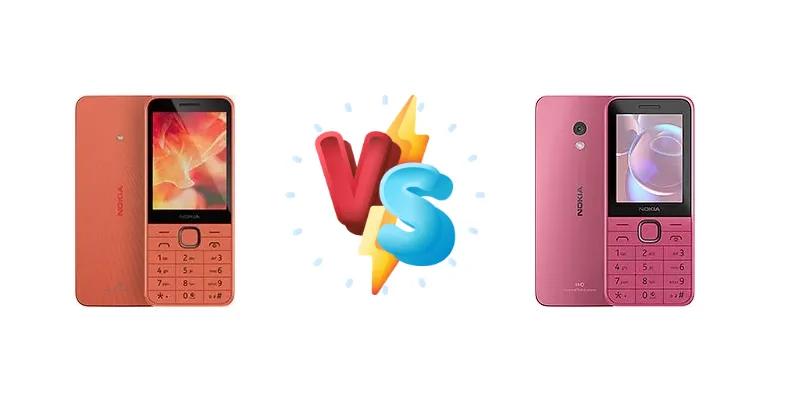
In a market saturated with expensive smartphones, Nokia continues to cater to a vital segment: users seeking reliable 4G connectivity in a durable, affordable package. The Nokia 220 4G (2024) and Nokia 225 4G (2024) represent the latest iterations of this philosophy. While appearing nearly identical on the surface, a closer examination reveals nuanced differences that could sway your decision, particularly regarding long-term usability and feature set.
🏆 Quick Verdict
For the average user prioritizing basic 4G connectivity and extended battery life, the Nokia 220 4G (2024) offers the best value. Both phones share the same Unisoc T107 chipset, but the 220 4G’s focus on core functionality translates to a slightly more streamlined experience and potentially longer software support.
| Network |
|---|
| 2G bands | GSM 850 / 900 / 1800 / 1900 | GSM 850 / 900 / 1800 / 1900 |
| 3G bands | HSDPA 850 / 900 / 2100 | HSDPA 850 / 900 / 2100 |
| 4G bands | 1, 3, 5, 8, 28, 38, 39, 40, 41 - IN, CN | 1, 3, 5, 7, 8, 20, 28, 38, 40, 41 - EU, EMEA, APAC |
| Speed | HSPA, LTE | HSPA, LTE |
| Technology | GSM / HSPA / LTE | GSM / HSPA / LTE |
| Launch |
|---|
| Announced | 2024, June 25 | 2024, April 30 |
| Status | Available. Released 2024, June 25 | Available. Released 2024, May |
| Body |
|---|
| Dimensions | 127.3 x 54.2 x 11.6 mm (5.01 x 2.13 x 0.46 in) | 121.5 x 52 x 11.6 mm (4.78 x 2.05 x 0.46 in) |
| SIM | Nano-SIM + Nano-SIM | Nano-SIM + Nano-SIM |
| Weight | - | - |
| Display |
|---|
| Resolution | 240 x 320 pixels, 4:3 ratio (~143 ppi density) | 240 x 320 pixels, 4:3 ratio (~167 ppi density) |
| Size | 2.8 inches, 24.3 cm2 (~35.2% screen-to-body ratio) | 2.4 inches, 17.8 cm2 (~28.2% screen-to-body ratio) |
| Type | TFT LCD | TFT LCD |
| Platform |
|---|
| CPU | 1.0 GHz Cortex-A7 | 1.0 GHz Cortex-A7 |
| Chipset | Unisoc T107 (22 nm) | Unisoc T107 (22 nm) |
| Memory |
|---|
| Call records | Yes | Yes |
| Card slot | microSDHC | microSDHC |
| Internal | 128MB 64MB RAM | 128MB 64MB RAM |
| Phonebook | Yes | Yes |
| Main Camera |
|---|
| Features | - | LED flash |
| Single | - | 0.3 MP |
| Video | - | Yes |
| Sound |
|---|
| 35mm jack | Yes | Yes |
| Loudspeaker | Yes | Yes |
| Comms |
|---|
| Bluetooth | 5.0, A2DP, LE | 5.0, A2DP, LE |
| NFC | No | No |
| Positioning | No | No |
| Radio | Wireless FM radio | Wireless FM radio |
| USB | USB Type-C | USB Type-C |
| WLAN | No | No |
| Features |
|---|
| Games | Yes | Yes |
| Java | No | No |
| Messaging | SMS | SMS |
| Sensors | No | No |
| Battery |
|---|
| Type | Li-Ion 1450 mAh, removable | Li-Ion 1450 mAh, removable |
| Misc |
|---|
| Colors | Black, Peach | Pink, Dark Blue |
| Price | About 40 EUR | - |
Nokia 220 4G (2024)
- Potentially longer battery life due to streamlined software.
- Excellent value for basic 4G connectivity.
- Durable build quality typical of Nokia feature phones.
- Limited features beyond core functionality.
- Low-resolution camera with limited image quality.
Nokia 225 4G (2024)
- May include additional pre-loaded apps or features.
- Potentially enhanced audio capabilities.
- Excellent value for basic 4G connectivity.
- Potentially shorter battery life due to added features.
- Low-resolution camera with limited image quality.
Display Comparison
Both the Nokia 220 4G and 225 4G feature displays designed for basic visibility rather than immersive experiences. Given the shared target market, we anticipate both utilize similar 2.4-inch color displays with resolutions around 320x240 pixels. The absence of detailed specifications necessitates an assumption of similar panel technology – likely TFT LCD – and comparable brightness levels. Bezels are expected to be substantial on both models, prioritizing durability and ease of use over a modern, edge-to-edge aesthetic. Color accuracy is unlikely to be a key consideration for either device.
Camera Comparison
Both the Nokia 220 4G and 225 4G are equipped with rear cameras, but detailed specifications are scarce. Given the price point, we can expect a basic VGA (0.3MP) camera on both models. Image quality will be limited, suitable only for very basic snapshots in good lighting conditions. The absence of features like autofocus or flash further restricts their photographic capabilities. The camera is primarily a functional addition rather than a key selling point for either device.
Performance
The core of both devices is the Unisoc T107 chipset, a 22nm processor featuring a 1.0 GHz Cortex-A7 CPU. This configuration is sufficient for basic tasks like calling, texting, and running simple applications. The shared chipset means performance will be virtually identical in day-to-day use. The limited RAM (likely 128MB or 256MB, based on similar devices) will constrain multitasking capabilities on both phones. Thermal management isn’t a concern given the low power draw of the Unisoc T107; neither device is expected to experience significant throttling.
Battery Life
Battery life is a critical factor for feature phones, and both Nokia models aim to deliver extended usage. While specific mAh ratings are not provided, the Nokia 220 4G’s focus on core functionality suggests it may have a slightly larger battery capacity or more efficient power management. Both phones support 4G connectivity, which inherently consumes more power than 2G/3G. Expect several days of standby time and a reasonable number of hours of talk time on both devices, but heavy 4G usage will reduce battery life considerably. Charging is likely via Micro-USB, with charging times expected to be several hours.
Buying Guide
Buy the Nokia 220 4G (2024) if you need a supremely reliable, no-frills 4G phone for calls, texts, and occasional internet browsing, prioritizing battery endurance above all else. Buy the Nokia 225 4G (2024) if you prefer a slightly more feature-rich experience, potentially including enhanced audio capabilities or pre-loaded apps, understanding this may come at the cost of marginally reduced battery life.
Frequently Asked Questions
❓ Will the Nokia 220 4G or 225 4G work with my current carrier in the US?
Both phones support 4G LTE, but compatibility depends on your carrier's specific frequency bands. It's crucial to check if your carrier supports the bands used by these devices before purchasing. Generally, they are designed for GSM networks commonly found internationally, and US compatibility can be limited.
❓ Can I use WhatsApp or Facebook on either the Nokia 220 4G or Nokia 225 4G?
While both phones support basic internet connectivity, running apps like WhatsApp and Facebook is possible but may be a limited experience. The Unisoc T107 chipset and limited RAM may result in slow loading times and sluggish performance. WhatsApp Lite is a more viable option than the full WhatsApp application.
❓ How durable are these phones, and are they water-resistant?
Nokia feature phones are known for their robust build quality. However, neither the 220 4G nor the 225 4G are officially water-resistant. While they can likely withstand minor splashes, they are not designed for submersion or prolonged exposure to moisture.