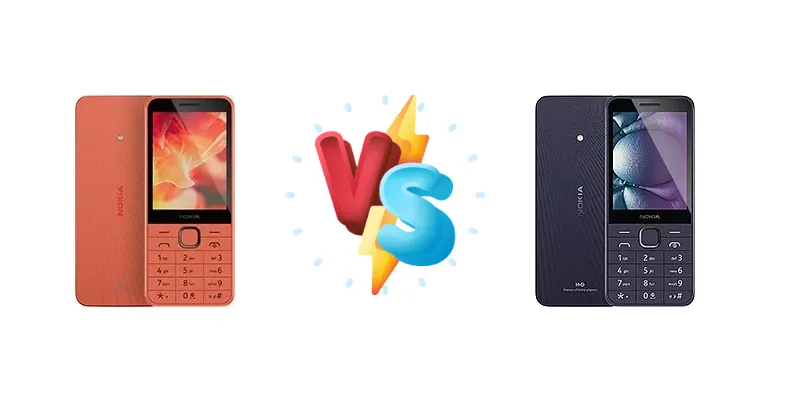
In the rapidly evolving smartphone landscape, Nokia continues to cater to a segment often overlooked: users prioritizing basic connectivity and long battery life. The Nokia 220 4G (2024) and Nokia 215 4G (2024) represent the latest iterations of this philosophy, offering 4G capabilities at an incredibly accessible price point. This comparison dissects the nuances between these two models, revealing which one best suits your needs.
🏆 Quick Verdict
For the average user seeking a reliable, ultra-budget 4G feature phone, the Nokia 220 4G (2024) emerges as the slightly better choice. While both share the same Unisoc T107 chipset, the 220 4G’s potential for slightly enhanced software features and broader availability gives it a marginal edge.
| Network |
|---|
| 2G bands | GSM 850 / 900 / 1800 / 1900 | GSM 850 / 900 / 1800 / 1900 |
| 3G bands | HSDPA 850 / 900 / 2100 | HSDPA 850 / 900 / 2100 |
| 4G bands | 1, 3, 5, 8, 28, 38, 39, 40, 41 - IN, CN | 1, 3, 5, 7, 8, 20, 28, 38, 40, 41 - EU, EMEA, APAC |
| Speed | HSPA, LTE | HSPA, LTE |
| Technology | GSM / HSPA / LTE | GSM / HSPA / LTE |
| Launch |
|---|
| Announced | 2024, June 25 | 2024, April 30 |
| Status | Available. Released 2024, June 25 | Available. Released 2024, May |
| Body |
|---|
| Dimensions | 127.3 x 54.2 x 11.6 mm (5.01 x 2.13 x 0.46 in) | 127.3 x 54.2 x 11.6 mm (5.01 x 2.13 x 0.46 in) |
| SIM | Nano-SIM + Nano-SIM | Nano-SIM + Nano-SIM |
| Weight | - | - |
| Display |
|---|
| Resolution | 240 x 320 pixels, 4:3 ratio (~143 ppi density) | 240 x 320 pixels, 4:3 ratio (~143 ppi density) |
| Size | 2.8 inches, 24.3 cm2 (~35.2% screen-to-body ratio) | 2.8 inches, 24.3 cm2 (~35.2% screen-to-body ratio) |
| Type | TFT LCD | TFT LCD |
| Platform |
|---|
| CPU | 1.0 GHz Cortex-A7 | 1.0 GHz Cortex-A7 |
| Chipset | Unisoc T107 (22 nm) | Unisoc T107 (22 nm) |
| Memory |
|---|
| Call records | Yes | Yes |
| Card slot | microSDHC | microSDHC |
| Internal | 128MB 64MB RAM | 128MB 64MB RAM |
| Phonebook | Yes | Yes |
| Sound |
|---|
| 35mm jack | Yes | Yes |
| Loudspeaker | Yes | Yes |
| Comms |
|---|
| Bluetooth | 5.0, A2DP, LE | 5.0, A2DP, LE |
| NFC | No | No |
| Positioning | No | No |
| Radio | Wireless FM radio | Wireless FM radio |
| USB | USB Type-C | USB Type-C |
| WLAN | No | No |
| Features |
|---|
| Games | Yes | Yes |
| Java | No | No |
| Messaging | SMS | SMS |
| Sensors | No | No |
| Battery |
|---|
| Type | Li-Ion 1450 mAh, removable | Li-Ion 1450 mAh, removable |
| Misc |
|---|
| Colors | Black, Peach | Peach, Black, Dark Blue |
| Price | About 40 EUR | - |
Nokia 220 4G (2024)
- Potential for slightly more frequent software updates.
- Wider availability in certain markets.
- Reliable 4G connectivity for basic communication.
- Limited features compared to smartphones.
- Camera quality is basic.
Nokia 215 4G (2024)
- Ultra-affordable price point.
- Long battery life.
- Simple and easy-to-use interface.
- Potentially less frequent software updates.
- Limited feature set.
Display Comparison
Both the Nokia 220 4G and 215 4G feature displays designed for basic visibility rather than immersive experiences. While exact screen sizes and resolutions aren't specified, they are likely similar, prioritizing legibility over pixel density. Given the target market, neither device is expected to boast high brightness nits or advanced panel technologies like LTPO. Bezels are likely substantial on both, maximizing screen real estate within the compact form factor. Color accuracy is expected to be standard for this price segment, focusing on functional clarity rather than color fidelity.
Camera Comparison
Camera capabilities on both the Nokia 220 4G and 215 4G are minimal. While a camera is present, its primary function is likely for basic snapshots rather than high-quality photography. Sensor size and resolution are not specified, but are expected to be low. Image processing will be basic, focusing on capturing a usable image in good lighting conditions. The absence of features like Optical Image Stabilization (OIS) or advanced lens apertures further emphasizes the camera's role as a secondary feature.
Performance
The core of both devices is the Unisoc T107 chipset, fabricated on a 22nm process. This chipset, paired with a 1.0 GHz Cortex-A7 CPU, delivers sufficient power for basic tasks like calling, texting, and FM radio. The 22nm node, while not cutting-edge, is a mature process offering reasonable power efficiency for extended battery life. Given the identical chipset and CPU, performance will be virtually indistinguishable between the two phones. RAM capacity is not specified, but is likely limited, reinforcing the focus on essential functionality. Thermal management isn't a concern given the low-power nature of the chipset.
Battery Life
Battery life is a key strength of both devices. While mAh capacity isn't specified, the combination of the power-efficient Unisoc T107 chipset and the lack of power-hungry features like a large display or demanding apps suggests excellent standby and talk time. Charging wattage is also unspecified, but is likely low, prioritizing a slow and steady charge to maximize battery longevity. Real-world usage will likely yield days of battery life on a single charge, making these phones ideal for users who prioritize long-term reliability.
Buying Guide
Buy the Nokia 220 4G (2024) if you need a dependable secondary phone for emergencies, travel, or simply disconnecting from smartphone overload. Its focus on core functionality and potential for software updates makes it a solid long-term investment. Buy the Nokia 215 4G (2024) if you prioritize a potentially lower initial cost and are content with a very basic feature set, accepting that software updates may be less frequent.
Frequently Asked Questions
❓ Will either of these phones receive software updates beyond basic security patches?
Given the nature of these feature phones, extensive software updates are unlikely. Nokia may release occasional security patches or minor bug fixes, but major feature additions are not expected. The 220 4G may have a slightly higher chance of receiving updates due to potential regional variations in software support.
❓ Can I use WhatsApp or Facebook on either the Nokia 220 4G or 215 4G?
While both phones support 4G connectivity, running modern apps like WhatsApp or Facebook is limited. Some versions may support basic versions of these apps designed for feature phones, but the experience will be significantly different from a smartphone. Expect limited functionality and a slower interface.
❓ What type of SIM card do these phones use?
Both the Nokia 220 4G and 215 4G support a single SIM card, utilizing a Micro-SIM format. This is a standard size for feature phones, but users upgrading from newer smartphones may need to obtain a Micro-SIM adapter.