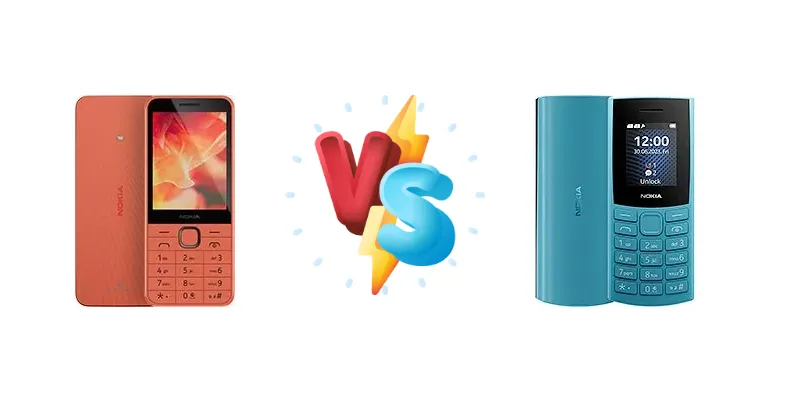
The Nokia 220 4G (2024) and Nokia 105 4G (2023) represent the continuing demand for reliable, affordable 4G feature phones. While both cater to the same basic connectivity needs, the 220 4G introduces a newer chipset, potentially offering a performance edge. This comparison dissects the differences to help you choose the right device for essential communication.
🏆 Quick Verdict
For most users, the Nokia 220 4G (2024) is the better choice. The inclusion of the Unisoc T107 chipset, even at 1.0 GHz, provides a demonstrable performance advantage over the Nokia 105 4G, which lacks detailed chipset information, suggesting a potentially older or less capable platform. This translates to a smoother user experience, especially when utilizing 4G data.
| Network |
|---|
| 2G bands | GSM 850 / 900 / 1800 / 1900 | GSM 900 / 1800 |
| 3G bands | HSDPA 850 / 900 / 2100 | HSDPA 850 / 900 / 1700(AWS) / 1900 / 2100 |
| 4G bands | 1, 3, 5, 8, 28, 38, 39, 40, 41 - IN, CN | LTE |
| Speed | HSPA, LTE | HSPA, LTE |
| Technology | GSM / HSPA / LTE | GSM / HSPA / LTE |
| | - | HSDPA 850 / 900 / 2100 |
| Launch |
|---|
| Announced | 2024, June 25 | 2023, May 18 |
| Status | Available. Released 2024, June 25 | Available. Released 2023, June |
| Body |
|---|
| Dimensions | 127.3 x 54.2 x 11.6 mm (5.01 x 2.13 x 0.46 in) | 121.5 x 50 x 14.4 mm (4.78 x 1.97 x 0.57 in) |
| SIM | Nano-SIM + Nano-SIM | · Nano-SIM· Nano-SIM + Nano-SIM |
| Weight | - | 93 g (3.28 oz) |
| | - | Flashlight
Splash resistant |
| Display |
|---|
| Resolution | 240 x 320 pixels, 4:3 ratio (~143 ppi density) | 120 x 160 pixels, 4:3 ratio (~111 ppi density) |
| Size | 2.8 inches, 24.3 cm2 (~35.2% screen-to-body ratio) | 1.8 inches, 10.0 cm2 (~16.5% screen-to-body ratio) |
| Type | TFT LCD | IPS LCD |
| Platform |
|---|
| CPU | 1.0 GHz Cortex-A7 | - |
| Chipset | Unisoc T107 (22 nm) | - |
| Memory |
|---|
| Call records | Yes | Yes |
| Card slot | microSDHC | microSDHC |
| Internal | 128MB 64MB RAM | Unspecified |
| Phonebook | Yes | Yes |
| Sound |
|---|
| 3.5mm jack | - | Yes |
| 35mm jack | Yes | Yes |
| Loudspeaker | Yes | Yes |
| Comms |
|---|
| Bluetooth | 5.0, A2DP, LE | 5.0, A2DP |
| NFC | No | No |
| Positioning | No | No |
| Radio | Wireless FM radio | Wireless FM radio |
| USB | USB Type-C | microUSB 2.0 |
| WLAN | No | No |
| Features |
|---|
| Games | Yes | Yes |
| Java | No | No |
| Messaging | SMS | SMS |
| Sensors | No | - |
| | - | MP3 player |
| Battery |
|---|
| Type | Li-Ion 1450 mAh, removable | Li-Ion 1450 mAh, removable |
| Misc |
|---|
| Colors | Black, Peach | Charcoal, Ocean Blue |
| Price | About 40 EUR | About 40 EUR |
Nokia 220 4G (2024)
- Newer Unisoc T107 chipset offers improved performance.
- Potentially better power efficiency due to 22nm process.
- Likely to receive longer software support.
- Still a basic feature phone with limited functionality.
- Display quality is likely to be minimal.
Nokia 105 4G (2023)
- Extremely affordable price point.
- Long battery life (typical of feature phones).
- Simple and easy to use interface.
- Likely slower performance due to older chipset.
- Limited features and functionality.
Display Comparison
Neither device boasts a sophisticated display. Both are likely to feature basic color screens with resolutions sufficient for text and simple icons. Without specific display specs for the Nokia 105 4G, it's reasonable to assume the Nokia 220 4G, being a newer model, may offer slightly improved color reproduction or viewing angles. However, neither will compete with smartphone displays in terms of brightness or clarity.
Camera Comparison
Both devices are unlikely to offer compelling camera experiences. Feature phones typically include basic cameras for occasional snapshots. Given the focus on affordability, image quality will be limited. It's safe to assume both feature cameras with low megapixel counts and minimal image processing capabilities. A detailed comparison is difficult without specific camera specs for either device.
Performance
The Nokia 220 4G’s Unisoc T107 (22nm) chipset with a 1.0 GHz Cortex-A7 CPU is the defining performance difference. The 22nm fabrication process, while not cutting-edge, is more efficient than older nodes likely used in the Nokia 105 4G. The Cortex-A7 architecture, while dated, provides a baseline level of processing power for basic tasks. The Nokia 105 4G, lacking published chipset details, likely relies on a significantly less powerful processor, resulting in slower menu navigation and app loading times. This difference is crucial for users who intend to utilize 4G data for even light browsing.
Battery Life
Battery life is a key strength of feature phones. While specific mAh ratings are unavailable for either device, the Unisoc T107’s 22nm process in the Nokia 220 4G suggests potentially improved power efficiency compared to the Nokia 105 4G’s unknown chipset. This could translate to slightly longer standby times, but both devices should easily last several days on a single charge with moderate use. Charging times will likely be similar, given the use of basic charging technology in both models.
Buying Guide
Buy the Nokia 220 4G (2024) if you prioritize a slightly more responsive user experience and future-proofing with a newer chipset. This is ideal for users who occasionally browse the web or use basic apps. Buy the Nokia 105 4G (2023) if you are seeking the absolute lowest price point and only require basic calling and texting functionality, and are comfortable with potentially slower performance.
Frequently Asked Questions
❓ Will the Nokia 220 4G (2024) handle WhatsApp reliably?
While the Unisoc T107 chipset is capable of running basic apps like WhatsApp, performance will be limited. Expect slower loading times and occasional lag, especially when sending media. It's functional for text-based communication, but not ideal for heavy WhatsApp usage.
❓ Does the Nokia 105 4G (2023) support VoLTE calling?
Given its 4G connectivity, the Nokia 105 4G likely supports VoLTE (Voice over LTE) calling, allowing for higher quality voice calls over the 4G network. However, compatibility depends on your carrier, so it's best to check with your provider to confirm.
❓ Can I expand the storage on either the Nokia 220 4G or Nokia 105 4G?
Both devices typically support microSD card expansion, allowing you to increase storage for contacts, messages, and media. The maximum supported microSD card capacity will vary, so check the device specifications for details.