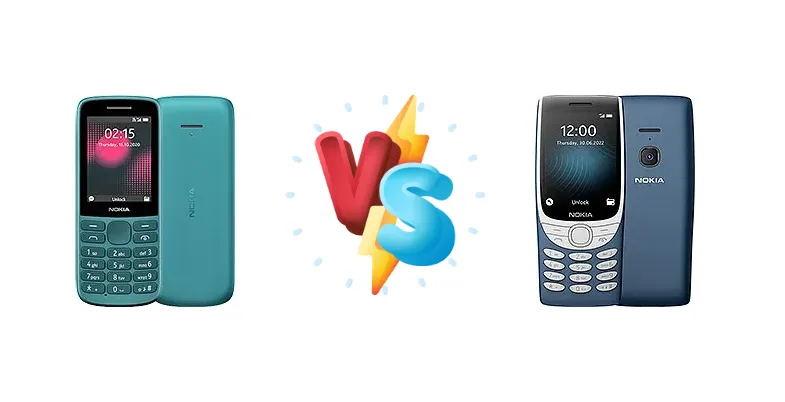
The Nokia 215 4G and Nokia 8210 4G represent a resurgence of affordable, reliable feature phones with 4G connectivity. While both cater to users seeking basic communication and long battery life, they differ significantly in their underlying hardware, impacting performance and usability. This comparison dissects those differences to determine which phone offers the best value for your money.
🏆 Quick Verdict
For the average user prioritizing a slightly smoother experience and a more modern chipset, the Nokia 8210 4G is the better choice. Its Unisoc T107, while still entry-level, offers a performance edge over the 215 4G’s UMS9117, translating to quicker app loading and a more responsive interface. However, the 215 4G remains a viable option for those on the tightest budgets.
| Network |
|---|
| 2G bands | GSM 850 / 900 / 1800 / 1900 | GSM 850 / 900 / 1800 / 1900 |
| 3G bands | HSDPA 850 / 900 / 2100 - International | HSDPA 850 / 900 / 2100 - International |
| 4G bands | 1, 3, 5, 7, 8, 20, 38, 40 - EU, APAC, SSA | 1, 3, 5, 7, 8, 20 - APAC, EU, RUCIS |
| Speed | HSPA, LTE | HSPA, LTE |
| Technology | GSM / HSPA / LTE | GSM / HSPA / LTE |
| | 2, 3, 4, 5, 7, 12, 13, 17, 28 - NA, LATAM | 1, 2, 3, 4, 5, 7, 8, 28, 40 - LATAM |
| Launch |
|---|
| Announced | 2020, October 10. Released 2020, October 17 | 2022, July 12 |
| Status | Discontinued | Available. Released 2022, July 28 |
| Body |
|---|
| Dimensions | 124.7 x 51 x 13.7 mm (4.91 x 2.01 x 0.54 in) | 131.3 x 56.2 x 13.8 mm (5.17 x 2.21 x 0.54 in) |
| SIM | · Nano-SIM· Nano-SIM + Nano-SIM | · Nano-SIM· Nano-SIM + Nano-SIM |
| Weight | 90.3 g (3.17 oz) | 107 g (3.77 oz) |
| Display |
|---|
| Resolution | 240 x 320 pixels, 4:3 ratio (~167 ppi density) | 240 x 320 pixels, 4:3 ratio (~143 ppi density) |
| Size | 2.4 inches, 17.8 cm2 (~28.0% screen-to-body ratio) | 2.8 inches, 24.3 cm2 (~32.9% screen-to-body ratio) |
| Type | TFT LCD, 256K colors | TFT LCD |
| Platform |
|---|
| CPU | - | 1.0 GHz Cortex-A7 |
| Chipset | Unisoc UMS9117 | Unisoc T107 (22 nm) |
| Memory |
|---|
| Call records | Yes | Yes |
| Card slot | microSDHC | microSDHC |
| Internal | 128MB 64MB RAM | 128MB 48MB RAM |
| Phonebook | Yes | Yes |
| Main Camera |
|---|
| Features | - | LED flash |
| Single | - | 0.3 MP |
| Video | - | Unspecified |
| Sound |
|---|
| 3.5mm jack | Yes | Yes |
| 35mm jack | Yes | Yes |
| Loudspeaker | Yes | Yes |
| Comms |
|---|
| Bluetooth | 5.0 | 5.0, A2DP, LE |
| NFC | No | No |
| Positioning | No | No |
| Radio | FM radio, built-in antenna | Wireless FM radio |
| USB | microUSB 2.0 | microUSB 2.0 |
| WLAN | No | No |
| Features |
|---|
| Games | Yes | Yes |
| Java | - | No |
| Messaging | SMS(threaded view), MMS, IM | SMS, MMS |
| | MP3 player | - |
| Battery |
|---|
| Type | Li-Ion 1150 mAh, removable | Li-Ion 1450 mAh, removable |
| Misc |
|---|
| Colors | Black, Cyan Green | Sand, Blue, Red |
| Models | TA-1284, TA-1281, TA-1272, TA-1264 | TA-1507, TA-1494, TA-1489, TA-1485, TA-1483 |
| Price | About 40 EUR | About 170 EUR |
| SAR | 1.14 W/kg (head) 1.35 W/kg (body) | 0.98 W/kg (head) 1.34 W/kg (body) |
| SAR EU | 1.63 W/kg (head) 1.79 W/kg (body) | 0.98 W/kg (head) 1.43 W/kg (body) |
Nokia 215 4G
- Extremely affordable price point
- Excellent battery life (expected)
- Simple and easy to use interface
- Less powerful chipset (Unisoc UMS9117)
- Slower app loading times
- Limited functionality
Nokia 8210 4G
- More powerful chipset (Unisoc T107)
- Slightly smoother user experience
- More responsive interface
- Slightly higher price than the 215 4G
- Battery life may be marginally shorter (though still excellent)
- Still a basic feature phone with limited capabilities
Display Comparison
Both devices feature relatively small displays, typical of feature phones. Specific display specs (resolution, panel type) are not provided, but the focus is on legibility and power efficiency. The Nokia 8210 4G’s slightly more modern chipset *could* allow for more efficient display driving, potentially extending battery life during prolonged use. However, without detailed display specs, a definitive comparison is impossible.
Camera Comparison
Both phones likely feature basic cameras, and detailed specifications are scarce. Given the target market, image quality is not a primary focus. It's safe to assume both cameras are adequate for basic snapshots in good lighting conditions, but will struggle in low light. Without specific sensor sizes or aperture information, a meaningful comparison is impossible. The presence of a camera is more about convenience than photographic excellence.
Performance
The core difference lies in the chipsets. The Nokia 215 4G utilizes the Unisoc UMS9117, a basic chipset designed for minimal power consumption. The Nokia 8210 4G steps up to the Unisoc T107, fabricated on a 22nm process and featuring a 1.0 GHz Cortex-A7 CPU. This represents a significant architectural improvement; the Cortex-A7, while still an older core, is demonstrably more capable than the cores found in the UMS9117. This translates to faster app launch times, smoother scrolling, and a more responsive user interface, particularly noticeable when using apps like WhatsApp or a basic web browser. The 22nm process also suggests better power efficiency compared to potentially older nodes used in the UMS9117.
Battery Life
Battery capacity details are not provided for either device. However, feature phones with basic chipsets like these are known for exceptional battery life. The more efficient Unisoc T107 in the Nokia 8210 4G *could* translate to slightly longer standby times, but the difference is likely to be marginal. Both phones should easily last several days on a single charge with moderate use, primarily consisting of calls and texts.
Buying Guide
Buy the Nokia 215 4G if you need an incredibly affordable phone primarily for calls and texts, and battery life is your absolute top priority. Buy the Nokia 8210 4G if you prefer a slightly more responsive user experience, appreciate a more modern chipset architecture, and are willing to spend a little extra for improved performance in basic apps like WhatsApp or web browsing.
Frequently Asked Questions
❓ Will the Nokia 8210 4G handle WhatsApp reliably?
Yes, the Unisoc T107 chipset in the Nokia 8210 4G provides enough processing power to run WhatsApp smoothly for basic messaging and calls. While it won't offer the same experience as a smartphone, it's a significant improvement over the 215 4G for app-based communication.
❓ How much faster is the Nokia 8210 4G compared to the 215 4G in real-world use?
The difference isn't dramatic, but noticeable. The 8210 4G will launch apps (like WhatsApp or a basic web browser) faster and scrolling will be smoother. The UMS9117 in the 215 4G can feel sluggish, especially when multitasking. The 8210 4G offers a more responsive experience overall.
❓ Can I use mobile hotspot functionality on either of these phones?
Both the Nokia 215 4G and Nokia 8210 4G support mobile hotspot functionality, allowing you to share your 4G connection with other devices. However, performance will be limited by the chipset and available bandwidth.