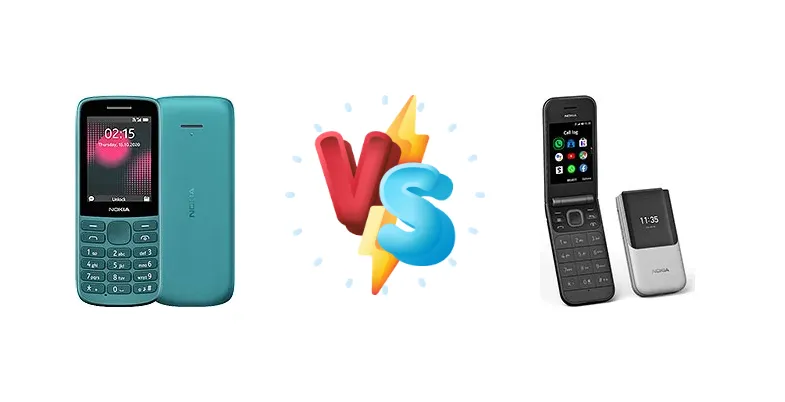
In a world dominated by smartphones, Nokia continues to cater to a niche market with its reliable and affordable feature phones. The Nokia 215 4G and Nokia 2720 Flip represent two distinct approaches to this segment – a traditional candybar design versus a nostalgic flip phone form factor. This comparison dissects their internal hardware and usability to determine which device best suits users prioritizing simplicity and longevity.
🏆 Quick Verdict
For the average user seeking a dependable, long-lasting feature phone with basic 4G connectivity, the Nokia 215 4G emerges as the better choice. Its Unisoc UMS9117 chipset, while not powerful, is more modern than the Snapdragon 205 in the 2720 Flip, potentially offering slightly better efficiency and future-proofing.
| Network |
|---|
| 2G bands | GSM 850 / 900 / 1800 / 1900 | GSM 850 / 900 / 1800 / 1900 |
| 3G bands | HSDPA 850 / 900 / 2100 - International | HSDPA 850 / 900 / 2100 |
| 4G bands | 1, 3, 5, 7, 8, 20, 38, 40 - EU, APAC, SSA | 1, 3, 5, 7, 8, 20 - EU |
| Speed | HSPA, LTE | HSPA 42.2/5.76 Mbps, LTE Cat4 150/50 Mbps |
| Technology | GSM / HSPA / LTE | GSM / HSPA / LTE |
| | 2, 3, 4, 5, 7, 12, 13, 17, 28 - NA, LATAM | 1, 3, 5, 7, 8, 20, 28, 38, 39, 40, 41 - MENA, APAC, GCR |
| Launch |
|---|
| Announced | 2020, October 10. Released 2020, October 17 | 2019, September 05. Released 2019, September 05 |
| Status | Discontinued | Discontinued |
| Body |
|---|
| Dimensions | 124.7 x 51 x 13.7 mm (4.91 x 2.01 x 0.54 in) | 192.7 x 54.5 x 11.6 mm (7.59 x 2.15 x 0.46 in) |
| SIM | · Nano-SIM· Nano-SIM + Nano-SIM | · Nano-SIM· Nano-SIM + Nano-SIM |
| Weight | 90.3 g (3.17 oz) | 118 g (4.16 oz) |
| Display |
|---|
| Resolution | 240 x 320 pixels, 4:3 ratio (~167 ppi density) | 240 x 320 pixels, 4:3 ratio (~143 ppi density) |
| Size | 2.4 inches, 17.8 cm2 (~28.0% screen-to-body ratio) | 2.8 inches, 24.3 cm2 (~23.1% screen-to-body ratio) |
| Type | TFT LCD, 256K colors | TFT LCD, 256K colors |
| | - | Second external TFT display, 240 x 240 pixels, 1.3 inches |
| Platform |
|---|
| CPU | - | Dual-core (2x1.1 GHz Cortex-A7) |
| Chipset | Unisoc UMS9117 | Qualcomm MSM8905 Snapdragon 205 (28 nm) |
| GPU | - | Adreno 304 |
| OS | - | KaiOS 2.5.2 |
| Memory |
|---|
| Call records | Yes | - |
| Card slot | microSDHC | microSDHC (dedicated slot) |
| Internal | 128MB 64MB RAM | 4GB 512MB |
| Phonebook | Yes | - |
| | - | eMMC 4.5 |
| Main Camera |
|---|
| Features | - | LED flash |
| Single | - | 2 MP |
| Video | - | Yes |
| Sound |
|---|
| 3.5mm jack | Yes | Yes |
| 35mm jack | Yes | Yes |
| Loudspeaker | Yes | Yes |
| Comms |
|---|
| Bluetooth | 5.0 | 4.2, A2DP, LE |
| NFC | No | No |
| Positioning | No | GPS, GLONASS |
| Radio | FM radio, built-in antenna | FM radio |
| USB | microUSB 2.0 | microUSB 2.0 |
| WLAN | No | Wi-Fi 802.11 b/g/n, hotspot |
| Features |
|---|
| Games | Yes | - |
| Messaging | SMS(threaded view), MMS, IM | - |
| | MP3 player | SNS applications
MP4/H.264 player
MP3/WAV/AAC player
Organizer
Voice memo
Predictive text input |
| Battery |
|---|
| Stand-by | - | Up to 700 h (3G) |
| Type | Li-Ion 1150 mAh, removable | Li-Ion 1500 mAh, removable |
| Misc |
|---|
| Colors | Black, Cyan Green | Black, Gray, Red |
| Models | TA-1284, TA-1281, TA-1272, TA-1264 | TA-1175, TA-1173, TA-1170, TA-1168 |
| Price | About 40 EUR | About 140 EUR |
| SAR | 1.14 W/kg (head) 1.35 W/kg (body) | 0.87 W/kg (head) 1.10 W/kg (body) |
| SAR EU | 1.63 W/kg (head) 1.79 W/kg (body) | 1.03 W/kg (head) 1.69 W/kg (body) |
Nokia 215 4G
- More modern chipset (Unisoc UMS9117) potentially offering better efficiency.
- Generally longer battery life in standby mode.
- Simpler, more durable candybar design.
- Lacks the nostalgic appeal of a flip phone.
- Display is more susceptible to scratches.
Nokia 2720 Flip
- Compact and pocketable flip phone form factor.
- Dual-screen design for quick notifications.
- Tactile satisfaction of physically ending calls.
- Older Snapdragon 205 chipset.
- Potentially shorter battery life during active use.
- More complex mechanism prone to wear and tear.
Display Comparison
Both phones feature relatively small displays, prioritizing battery life over visual immersion. The Nokia 2720 Flip’s internal display benefits from the protective nature of the flip design, reducing the risk of accidental scratches. However, neither device specifies display brightness in nits, suggesting they are optimized for indoor use rather than direct sunlight readability. The 2720 Flip’s dual-screen setup (external and internal) adds a layer of convenience for quick glances at notifications without opening the phone.
Camera Comparison
Both phones feature cameras, but their capabilities are extremely limited and should not be considered a primary purchasing factor. Details regarding sensor size and image quality are scarce, but given the target market, image quality is likely comparable – sufficient for basic snapshots but lacking in detail and low-light performance. The 2720 Flip’s camera is primarily for nostalgic use, while the 215 4G’s camera serves a similar, basic function.
Performance
The core difference lies in the chipsets. The Nokia 2720 Flip utilizes the Qualcomm MSM8905 Snapdragon 205, a 28nm process node chip with a dual-core 1.1 GHz Cortex-A7 CPU. This is a relatively older architecture. Conversely, the Nokia 215 4G is powered by the Unisoc UMS9117. While Unisoc’s architecture isn’t as widely benchmarked, the absence of a process node specification suggests a more recent design, potentially offering improved power efficiency despite lacking the Snapdragon’s brand recognition. The 2720 Flip’s dual-core CPU will handle basic tasks, but the 215 4G may exhibit slightly smoother performance in app loading and web browsing due to the newer chipset.
Battery Life
Battery life is a key strength of both devices. The Nokia 215 4G typically boasts longer standby times due to its simpler design and potentially more efficient chipset. The Nokia 2720 Flip’s flip design offers some battery protection when closed, but the Snapdragon 205’s older architecture may consume more power during active use. Neither phone supports fast charging; both rely on micro-USB for charging, and a full charge will likely take several hours.
Buying Guide
Buy the Nokia 215 4G if you need a straightforward, durable phone for calls and texts with reliable 4G access and a longer potential software support window. Buy the Nokia 2720 Flip if you prioritize the compact, pocketable form factor of a flip phone and enjoy the tactile experience of physically ending calls with the satisfying 'snap' of the clamshell design.
Frequently Asked Questions
❓ Will the Nokia 2720 Flip’s Snapdragon 205 struggle with modern 4G networks?
While the Snapdragon 205 supports 4G, it's an older chipset. It will function on most 4G networks, but you might experience slower data speeds compared to devices with newer modems, especially in areas with network congestion. The Unisoc UMS9117 in the 215 4G, being a more recent design, may offer slightly better 4G performance.
❓ Is the Nokia 215 4G a good choice for someone who primarily needs a phone for emergency calls?
Absolutely. The Nokia 215 4G excels as a reliable emergency phone. Its long battery life ensures it will remain functional for extended periods without needing a charge, and its durable construction can withstand harsh conditions. The 4G connectivity also allows for clearer call quality and faster access to emergency services.
❓ Can I use WhatsApp or Facebook on either of these phones?
Limited functionality is available. Both phones support basic Java apps, and older versions of WhatsApp and Facebook were available for Java feature phones. However, these versions are extremely limited in features and may no longer be supported by the respective platforms. Don't expect a smartphone-like experience.