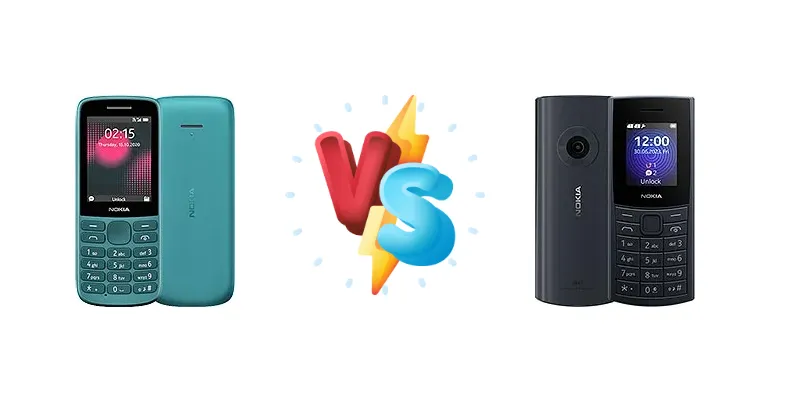
In a market saturated with expensive smartphones, Nokia continues to cater to a different segment with its line of feature phones. We're pitting the Nokia 215 4G against the Nokia 110 4G 2nd Edition, two of the most affordable 4G-enabled devices available. This comparison isn't about raw power; it's about understanding which phone delivers the best experience for basic communication and essential features within a very tight budget.
🏆 Quick Verdict
For users prioritizing a slightly more responsive experience and access to apps via the Opera Mini store, the Nokia 215 4G is the better choice, thanks to its Unisoc UMS9117 chipset. However, if absolute simplicity and potentially longer standby time are paramount, the Nokia 110 4G 2nd Edition remains a viable option.
| Network |
|---|
| 2G bands | GSM 850 / 900 / 1800 / 1900 | GSM 900 / 1800 |
| 3G bands | HSDPA 850 / 900 / 2100 - International | HSDPA 850 / 900 / 1700(AWS) / 1900 / 2100 |
| 4G bands | 1, 3, 5, 7, 8, 20, 38, 40 - EU, APAC, SSA | LTE |
| Speed | HSPA, LTE | HSPA, LTE |
| Technology | GSM / HSPA / LTE | GSM / HSPA / LTE |
| | 2, 3, 4, 5, 7, 12, 13, 17, 28 - NA, LATAM | - |
| Launch |
|---|
| Announced | 2020, October 10. Released 2020, October 17 | 2024, December |
| Status | Discontinued | Available. Released 2024, December |
| Body |
|---|
| Dimensions | 124.7 x 51 x 13.7 mm (4.91 x 2.01 x 0.54 in) | 121.5 x 50 x 14.4 mm (4.78 x 1.97 x 0.57 in) |
| SIM | · Nano-SIM· Nano-SIM + Nano-SIM | · Nano-SIM· Nano-SIM + Nano-SIM |
| Weight | 90.3 g (3.17 oz) | 94.5 g (3.35 oz) |
| Display |
|---|
| Resolution | 240 x 320 pixels, 4:3 ratio (~167 ppi density) | 120 x 160 pixels, 4:3 ratio (~111 ppi density) |
| Size | 2.4 inches, 17.8 cm2 (~28.0% screen-to-body ratio) | 1.8 inches, 10.0 cm2 (~16.5% screen-to-body ratio) |
| Type | TFT LCD, 256K colors | IPS LCD |
| Platform |
|---|
| Chipset | Unisoc UMS9117 | - |
| Memory |
|---|
| Call records | Yes | Yes |
| Card slot | microSDHC | microSDHC |
| Internal | 128MB 64MB RAM | 48MB 128MB RAM |
| Phonebook | Yes | Yes |
| Main Camera |
|---|
| Single | - | QVGA |
| Video | - | Yes |
| Sound |
|---|
| 3.5mm jack | Yes | - |
| 35mm jack | Yes | Yes |
| Loudspeaker | Yes | Yes |
| Comms |
|---|
| Bluetooth | 5.0 | 5.0, A2DP |
| NFC | No | No |
| Positioning | No | No |
| Radio | FM radio, built-in antenna | Wireless FM radio |
| USB | microUSB 2.0 | USB Type-C |
| WLAN | No | No |
| Features |
|---|
| Games | Yes | Yes |
| Java | - | No |
| Messaging | SMS(threaded view), MMS, IM | SMS |
| | MP3 player | - |
| Battery |
|---|
| Type | Li-Ion 1150 mAh, removable | Li-Ion 1450 mAh, removable |
| Misc |
|---|
| Colors | Black, Cyan Green | Midnight Blue, Arctic Purple |
| Models | TA-1284, TA-1281, TA-1272, TA-1264 | - |
| Price | About 40 EUR | About 60 EUR |
| SAR | 1.14 W/kg (head) 1.35 W/kg (body) | - |
| SAR EU | 1.63 W/kg (head) 1.79 W/kg (body) | - |
Nokia 215 4G
- Faster processor (Unisoc UMS9117) for smoother app usage
- Access to Opera Mini app store for expanded functionality
- Slightly more versatile due to app support
- Slightly shorter battery life compared to the 110 4G 2nd Edition
- Higher price point than the 110 4G 2nd Edition
Nokia 110 4G 2nd Edition
- Longer standby time due to simpler hardware
- Extremely affordable price
- Very easy to use, ideal for first-time mobile users
- Limited functionality compared to the 215 4G
- Slower performance and less responsive interface
Display Comparison
Both devices feature relatively small displays typical of feature phones. While specific display resolutions aren't available for the Nokia 110 4G 2nd Edition, it's reasonable to assume a similar QVGA resolution to the Nokia 215 4G. The focus isn't on visual fidelity, but on readability for basic text and menu navigation. Bezels are substantial on both, prioritizing durability and ease of grip over maximizing screen real estate. Color accuracy is unlikely to be a key consideration for either device.
Camera Comparison
Both phones feature cameras, but their utility is limited. The Nokia 215 4G is equipped with a VGA camera, while the Nokia 110 4G 2nd Edition also features a VGA camera. Image quality will be basic, suitable for quick snapshots in good lighting conditions. Don't expect detailed photos or low-light performance. The cameras are primarily for convenience, not for serious photography.
Performance
The Nokia 215 4G distinguishes itself with the Unisoc UMS9117 chipset. This provides a noticeable performance advantage over the likely simpler processor within the Nokia 110 4G 2nd Edition. While neither phone is capable of demanding tasks, the UMS9117 allows for smoother operation of pre-installed apps like Opera Mini and potentially faster web browsing. RAM capacity is likely similar on both, but the chipset architecture is the defining factor. Thermal management isn't a concern given the low power draw of these devices.
Battery Life
Both devices boast impressive standby times, typical of feature phones. The Nokia 215 4G has a 1300mAh battery, while the Nokia 110 4G 2nd Edition has a 1450mAh battery. While the Nokia 110 4G 2nd Edition has a larger capacity, the more powerful Unisoc UMS9117 in the 215 4G will consume more power. Real-world usage will dictate which phone lasts longer, but the 110 4G 2nd Edition likely has an edge in standby duration.
Buying Guide
Buy the Nokia 215 4G if you need basic smartphone-like functionality – access to WhatsApp, Facebook, and YouTube via Opera Mini – and a slightly smoother user interface. Buy the Nokia 110 4G 2nd Edition if you prefer an extremely simple device focused solely on calls and texts, with potentially longer battery life due to reduced processing demands and a more streamlined software experience.
Frequently Asked Questions
❓ Will the Nokia 215 4G run WhatsApp reliably?
Yes, the Nokia 215 4G can run a version of WhatsApp via the Opera Mini browser. However, it's not the native app experience you'd find on a smartphone. Expect a simplified interface and potentially slower loading times. It's functional for basic messaging but not ideal for heavy usage.
❓ How much faster is the Nokia 215 4G compared to older feature phones?
The Unisoc UMS9117 chipset in the Nokia 215 4G provides a significant speed boost over older, non-4G feature phones. This translates to faster web browsing (via Opera Mini), quicker app loading, and a more responsive user interface. While still not comparable to a smartphone, it's a noticeable improvement for basic tasks.
❓ Is the Nokia 110 4G 2nd Edition a good choice for someone who only needs a phone for calls and texts?
Absolutely. The Nokia 110 4G 2nd Edition excels as a basic communication device. Its simplicity, long battery life, and affordable price make it ideal for users who primarily need a phone for making calls and sending texts, without the distractions of smartphone features.