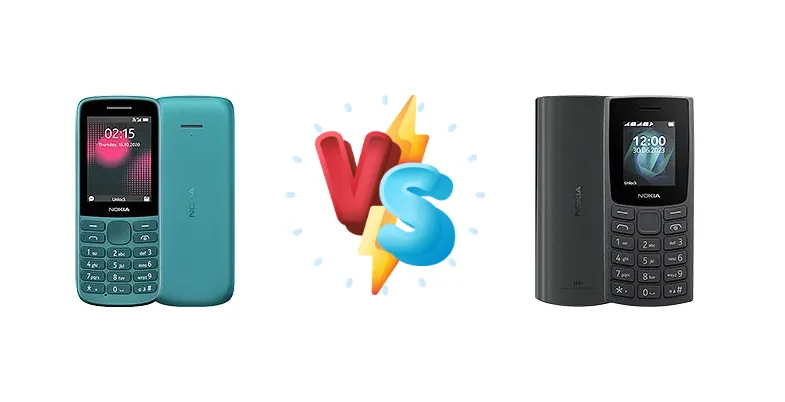
In a market saturated with expensive smartphones, Nokia continues to cater to a segment often overlooked: users needing reliable, affordable 4G connectivity in a classic feature phone form factor. We pit the Nokia 215 4G, powered by a Unisoc chipset, against the Nokia 105 4G 2nd Edition to determine which offers the best value for those prioritizing call quality, battery life, and basic functionality over app ecosystems.
🏆 Quick Verdict
For users needing a slight performance edge and access to more apps (even limited ones), the Nokia 215 4G is the better choice thanks to its Unisoc UMS9117 chipset. However, if absolute simplicity and potentially longer standby time are paramount, the Nokia 105 4G 2nd Edition remains a viable option.
| Network |
|---|
| 2G bands | GSM 850 / 900 / 1800 / 1900 | GSM 900 / 1800 |
| 3G bands | HSDPA 850 / 900 / 2100 - International | HSDPA 850 / 900 / 1700(AWS) / 1900 / 2100 |
| 4G bands | 1, 3, 5, 7, 8, 20, 38, 40 - EU, APAC, SSA | LTE |
| Speed | HSPA, LTE | HSPA, LTE |
| Technology | GSM / HSPA / LTE | GSM / HSPA / LTE |
| | 2, 3, 4, 5, 7, 12, 13, 17, 28 - NA, LATAM | - |
| Launch |
|---|
| Announced | 2020, October 10. Released 2020, October 17 | 2024, December |
| Status | Discontinued | Available. Released 2024, December |
| Body |
|---|
| Dimensions | 124.7 x 51 x 13.7 mm (4.91 x 2.01 x 0.54 in) | 121.5 x 50 x 14.4 mm (4.78 x 1.97 x 0.57 in) |
| SIM | · Nano-SIM· Nano-SIM + Nano-SIM | · Nano-SIM· Nano-SIM + Nano-SIM |
| Weight | 90.3 g (3.17 oz) | 93 g (3.28 oz) |
| Display |
|---|
| Resolution | 240 x 320 pixels, 4:3 ratio (~167 ppi density) | 120 x 160 pixels, 4:3 ratio (~111 ppi density) |
| Size | 2.4 inches, 17.8 cm2 (~28.0% screen-to-body ratio) | 1.8 inches, 10.0 cm2 (~16.5% screen-to-body ratio) |
| Type | TFT LCD, 256K colors | IPS LCD |
| Platform |
|---|
| Chipset | Unisoc UMS9117 | - |
| Memory |
|---|
| Call records | Yes | Yes |
| Card slot | microSDHC | microSDHC |
| Internal | 128MB 64MB RAM | 48MB 128MB RAM |
| Phonebook | Yes | Yes |
| Sound |
|---|
| 3.5mm jack | Yes | - |
| 35mm jack | Yes | Yes |
| Loudspeaker | Yes | Yes |
| Comms |
|---|
| Bluetooth | 5.0 | 5.0, A2DP |
| NFC | No | No |
| Positioning | No | No |
| Radio | FM radio, built-in antenna | Wireless FM radio |
| USB | microUSB 2.0 | USB Type-C |
| WLAN | No | No |
| Features |
|---|
| Games | Yes | Yes |
| Java | - | No |
| Messaging | SMS(threaded view), MMS, IM | SMS |
| | MP3 player | - |
| Battery |
|---|
| Type | Li-Ion 1150 mAh, removable | Li-Ion 1450 mAh, removable |
| Misc |
|---|
| Colors | Black, Cyan Green | Charcoal |
| Models | TA-1284, TA-1281, TA-1272, TA-1264 | - |
| Price | About 40 EUR | About 50 EUR |
| SAR | 1.14 W/kg (head) 1.35 W/kg (body) | - |
| SAR EU | 1.63 W/kg (head) 1.79 W/kg (body) | - |
Nokia 215 4G
- Unisoc UMS9117 offers basic app support (WhatsApp, Opera Mini)
- Slightly larger 1100mAh battery
- 4G connectivity for faster data speeds
- QVGA display resolution is low
- Limited internal storage
Nokia 105 4G 2nd Edition
- Extremely simple and easy to use
- Potentially longer standby time due to simpler chipset
- Very affordable price point
- Limited functionality – no app support beyond basic features
- Unspecified chipset likely offers minimal performance
Display Comparison
Both the Nokia 215 4G and 105 4G 2nd Edition feature relatively small displays, likely utilizing TFT LCD technology given their price point. Specific resolution and size details for the 105 4G 2nd Edition are unavailable, but it's reasonable to assume they are comparable to the 215 4G’s 2.4-inch QVGA display. The lack of detailed display specifications suggests neither phone is geared towards media consumption; their displays are purely functional for navigating menus and reading text. Bezels are expected to be substantial on both models, maximizing grip and durability.
Camera Comparison
Neither device is intended for serious photography. Both likely feature a basic VGA camera, sufficient for extremely low-resolution snapshots. Image quality will be poor in all lighting conditions. The absence of detailed camera specifications for either phone reinforces their focus on core communication features rather than imaging.
Performance
The key differentiator here is the chipset. The Nokia 215 4G utilizes the Unisoc UMS9117, a low-power processor designed for feature phones with 4G connectivity. While not a powerhouse, the UMS9117 enables basic app functionality like WhatsApp and Opera Mini. The Nokia 105 4G 2nd Edition’s chipset remains unspecified, but given its likely lower price point, it likely employs a simpler, less capable platform focused solely on voice and SMS. This translates to potentially longer standby times for the 105 4G, but a significantly slower and more limited user experience.
Battery Life
Both phones prioritize battery life, a critical feature for users seeking a reliable secondary device. The Nokia 215 4G has a 1100mAh battery, while the Nokia 105 4G 2nd Edition has a 1000mAh battery. While the 215 4G has a slightly larger capacity, the simpler chipset in the 105 4G 2nd Edition likely results in longer standby times. Charging times are expected to be slow via micro-USB on both devices, reflecting their budget nature.
Buying Guide
Buy the Nokia 215 4G if you need access to WhatsApp, basic internet browsing, and a slightly more responsive user experience. Its Unisoc chipset provides a marginal performance boost over the likely simpler platform in the 105 4G. Buy the Nokia 105 4G 2nd Edition if you prioritize extreme simplicity, maximum battery life for voice calls, and a truly no-frills experience – ideal for emergency use or those avoiding digital distractions.
Frequently Asked Questions
❓ Does the Nokia 215 4G support WhatsApp, and how well does it run?
Yes, the Nokia 215 4G supports WhatsApp thanks to its Unisoc UMS9117 chipset. However, performance will be basic. Expect slow loading times and limited functionality compared to a smartphone. It's suitable for occasional messaging, but not for heavy WhatsApp usage.
❓ What kind of SIM card does the Nokia 105 4G 2nd Edition use?
The Nokia 105 4G 2nd Edition uses a Micro-SIM card. This is a common SIM card format for feature phones, but it's important to ensure you have the correct size SIM card before purchasing the device.
❓ Can I browse the internet on either of these phones, and is it a good experience?
Both phones support 4G internet browsing, but the experience is extremely limited. The small screens and basic browsers (likely Opera Mini) make it suitable only for very simple tasks like checking email or reading short articles. Don't expect to stream videos or browse complex websites.