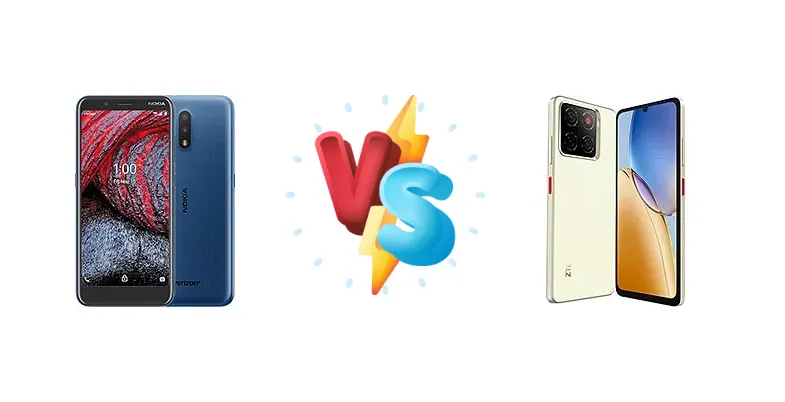
The sub-$150 smartphone market is fiercely competitive. Both the Nokia 2 V Tella and ZTE Blade A56 aim to deliver essential smartphone functionality at an accessible price point. However, they take distinctly different approaches to achieving this, with the ZTE prioritizing processing power and the Nokia focusing on a streamlined experience. This comparison will dissect their key specifications to determine which device offers the best value.
🏆 Quick Verdict
For the average user, the ZTE Blade A56 is the superior choice. Its Unisoc T7200 chipset, built on a more efficient 12nm process, delivers a noticeably faster and more responsive experience than the Nokia 2 V Tella’s Mediatek Helio A22. While both offer 10W charging, the ZTE’s impressive battery endurance makes it the winner.
| Network |
|---|
| 2G bands | GSM 850 / 900 / 1800 / 1900 | GSM 850 / 900 / 1800 / 1900 |
| 3G bands | HSDPA 850 / 1700(AWS) / 1900 | HSDPA 850 / 900 / 1900 / 2100 |
| 4G bands | LTE | 1, 3, 5, 7, 8, 20, 28, 38, 40, 41 |
| Speed | HSPA 42.2/5.76 Mbps, LTE Cat6 300/50 Mbps | HSPA, LTE |
| Technology | GSM / HSPA / LTE | GSM / HSPA / LTE |
| Launch |
|---|
| Announced | 2020, October 21. Released 2020, October 21 | 2025, June 11 |
| Status | Discontinued | Available. Released 2025, July |
| Body |
|---|
| Build | Glass front, plastic back, plastic frame | - |
| Dimensions | 150.6 x 71.6 x 9.1 mm (5.93 x 2.82 x 0.36 in) | 167.6 x 77.4 x 8.3 mm (6.60 x 3.05 x 0.33 in) |
| SIM | Nano-SIM | Nano-SIM + Nano-SIM |
| Weight | 180 g (6.35 oz) | 193 g (6.81 oz) |
| Display |
|---|
| Protection | - | Mohs level 4 |
| Resolution | 720 x 1440 pixels, 18:9 ratio (~295 ppi density) | 720 x 1600 pixels, 20:9 ratio (~260 ppi density) |
| Size | 5.45 inches, 76.7 cm2 (~71.1% screen-to-body ratio) | 6.75 inches, 110.0 cm2 (~84.8% screen-to-body ratio) |
| Type | IPS LCD | IPS LCD, 90Hz |
| Platform |
|---|
| CPU | Quad-core 2.0 GHz Cortex-A53 | Octa-core (2x1.6 GHz Cortex-A75 & 6x1.6 GHz Cortex-A55) |
| Chipset | Mediatek MT6761 Helio A22 (16 nm) | Unisoc T7200 (12 nm) |
| GPU | PowerVR GE8320 | Mali-G57 MP1 |
| OS | Android 10 | Android 15 |
| Memory |
|---|
| Card slot | microSDXC | microSDXC (dedicated slot) |
| Internal | 16GB 2GB RAM | 64GB 4GB RAM, 128GB 4GB RAM |
| | eMMC 5.1 | - |
| Main Camera |
|---|
| Dual | 8 MP, AF
2 MP | - |
| Features | LED flash, HDR, panorama | LED flash |
| Single | - | 13 MP, AF
Auxiliary lenses |
| Video | 1080p@30fps | 1080p@30fps |
| Selfie camera |
|---|
| Single | 5 MP | 8 MP |
| Video | 720p@30fps | Yes |
| Sound |
|---|
| 3.5mm jack | Yes | - |
| 35mm jack | Yes | Yes |
| Loudspeaker | Yes | Yes |
| Comms |
|---|
| Bluetooth | 4.2, A2DP, LE | 5.2, A2DP, LE |
| NFC | No | No |
| Positioning | GPS | GPS, GALILEO, GLONASS |
| Radio | FM radio | FM radio |
| USB | USB Type-C 2.0 | USB Type-C 2.0, OTG |
| WLAN | Wi-Fi 802.11 b/g/n | Wi-Fi 802.11 b/g/n |
| Features |
|---|
| Sensors | Accelerometer, proximity | Fingerprint (side-mounted), accelerometer |
| Battery |
|---|
| Charging | 10W wired | 10W wired |
| Type | Li-Po 3000 mAh, removable | Li-Po 5000 mAh |
| Misc |
|---|
| Colors | Blue | Black, Yellow |
| Models | - | Z2473 |
| Price | About 140 EUR | € 69.00 / $ 87.12 / £ 66.75 |
| EU LABEL |
|---|
| Battery | - | 56:03h endurance, 800 cycles |
| Energy | - | Class A |
| Free fall | - | Class D (80 falls) |
| Repairability | - | Class B |
Nokia 2 V Tella
- Clean Android experience (likely)
- Potentially more durable build quality (Nokia's reputation)
- Simple and easy to use
- Significantly weaker processor
- Less efficient chipset
- Likely shorter battery life
ZTE Blade A56
- Faster and more responsive processor
- Excellent battery endurance (56:03h)
- More efficient chipset (12nm)
- Software experience may be less refined
- Build quality may be less premium
- Potential for bloatware
Display Comparison
Neither device boasts a standout display. Details regarding panel type, resolution, and brightness are absent for both, suggesting both utilize basic LCD panels common in this price bracket. The focus here isn't on visual fidelity, but rather functional usability. Bezels are likely to be substantial on both, and color accuracy will be standard for budget devices. Without further data, it's safe to assume a similar viewing experience.
Camera Comparison
Camera performance is likely to be similar, leaning towards basic functionality on both devices. Specific sensor details are unavailable, but given the price point, expect modest image quality in good lighting conditions. The absence of Optical Image Stabilization (OIS) on either device suggests reliance on software processing for stabilization. The ZTE Blade A56’s more powerful processor *could* translate to slightly better image processing, but the difference will likely be minimal. Avoid expecting flagship-level camera capabilities from either phone.
Performance
The performance gap is the most significant differentiator. The ZTE Blade A56’s Unisoc T7200, fabricated on a 12nm process, features an octa-core configuration (2x1.6 GHz Cortex-A75 & 6x1.6 GHz Cortex-A55) offering a substantial advantage over the Nokia 2 V Tella’s quad-core 2.0 GHz Cortex-A53 processor built on a larger 16nm node. The Cortex-A75 cores in the ZTE provide a significant boost in single-core performance, crucial for app launch speeds and general responsiveness. The Unisoc’s more efficient process also translates to better thermal management, potentially reducing throttling during sustained workloads. The Nokia’s Helio A22 is adequate for basic tasks, but will struggle with demanding applications.
Battery Life
The ZTE Blade A56 shines in battery endurance, boasting a reported 56:03h endurance and 800 charge cycles. This suggests a larger battery capacity and optimized power management. While both phones support 10W wired charging, the ZTE’s superior endurance means users will need to charge less frequently. The Nokia 2 V Tella’s battery capacity is not specified, but given its less efficient chipset, it will likely require more frequent charging to achieve a comparable runtime.
Buying Guide
Buy the Nokia 2 V Tella if you prioritize simplicity and a clean Android experience, and your smartphone usage is limited to basic tasks like calls, texts, and light social media. Buy the ZTE Blade A56 if you need a phone capable of handling multitasking, streaming video, and occasional gaming without significant lag, and you value longer battery life between charges.
Frequently Asked Questions
❓ Is the Unisoc T7200 in the ZTE Blade A56 capable of playing modern mobile games?
While the Unisoc T7200 isn't a gaming powerhouse, it's significantly more capable than the Helio A22. It can handle less demanding titles and older games at medium settings. Expect some frame drops in graphically intensive games like PUBG or Genshin Impact, but it will provide a playable experience.
❓ How does the Nokia 2 V Tella's software experience compare to the ZTE Blade A56?
Nokia typically offers a cleaner, near-stock Android experience with fewer pre-installed apps (bloatware). ZTE's software experience may include more pre-installed apps and a customized user interface. Users who prefer a minimalist approach will likely favor the Nokia, while those who don't mind customization may find the ZTE acceptable.
❓ What is the expected lifespan of the ZTE Blade A56's battery, given its 800 charge cycle rating?
The 800 charge cycle rating suggests the ZTE Blade A56's battery is designed for longevity. Assuming one charge cycle per day, this translates to over two years of reliable battery performance before significant degradation is expected. This is a notable advantage over phones with lower-rated batteries.