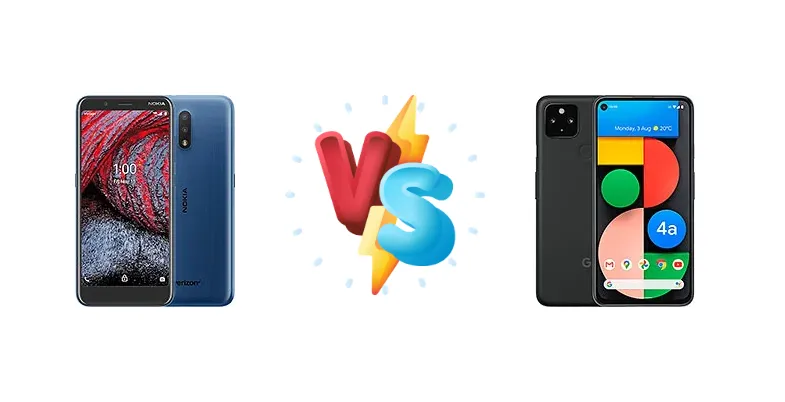
The Nokia 2 V Tella and Google Pixel 4a 5G represent different approaches to the budget 5G market. The Nokia prioritizes affordability, while the Pixel 4a 5G aims to deliver a more refined experience with a stronger emphasis on camera capabilities and processing power. This comparison dissects their key differences to help you determine which device best suits your needs.
🏆 Quick Verdict
For most users, the Google Pixel 4a 5G is the superior choice. Its Snapdragon 765G chipset provides significantly faster performance and smoother multitasking, while its camera system delivers noticeably better image quality. The Nokia 2 V Tella remains a viable option for those on an extremely tight budget who prioritize basic functionality.
| Network |
|---|
| 2G bands | GSM 850 / 900 / 1800 / 1900 | GSM 850 / 900 / 1800 / 1900 |
| 3G bands | HSDPA 850 / 1700(AWS) / 1900 | HSDPA 850 / 900 / 1700(AWS) / 1900 / 2100 |
| 4G bands | LTE | 1, 2, 3, 4, 5, 7, 8, 12, 13, 14, 17, 18, 19, 20, 25, 26, 28, 29, 30, 32, 38, 39, 40, 41, 42, 46, 48, 66, 71 |
| 5G bands | - | 1, 2, 3, 5, 7, 8, 12, 28, 41, 66, 71, 77, 78 Sub6, mmWave (market dependant) |
| Speed | HSPA 42.2/5.76 Mbps, LTE Cat6 300/50 Mbps | HSPA, LTE, 5G |
| Technology | GSM / HSPA / LTE | GSM / HSPA / LTE / 5G |
| Launch |
|---|
| Announced | 2020, October 21. Released 2020, October 21 | 2020, September 30 |
| Status | Discontinued | Available. Released 2020, November 05 |
| Body |
|---|
| Build | Glass front, plastic back, plastic frame | Glass front (Gorilla Glass 3), plastic back, plastic frame |
| Dimensions | 150.6 x 71.6 x 9.1 mm (5.93 x 2.82 x 0.36 in) | 153.9 x 74 x 8.2 mm (Sub-6) or 8.5 mm (Sub-6 and mmWave) |
| SIM | Nano-SIM | Nano-SIM + eSIM |
| Weight | 180 g (6.35 oz) | 168 g (5G Sub-6); 171 g ( 5G Sub-6 and mmWave) (5.93 oz) |
| Display |
|---|
| Protection | - | Corning Gorilla Glass 3 |
| Resolution | 720 x 1440 pixels, 18:9 ratio (~295 ppi density) | 1080 x 2340 pixels, 19.5:9 ratio (~413 ppi density) |
| Size | 5.45 inches, 76.7 cm2 (~71.1% screen-to-body ratio) | 6.2 inches, 95.7 cm2 (~84.1% screen-to-body ratio) |
| Type | IPS LCD | OLED, HDR |
| | - | Always-on display |
| Platform |
|---|
| CPU | Quad-core 2.0 GHz Cortex-A53 | Octa-core (1x2.4 GHz Kryo 475 Prime & 1x2.2 GHz Kryo 475 Gold & 6x1.8 GHz Kryo 475 Silver) |
| Chipset | Mediatek MT6761 Helio A22 (16 nm) | Qualcomm SM7250 Snapdragon 765G 5G (7 nm) |
| GPU | PowerVR GE8320 | Adreno 620 |
| OS | Android 10 | Android 11, upgradable to Android 14 |
| Memory |
|---|
| Card slot | microSDXC | No |
| Internal | 16GB 2GB RAM | 128GB 6GB RAM |
| | eMMC 5.1 | UFS 2.1 |
| Main Camera |
|---|
| Dual | 8 MP, AF
2 MP | 12.2 MP, f/1.7, 27mm (wide), 1/2.55", 1.4µm, dual pixel PDAF, OIS
16 MP, f/2.2, 107˚ (ultrawide), 1.0µm |
| Features | LED flash, HDR, panorama | LED flash, Pixel Shift, Auto-HDR, panorama |
| Video | 1080p@30fps | 4K@30/60fps, 1080p@30/60/120/240fps; gyro-EIS |
| Selfie camera |
|---|
| Features | - | HDR |
| Single | 5 MP | 8 MP, f/2.0, 24mm (wide), 1/4.0", 1.12µm |
| Video | 720p@30fps | 1080p@30fps |
| Sound |
|---|
| 3.5mm jack | Yes | Yes |
| 35mm jack | Yes | Yes |
| Loudspeaker | Yes | Yes, with stereo speakers |
| Comms |
|---|
| Bluetooth | 4.2, A2DP, LE | 5.0, A2DP, LE, aptX HD |
| NFC | No | Yes |
| Positioning | GPS | GPS, GLONASS, GALILEO, QZSS, BDS |
| Radio | FM radio | No |
| USB | USB Type-C 2.0 | USB Type-C 3.1 |
| WLAN | Wi-Fi 802.11 b/g/n | Wi-Fi 802.11 a/b/g/n/ac, dual-band, Wi-Fi Direct |
| Features |
|---|
| Sensors | Accelerometer, proximity | Fingerprint (rear-mounted), accelerometer, gyro, proximity, compass, barometer |
| Battery |
|---|
| Charging | 10W wired | 18W wired, PD2.0 |
| Type | Li-Po 3000 mAh, removable | Li-Po 3885 mAh |
| Misc |
|---|
| Colors | Blue | Just Black, Clearly White |
| Models | - | GD1YQ, G025I, G025E, G025H, G6QU3 |
| Price | About 140 EUR | About 140 EUR |
Nokia 2 V Tella
- Extremely affordable price point
- Potentially longer battery life due to less demanding processor
- 5G connectivity for future-proofing
- Significantly slower performance
- Inferior camera quality
- Slower charging speeds
Google Pixel 4a 5G
- Much faster and smoother performance
- Superior camera quality with Google’s image processing
- Faster charging with PD2.0 support
- Higher price tag
- Potentially shorter battery life compared to Nokia (depending on usage)
- May not be as durable as Nokia's traditionally robust build
Display Comparison
While both devices likely feature LCD panels (data not provided), the overall experience will differ. The Nokia 2 V Tella, given its price point, likely utilizes a lower-quality panel with narrower viewing angles and lower peak brightness. The Pixel 4a 5G, benefiting from Google’s design choices, likely offers a more vibrant and accurate display. The lack of high refresh rate support on either device is typical for this segment, but the Pixel’s superior processing power could potentially enable smoother animations.
Camera Comparison
The Pixel 4a 5G is expected to significantly outperform the Nokia 2 V Tella in camera quality. While specific sensor details aren’t provided for the Nokia, its budget nature suggests a lower-resolution sensor and limited image processing capabilities. The Pixel 4a 5G benefits from Google’s renowned computational photography algorithms, which excel at dynamic range, noise reduction, and detail preservation. The Pixel’s image processing will deliver superior results in challenging lighting conditions. The Nokia’s camera is likely adequate for basic snapshots, but won’t compete with the Pixel’s consistently high-quality images.
Performance
The performance gap between these two phones is substantial. The Nokia 2 V Tella’s MediaTek Helio A22, a quad-core Cortex-A53 processor built on a 16nm process, is designed for basic tasks. The Google Pixel 4a 5G’s Snapdragon 765G, an octa-core processor fabricated on a more efficient 7nm node, offers a dramatic improvement in CPU and GPU performance. The 765G’s Kryo architecture, with its Prime, Gold, and Silver cores, allows for intelligent task allocation, resulting in smoother multitasking and a more responsive user experience. Gamers will find the Pixel 4a 5G far more capable of handling demanding titles. The Nokia will struggle with anything beyond casual games.
Battery Life
Battery life is a complex equation. While the Nokia 2 V Tella may have a larger battery capacity (data not provided, but likely), the Pixel 4a 5G’s more efficient Snapdragon 765G processor and optimized software could result in comparable or even better real-world battery performance. Furthermore, the Pixel 4a 5G supports 18W wired charging with PD2.0, allowing for significantly faster charging times compared to the Nokia 2 V Tella’s 10W charging. This means less time tethered to an outlet.
Buying Guide
Buy the Nokia 2 V Tella if you need a functional, ultra-affordable 5G phone for essential tasks like calls, texts, and light browsing, and battery life is paramount. Buy the Google Pixel 4a 5G if you prioritize a responsive user experience, a capable camera for everyday photography, and access to timely software updates, even if it means spending a bit more.
Frequently Asked Questions
❓ Is the Snapdragon 765G in the Pixel 4a 5G powerful enough for demanding games like Genshin Impact?
Yes, the Snapdragon 765G is capable of running Genshin Impact, though you may need to lower the graphics settings for a consistently smooth experience. It’s a significant step up from the Helio A22 in the Nokia 2 V Tella, which would struggle to run the game at all.
❓ How much faster is the charging on the Pixel 4a 5G compared to the Nokia 2 V Tella?
The Pixel 4a 5G’s 18W charging with PD2.0 will significantly reduce charging times. While exact figures depend on the charger and battery level, you can expect a full charge in around 1.5-2 hours, compared to potentially 3+ hours with the Nokia 2 V Tella’s 10W charging.
❓ Will the Pixel 4a 5G receive long-term software and security updates?
Yes, Google is known for providing excellent software support for its Pixel devices. The Pixel 4a 5G is guaranteed to receive several years of Android OS updates and security patches, ensuring your phone remains secure and up-to-date, unlike the Nokia which will likely have limited support.