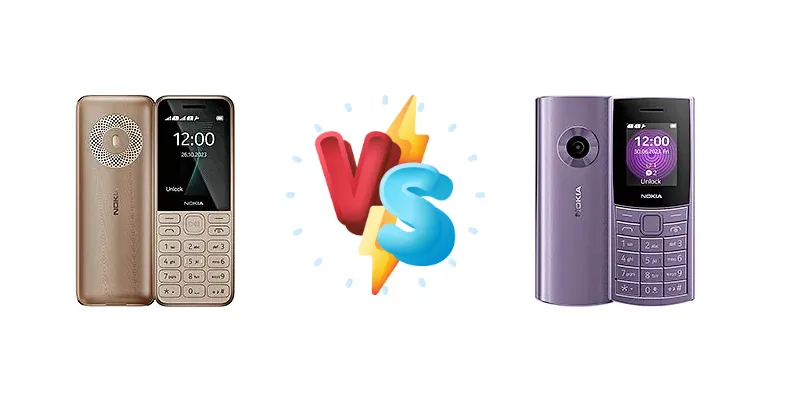
In a market saturated with smartphones, Nokia continues to cater to a segment seeking simplicity and affordability with the 130 (2023) and 110 4G (2023). Both represent a return to the basics, but key differences in connectivity and potential features dictate which phone best suits a user’s needs. This comparison dissects these nuances, focusing on what truly matters in the ultra-budget space.
🏆 Quick Verdict
For the average user prioritizing basic communication and extended battery life, the Nokia 110 4G (2023) emerges as the better choice. Its inclusion of 4G connectivity provides a significant advantage for voice calls and potential access to limited data services, justifying a likely slight price premium over the 130.
| Network |
|---|
| 2G bands | GSM 900 / 1800 | GSM 900 / 1800 |
| 3G bands | - | HSDPA 850 / 900 / 1700(AWS) / 1900 / 2100 |
| 4G bands | - | LTE |
| EDGE | No | - |
| GPRS | No | - |
| Speed | - | HSPA, LTE |
| Technology | GSM | GSM / HSPA / LTE |
| Launch |
|---|
| Announced | 2023, August 10 | 2023, May 18 |
| Status | Available. Released 2023, August 10 | Available. Released 2023, June |
| Body |
|---|
| Dimensions | 130.9 x 50.6 x 14 mm (5.15 x 1.99 x 0.55 in) | 121.5 x 50 x 14.4 mm (4.78 x 1.97 x 0.57 in) |
| SIM | Dual SIM (Mini-SIM, dual stand-by) | · Nano-SIM· Nano-SIM + Nano-SIM |
| Weight | 98.2 g (3.46 oz) | 94.5 g (3.35 oz) |
| | - | Flashlight
Splash resistant |
| Display |
|---|
| Resolution | 240 x 320 pixels, 4:3 ratio (~167 ppi density) | 120 x 160 pixels, 4:3 ratio (~111 ppi density) |
| Size | 2.4 inches, 17.8 cm2 (~26.9% screen-to-body ratio) | 1.8 inches, 10.0 cm2 (~16.5% screen-to-body ratio) |
| Type | TFT LCD, 65K colors | TFT LCD, 65K colors |
| Memory |
|---|
| Call records | Yes | Yes |
| Card slot | microSDHC | microSDHC |
| Internal | 4MB | Unspecified |
| Phonebook | 2000 entries | Yes |
| Sound |
|---|
| 3.5mm jack | - | Yes |
| 35mm jack | Yes | Yes |
| Loudspeaker | Yes | Yes |
| Comms |
|---|
| Bluetooth | No | 5.0, A2DP |
| NFC | No | No |
| Positioning | No | No |
| Radio | FM radio; built-in antenna | Wireless FM radio |
| USB | microUSB 1.1 | microUSB 2.0 |
| WLAN | No | No |
| Features |
|---|
| Games | Yes | Yes |
| Java | No | No |
| Messaging | SMS | SMS |
| Sensors | No | - |
| | - | MP3 player |
| Battery |
|---|
| Type | Li-Ion 1450 mAh, removable | Li-Ion 1450 mAh |
| Misc |
|---|
| Colors | Dark Blue, Purple, Light Gold | Midnight Blue, Arctic Purple |
| Price | About 20 EUR | About 40 EUR |
Nokia 130 (2023)
- Extremely affordable price point
- Long standby time due to 2G/3G focus
- Simple and easy to use interface
- Limited connectivity (2G/3G only)
- Low-resolution display
- Basic camera quality
Nokia 110 4G (2023)
- 4G connectivity for improved call quality and data access
- Potentially slightly brighter display
- Modernized feature set
- Slightly higher price than the Nokia 130
- 4G connectivity will reduce battery life (though still excellent)
- Low-resolution display
Display Comparison
Given the lack of detailed specifications, we can infer both devices utilize similar, low-resolution color displays typical of feature phones. The Nokia 130 likely features a 2.4-inch display, consistent with previous iterations, while the 110 4G likely has a similar size. The key difference isn’t likely in resolution or panel technology, but potentially in brightness. The 110 4G, being a newer model, may benefit from slight improvements in display clarity for outdoor visibility. Bezels are expected to be substantial on both devices, prioritizing durability over aesthetics.
Camera Comparison
Neither device is positioned as a photography tool. Both likely feature a basic VGA camera, suitable only for extremely low-resolution snapshots. Image quality will be poor in all lighting conditions. The presence of a camera is more of a novelty feature than a practical benefit. Focusing on camera specs is irrelevant in this segment.
Performance
Both phones are powered by basic MediaTek feature phone chipsets, optimized for extremely low power consumption rather than processing speed. The Nokia 110 4G’s inclusion of 4G connectivity necessitates a more capable chipset than the 130, which likely remains limited to 2G/3G. This translates to faster call setup times and potentially smoother operation of any included apps on the 110 4G. RAM is expected to be minimal on both, sufficient only for basic functions.
Battery Life
Battery life is a key selling point for both devices. Both the Nokia 130 and 110 4G are expected to offer days, even weeks, of standby time on a single charge, thanks to their low-power chipsets and minimal features. The 110 4G’s 4G connectivity will draw more power than the 130’s 2G/3G, but the difference is unlikely to be substantial. Both likely utilize a 1000mAh battery, optimized for longevity over quick charging.
Buying Guide
Buy the Nokia 130 (2023) if you need a supremely affordable phone for essential calls and texts, and 4G connectivity is not a requirement. It’s ideal for those in areas with reliable 2G/3G coverage or as a backup device. Buy the Nokia 110 4G (2023) if you prefer the future-proofing and improved call quality offered by 4G, and potentially want to access basic internet services like WhatsApp or limited web browsing.
Frequently Asked Questions
❓ Will the Nokia 110 4G work with my existing SIM card?
Yes, the Nokia 110 4G is compatible with standard Nano-SIM cards. However, ensure your carrier supports the 4G bands used by the device for optimal performance. Check your carrier's website for compatibility information.
❓ Can I use WhatsApp on the Nokia 110 4G?
While the Nokia 110 4G supports basic internet access via 4G, WhatsApp's functionality may be limited due to the phone's low processing power and small screen size. You may be able to use WhatsApp for text-based messaging, but image and video sharing may be slow or unreliable.
❓ How long will the battery last on the Nokia 130 if I only use it for calls and texts?
The Nokia 130, when used primarily for calls and texts on 2G/3G networks, can easily achieve several days, even weeks, of standby time on a single charge. Its low-power chipset and minimal features contribute to exceptional battery life.