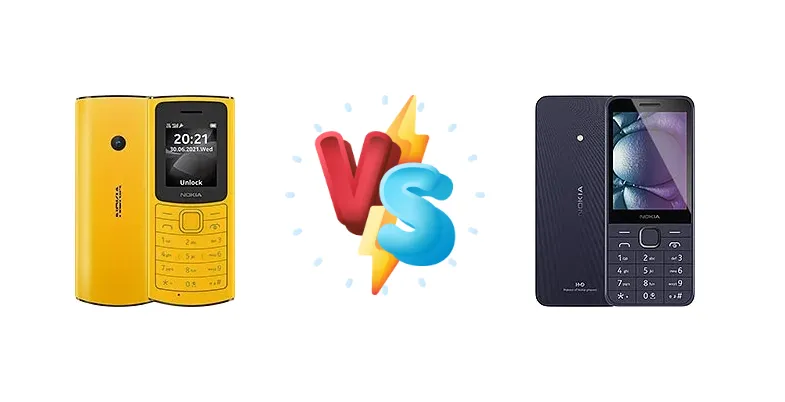
The feature phone isn't dead, and Nokia is proving it. We're comparing the Nokia 110 4G, a staple in the ultra-budget category, against the newer Nokia 215 4G (2024). While both offer 4G connectivity, the 215 introduces a chipset – the Unisoc T107 – that hints at a slightly more modern user experience. This comparison will dissect whether that processor justifies the potential price difference.
🏆 Quick Verdict
For the average user needing a reliable, no-frills 4G phone for calls and texts, the Nokia 215 4G (2024) is the better choice. The Unisoc T107 chipset, while modest, provides a smoother experience than the likely unoptimized software running on the Nokia 110 4G, making it worth the small investment.
| Network |
|---|
| 2G bands | GSM 900 / 1800 | GSM 850 / 900 / 1800 / 1900 |
| 3G bands | HSDPA 850 / 900 / 1700(AWS) / 1900 / 2100 - LATAM | HSDPA 850 / 900 / 2100 |
| 4G bands | 1, 3, 5, 7, 8, 20 - KSA, EG, SSA, Rest of APAC | 1, 3, 5, 7, 8, 20, 28, 38, 40, 41 - EU, EMEA, APAC |
| Speed | HSPA, LTE | HSPA, LTE |
| Technology | GSM / HSPA / LTE | GSM / HSPA / LTE |
| Launch |
|---|
| Announced | 2021, June 15 | 2024, April 30 |
| Status | Available. Released 2021, July 15 | Available. Released 2024, May |
| Body |
|---|
| Dimensions | 121 x 50 x 14.5 mm (4.76 x 1.97 x 0.57 in) | 127.3 x 54.2 x 11.6 mm (5.01 x 2.13 x 0.46 in) |
| SIM | · Nano-SIM· Nano-SIM + Nano-SIM | Nano-SIM + Nano-SIM |
| Weight | 84.5 g (3.00 oz) | - |
| Display |
|---|
| Resolution | 120 x 160 pixels, 4:3 ratio (~111 ppi density) | 240 x 320 pixels, 4:3 ratio (~143 ppi density) |
| Size | 1.8 inches, 10.0 cm2 (~16.6% screen-to-body ratio) | 2.8 inches, 24.3 cm2 (~35.2% screen-to-body ratio) |
| Type | TFT LCD, 65K colors | TFT LCD |
| Platform |
|---|
| CPU | - | 1.0 GHz Cortex-A7 |
| Chipset | - | Unisoc T107 (22 nm) |
| Memory |
|---|
| Call records | Yes | Yes |
| Card slot | microSDHC | microSDHC |
| Internal | 48MB 128MB RAM | 128MB 64MB RAM |
| Phonebook | Yes | Yes |
| Main Camera |
|---|
| Single | Yes | - |
| Video | Yes | - |
| Sound |
|---|
| 35mm jack | Yes | Yes |
| Loudspeaker | Yes | Yes |
| Comms |
|---|
| Bluetooth | No | 5.0, A2DP, LE |
| NFC | No | No |
| Positioning | No | No |
| Radio | Wireless FM radio | Wireless FM radio |
| USB | microUSB 2.0 | USB Type-C |
| WLAN | No | No |
| Features |
|---|
| Games | Yes | Yes |
| Java | No | No |
| Messaging | SMS | SMS |
| Sensors | - | No |
| Battery |
|---|
| Type | Li-Ion 1020 mAh, removable | Li-Ion 1450 mAh, removable |
| Misc |
|---|
| Colors | Yellow, Aqua, Black | Peach, Black, Dark Blue |
| Models | TA-1395, TA-1386, TA-1384, TA-1376 | - |
| Price | About 50 EUR | - |
| SAR | 1.39 W/kg (head) 1.42 W/kg (body) | - |
| SAR EU | 1.32 W/kg (head) 1.78 W/kg (body) | - |
Nokia 110 4G
- Likely the lowest possible price point.
- Extremely long standby time.
- Simple and durable design.
- Very slow performance.
- Limited functionality.
- Poor user experience.
Nokia 215 4G (2024)
- Smoother performance thanks to the Unisoc T107.
- Potentially better app support.
- More modern user interface.
- Slightly higher price.
- Camera quality is still very basic.
- Limited functionality compared to smartphones.
Display Comparison
Given the lack of detailed display specifications for the Nokia 110 4G, we can assume it utilizes a standard LCD panel common in this price bracket. The Nokia 215 4G (2024) also likely features an LCD, but the presence of a processor suggests potential for slightly better color calibration and responsiveness. Bezels are expected to be substantial on both devices, prioritizing durability over immersive viewing. Neither phone is expected to offer high brightness or wide viewing angles.
Camera Comparison
Both phones likely feature very basic cameras, and detailed specifications are unavailable for the Nokia 110 4G. The Nokia 215 4G (2024) likely includes a VGA camera, but image quality will be extremely limited. Neither phone is intended for serious photography; the cameras are primarily for basic documentation. Focusing on sensor size or image processing is irrelevant given the low resolution and limited capabilities.
Performance
The key differentiator here is the Unisoc T107 in the Nokia 215 4G (2024). Built on a 22nm process and featuring a 1.0 GHz Cortex-A7 CPU, it represents a significant step up from the likely unbranded or very low-power chipset in the Nokia 110 4G. While not a powerhouse, the T107 allows for smoother operation of basic apps like the web browser and potentially more responsive menu navigation. The Nokia 110 4G will likely exhibit noticeable lag even with simple tasks. The 215's processor also suggests a better ability to handle future software updates, though the extent of those updates remains limited.
Battery Life
Both devices are expected to offer excellent battery life due to their low-power components and small displays. The Nokia 110 4G likely has a smaller battery capacity, but its simpler chipset may offset this. The Nokia 215 4G (2024)'s Unisoc T107 will consume more power, but the increased efficiency of the 22nm process should still result in multi-day battery life. Charging times will be slow on both devices, likely taking several hours via micro-USB.
Buying Guide
Buy the Nokia 110 4G if your primary need is the absolute lowest possible price and you only require basic calling and texting functionality. It's a true 'emergency phone' or a secondary device for minimal use. Buy the Nokia 215 4G (2024) if you value a slightly more responsive user interface, potentially better app support (even if limited), and a phone that feels a bit more modern despite its feature phone limitations.
Frequently Asked Questions
❓ Will the Nokia 215 4G (2024) run WhatsApp or Facebook?
The Nokia 215 4G (2024) supports a limited number of apps through its web apps platform. WhatsApp and Facebook *may* be accessible through their web app versions, but the experience will be significantly different from a smartphone. Expect a simplified interface and limited functionality. The Nokia 110 4G is unlikely to support these apps reliably.
❓ How much faster is the Nokia 215 4G (2024) compared to the Nokia 110 4G?
The Nokia 215 4G (2024) is noticeably faster due to the Unisoc T107 chipset. While still not powerful, the T107 allows for smoother menu navigation, faster app loading times (for supported apps), and a more responsive web browsing experience. The Nokia 110 4G will likely exhibit significant lag even with basic tasks.
❓ Can I use a microSD card with either phone to store photos or music?
Yes, both the Nokia 110 4G and the Nokia 215 4G (2024) support microSD card expansion, allowing you to store photos, music, and other files. This is crucial given the limited internal storage on both devices.