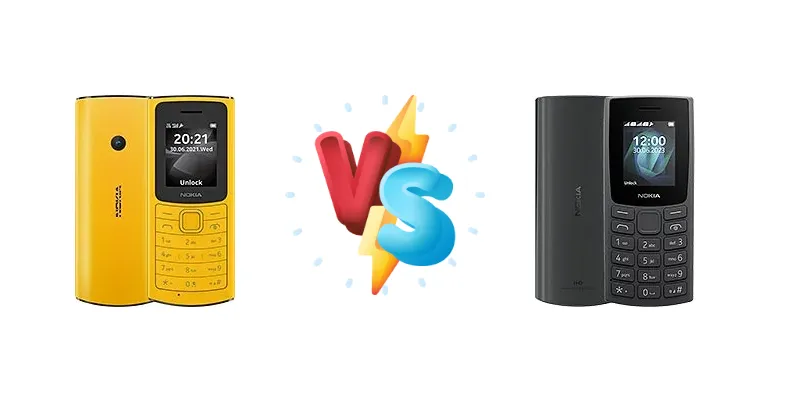
In a market saturated with smartphones, Nokia continues to cater to a specific niche: users prioritizing simplicity, reliability, and affordability. The Nokia 110 4G and Nokia 105 4G 2nd Edition represent the latest iterations of this philosophy, offering 4G connectivity in a classic feature phone form factor. This comparison dissects the nuances between these two models, helping you determine which best suits your needs for basic communication and entertainment.
🏆 Quick Verdict
For the average user seeking a dependable, ultra-affordable 4G feature phone, the Nokia 105 4G 2nd Edition emerges as the slightly better choice. Its established market presence and likely optimized software experience, given its second edition status, provide a more refined user experience compared to the newer, less documented Nokia 110 4G.
| Network |
|---|
| 2G bands | GSM 900 / 1800 | GSM 900 / 1800 |
| 3G bands | HSDPA 850 / 900 / 1700(AWS) / 1900 / 2100 - LATAM | HSDPA 850 / 900 / 1700(AWS) / 1900 / 2100 |
| 4G bands | 1, 3, 5, 7, 8, 20 - KSA, EG, SSA, Rest of APAC | LTE |
| Speed | HSPA, LTE | HSPA, LTE |
| Technology | GSM / HSPA / LTE | GSM / HSPA / LTE |
| Launch |
|---|
| Announced | 2021, June 15 | 2024, December |
| Status | Available. Released 2021, July 15 | Available. Released 2024, December |
| Body |
|---|
| Dimensions | 121 x 50 x 14.5 mm (4.76 x 1.97 x 0.57 in) | 121.5 x 50 x 14.4 mm (4.78 x 1.97 x 0.57 in) |
| SIM | · Nano-SIM· Nano-SIM + Nano-SIM | · Nano-SIM· Nano-SIM + Nano-SIM |
| Weight | 84.5 g (3.00 oz) | 93 g (3.28 oz) |
| Display |
|---|
| Resolution | 120 x 160 pixels, 4:3 ratio (~111 ppi density) | 120 x 160 pixels, 4:3 ratio (~111 ppi density) |
| Size | 1.8 inches, 10.0 cm2 (~16.6% screen-to-body ratio) | 1.8 inches, 10.0 cm2 (~16.5% screen-to-body ratio) |
| Type | TFT LCD, 65K colors | IPS LCD |
| Memory |
|---|
| Call records | Yes | Yes |
| Card slot | microSDHC | microSDHC |
| Internal | 48MB 128MB RAM | 48MB 128MB RAM |
| Phonebook | Yes | Yes |
| Main Camera |
|---|
| Single | Yes | - |
| Video | Yes | - |
| Sound |
|---|
| 35mm jack | Yes | Yes |
| Loudspeaker | Yes | Yes |
| Comms |
|---|
| Bluetooth | No | 5.0, A2DP |
| NFC | No | No |
| Positioning | No | No |
| Radio | Wireless FM radio | Wireless FM radio |
| USB | microUSB 2.0 | USB Type-C |
| WLAN | No | No |
| Features |
|---|
| Games | Yes | Yes |
| Java | No | No |
| Messaging | SMS | SMS |
| Battery |
|---|
| Type | Li-Ion 1020 mAh, removable | Li-Ion 1450 mAh, removable |
| Misc |
|---|
| Colors | Yellow, Aqua, Black | Charcoal |
| Models | TA-1395, TA-1386, TA-1384, TA-1376 | - |
| Price | About 50 EUR | About 50 EUR |
| SAR | 1.39 W/kg (head) 1.42 W/kg (body) | - |
| SAR EU | 1.32 W/kg (head) 1.78 W/kg (body) | - |
Nokia 110 4G
- Newest model in the lineup
- Potential for minor software optimizations
- Latest 4G modem implementation
- Limited user reviews and support
- Potentially less refined software experience
Nokia 105 4G 2nd Edition
- Proven reliability and stability
- Wider availability of user reviews
- Potentially optimized software experience (2nd Edition)
- Older model
- May lack the very latest 4G modem features
Display Comparison
Given the target market, both devices likely employ similar low-resolution color displays, around 1.8-2.4 inches. The Nokia 105 4G 2nd Edition, benefiting from being a second edition, may have slightly improved color calibration or viewing angles due to manufacturing refinements. However, neither display will rival smartphone quality; they are designed for basic readability of text and simple icons. Expect similar pixel densities, prioritizing legibility over sharpness.
Camera Comparison
Both devices are likely equipped with extremely basic VGA cameras, primarily for occasional snapshots. Image quality will be poor by modern standards, suitable only for sharing on other basic phones or via MMS. The aperture and sensor size are likely identical, rendering any comparison moot. Focusing on camera capabilities for these devices is largely irrelevant; they are not designed for photography.
Performance
Both phones utilize basic mobile chipsets designed for voice calls, SMS, and limited feature phone applications. The performance difference will be negligible in real-world usage. The Nokia 110 4G, being newer, *might* benefit from a slightly more efficient chipset, potentially leading to marginally improved battery life, but this is speculative. RAM capacity is likely extremely limited on both (under 64MB), sufficient only for the intended functions. The 4G modem is the key performance component, and both likely utilize similar Qualcomm or MediaTek solutions.
Battery Life
Battery life is a critical factor for feature phones. Both the Nokia 110 4G and 105 4G 2nd Edition likely feature batteries in the 1000-1500 mAh range. The Nokia 105 4G 2nd Edition, with its potentially more optimized software and established design, may exhibit slightly longer standby times. Charging is likely via Micro-USB, and charging speeds will be slow, prioritizing battery health over rapid charging.
Buying Guide
Buy the Nokia 110 4G if you prioritize having the absolute newest model and are comfortable with potentially less refined software. Its appeal lies in being the latest iteration, potentially benefiting from minor, undocumented improvements. Buy the Nokia 105 4G 2nd Edition if you value a proven track record, a potentially more stable software experience, and a wider availability of user reviews and support resources. It's the safer bet for a reliable, no-frills 4G connection.
Frequently Asked Questions
❓ Is the Nokia 105 4G 2nd Edition compatible with VoLTE carriers?
Compatibility with VoLTE (Voice over LTE) carriers depends on the specific carrier and region. It's crucial to check with your mobile provider to confirm VoLTE support for the Nokia 105 4G 2nd Edition before purchasing, as 4G functionality may be limited without it on some networks.
❓ Can I use WhatsApp on either the Nokia 110 4G or Nokia 105 4G 2nd Edition?
While both phones support 4G connectivity, running WhatsApp is not officially supported. WhatsApp requires a more robust operating system and processing power than these feature phones provide. However, some users have reported limited functionality through unofficial workarounds, but this is not guaranteed and may be unreliable.
❓ How many SIM cards can the Nokia 110 4G and Nokia 105 4G 2nd Edition support?
Both devices are dual-SIM phones, allowing you to use two SIM cards simultaneously. This is particularly useful for separating work and personal calls or for taking advantage of different carrier plans.
❓ What type of memory card does the Nokia 105 4G 2nd Edition support, and what is the maximum capacity?
Both phones support microSD card expansion for storing contacts, messages, and limited media. They typically support microSD cards up to 32GB, allowing for a reasonable amount of storage for a feature phone.