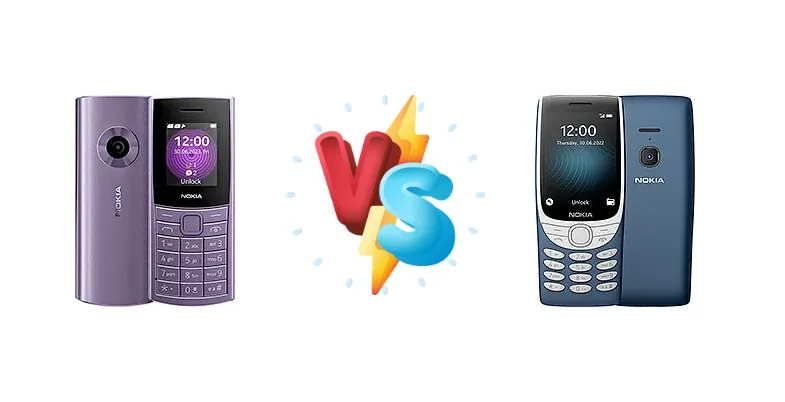
Nokia's resurgence continues with a pair of retro-inspired 4G feature phones: the Nokia 110 4G (2023) and the Nokia 8210 4G. Both offer a nostalgic design and 4G connectivity, but which one delivers the better experience? Let's dive into a detailed comparison.
🏆 Quick Verdict
The Nokia 8210 4G edges out the 110 4G (2023) thanks to its slightly more powerful chipset and improved design. While the 110 4G is a budget champion, the 8210 4G provides a more refined and feature-rich experience for those seeking a touch more performance and style.
| Network |
|---|
| 2G bands | GSM 900 / 1800 | GSM 850 / 900 / 1800 / 1900 |
| 3G bands | HSDPA 850 / 900 / 1700(AWS) / 1900 / 2100 | HSDPA 850 / 900 / 2100 - International |
| 4G bands | LTE | 1, 3, 5, 7, 8, 20 - APAC, EU, RUCIS |
| Speed | HSPA, LTE | HSPA, LTE |
| Technology | GSM / HSPA / LTE | GSM / HSPA / LTE |
| | - | 1, 2, 3, 4, 5, 7, 8, 28, 40 - LATAM |
| Launch |
|---|
| Announced | 2023, May 18 | 2022, July 12 |
| Status | Available. Released 2023, June | Available. Released 2022, July 28 |
| Body |
|---|
| Dimensions | 121.5 x 50 x 14.4 mm (4.78 x 1.97 x 0.57 in) | 131.3 x 56.2 x 13.8 mm (5.17 x 2.21 x 0.54 in) |
| SIM | · Nano-SIM· Nano-SIM + Nano-SIM | · Nano-SIM· Nano-SIM + Nano-SIM |
| Weight | 94.5 g (3.35 oz) | 107 g (3.77 oz) |
| | Flashlight
Splash resistant | - |
| Display |
|---|
| Resolution | 120 x 160 pixels, 4:3 ratio (~111 ppi density) | 240 x 320 pixels, 4:3 ratio (~143 ppi density) |
| Size | 1.8 inches, 10.0 cm2 (~16.5% screen-to-body ratio) | 2.8 inches, 24.3 cm2 (~32.9% screen-to-body ratio) |
| Type | TFT LCD, 65K colors | TFT LCD |
| Platform |
|---|
| CPU | - | 1.0 GHz Cortex-A7 |
| Chipset | - | Unisoc T107 (22 nm) |
| Memory |
|---|
| Call records | Yes | Yes |
| Card slot | microSDHC | microSDHC |
| Internal | Unspecified | 128MB 48MB RAM |
| Phonebook | Yes | Yes |
| Main Camera |
|---|
| Features | - | LED flash |
| Single | QVGA | 0.3 MP |
| Video | - | Unspecified |
| Sound |
|---|
| 3.5mm jack | Yes | Yes |
| 35mm jack | Yes | Yes |
| Loudspeaker | Yes | Yes |
| Comms |
|---|
| Bluetooth | 5.0, A2DP | 5.0, A2DP, LE |
| NFC | No | No |
| Positioning | No | No |
| Radio | Wireless FM radio | Wireless FM radio |
| USB | microUSB 2.0 | microUSB 2.0 |
| WLAN | No | No |
| Features |
|---|
| Games | Yes | Yes |
| Java | No | No |
| Messaging | SMS | SMS, MMS |
| | MP3 player | - |
| Battery |
|---|
| Type | Li-Ion 1450 mAh | Li-Ion 1450 mAh, removable |
| Misc |
|---|
| Colors | Midnight Blue, Arctic Purple | Sand, Blue, Red |
| Models | - | TA-1507, TA-1494, TA-1489, TA-1485, TA-1483 |
| Price | About 40 EUR | About 170 EUR |
| SAR | - | 0.98 W/kg (head) 1.34 W/kg (body) |
| SAR EU | - | 0.98 W/kg (head) 1.43 W/kg (body) |
Nokia 110 4G (2023)
- Extremely affordable
- Excellent battery life
- Durable build
- FM Radio
- Basic performance
- Low-resolution display
- Rudimentary camera
- Simple design
Nokia 8210 4G
- Stylish retro design
- Slightly better performance
- More comfortable keypad
- 4G connectivity
- Higher price than 110 4G
- Still limited performance
- Basic camera
- Battery life slightly less than 110 4G
Display Comparison
Both phones feature small, basic LCD displays. The Nokia 8210 4G might have a slightly more vibrant display, but overall, screen quality is secondary in these devices. Expect limited resolution and viewing angles.
Camera Comparison
Both phones likely have rudimentary VGA cameras, offering minimal photographic capabilities. Image quality will be poor in low light, and these cameras are primarily for novelty rather than serious photography.
Performance
The Nokia 8210 4G's Unisoc T107 chipset provides a noticeable performance boost over the likely simpler processor in the Nokia 110 4G (2023). Expect smoother navigation and slightly faster app loading on the 8210 4G. However, neither phone is designed for demanding tasks.
Battery Life
The Nokia 110 4G (2023) is expected to have excellent battery life, typical of Nokia's feature phones, potentially lasting for days on a single charge. The Nokia 8210 4G's battery life should also be good, but the slightly more powerful chipset might result in slightly shorter longevity.
Buying Guide
Who should buy the Nokia 110 4G (2023)? Those seeking the absolute cheapest 4G-enabled phone for basic calls, texts, and occasional FM radio use. Who should buy the Nokia 8210 4G? Users wanting a more stylish retro phone with slightly better performance, a more comfortable keypad, and a more premium feel, without breaking the bank.
Frequently Asked Questions
❓ What is the main difference between the Nokia 110 4G (2023) and the Nokia 8210 4G?
The main difference lies in the chipset and design. The 8210 4G has a Unisoc T107 chipset for slightly better performance and a more stylish, curved design, while the 110 4G (2023) prioritizes affordability and extreme battery life.
❓ Are these phones suitable for gaming?
No, neither phone is suitable for gaming. They are designed for basic communication and entertainment like FM radio, not demanding applications.