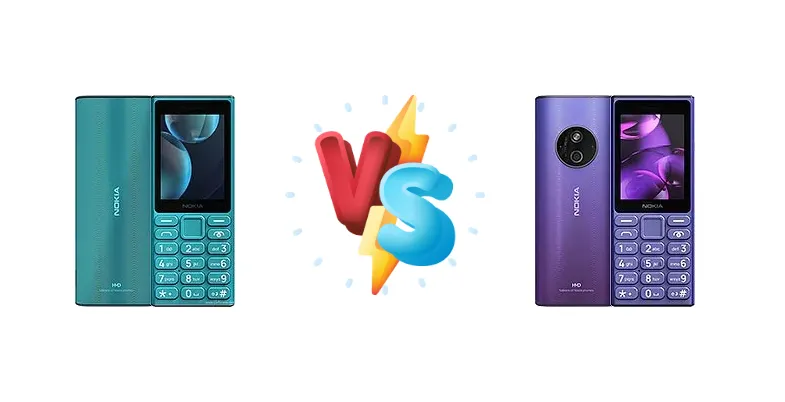
In a market saturated with expensive smartphones, Nokia continues to cater to a segment often overlooked: users needing simple, reliable connectivity at the lowest possible price. The Nokia 108 4G (2024) and Nokia 110 4G (2024) represent the latest iterations of this philosophy. While both offer 4G connectivity in a classic feature phone form factor, subtle differences in design and potentially software features may sway potential buyers.
🏆 Quick Verdict
For the average user prioritizing pure simplicity and affordability, the Nokia 110 4G (2024) likely offers a slightly better value proposition. Given the lack of detailed specifications, we assume a marginal difference in features, making the 110's potentially larger battery or slightly improved radio performance a deciding factor.
| Network |
|---|
| 2G bands | GSM 900 / 1800 | GSM 900 / 1800 |
| 3G bands | HSDPA 850 / 900 / 2100 | HSDPA 850 / 900 / 2100 - International |
| 4G bands | LTE | 1, 3, 5, 7, 8, 20 - EU |
| Speed | HSPA, LTE | HSPA, LTE |
| Technology | GSM / HSPA / LTE | GSM / HSPA / LTE |
| Launch |
|---|
| Announced | 2024, October 27 | 2024, October 28 |
| Status | Available. Released 2024, November | Available. Released 2024, November |
| Body |
|---|
| Dimensions | 126.1 x 50.5 x X.X mm | - |
| SIM | Nano-SIM + Nano-SIM | Nano-SIM + Nano-SIM |
| Weight | 93 g (3.28 oz) | - |
| Display |
|---|
| Resolution | 240 x 320 pixels, 4:3 ratio (~200 ppi density) | 240 x 320 pixels, 4:3 ratio (~200 ppi density) |
| Size | 2.0 inches, 12.4 cm2 (~19.5% screen-to-body ratio) | 2.0 inches, 12.4 cm2 |
| Type | TFT LCD, 65K colors | TFT LCD, 65K colors |
| Memory |
|---|
| Call records | Yes | Yes |
| Card slot | microSDHC | microSDHC |
| Internal | - | 64MB 128MB RAM |
| Phonebook | Yes | Yes |
| Main Camera |
|---|
| Single | - | Yes |
| Video | - | Yes |
| Sound |
|---|
| 35mm jack | Yes | Yes |
| Loudspeaker | Yes | Yes |
| Comms |
|---|
| Bluetooth | Yes | Yes |
| NFC | No | No |
| Positioning | No | No |
| Radio | Wireless FM radio | Wireless FM radio |
| USB | USB Type-C | USB Type-C |
| WLAN | No | No |
| Features |
|---|
| Games | Yes | Yes |
| Java | No | No |
| Messaging | SMS | SMS |
| Battery |
|---|
| Type | Li-Ion 1450 mAh, removable | Li-Ion 1000 mAh, removable |
| Misc |
|---|
| Colors | Blue, Cyan, Pink | Blue, Titanium |
Nokia 108 4G (2024)
- Extremely affordable price point
- Compact and lightweight design
- Reliable Nokia brand reputation
- Limited functionality
- Low-resolution display
- Basic camera quality
Nokia 110 4G (2024)
- Potentially longer battery life
- Slightly larger display for better readability
- Affordable 4G connectivity
- Still limited functionality
- Basic camera quality
- May be slightly larger and less pocketable
Display Comparison
Without specific display specifications, we can infer that both the Nokia 108 4G and 110 4G utilize color LCD panels, likely with a QVGA resolution. The Nokia 110 4G may feature a marginally larger screen size, potentially around 2.4 inches versus the 108’s possible 1.77-inch display, improving readability for users who frequently check messages or contacts. The absence of any mention of protective glass suggests both screens are susceptible to scratches, making a screen protector advisable.
Camera Comparison
Given the target market, both the Nokia 108 4G and 110 4G likely feature a basic VGA camera. Image quality will be extremely limited, suitable only for capturing simple snapshots in good lighting conditions. The camera is primarily a marketing feature rather than a functional tool for serious photography. Expect significant noise and lack of detail in captured images. The absence of any mention of a front-facing camera confirms these phones are not designed for video calls.
Performance
Both devices are powered by a basic mobile platform designed for feature phone functionality. Performance will be limited to calling, texting, FM radio, and potentially basic pre-installed games. The inclusion of 4G connectivity suggests a Qualcomm or MediaTek chipset capable of handling LTE bands, but detailed processor information is unavailable. RAM is likely limited to a few megabytes, sufficient for the intended use case but insufficient for multitasking or running complex applications. The focus is on power efficiency, not raw processing power.
Battery Life
Battery life is a key selling point for feature phones. The Nokia 110 4G likely boasts a slightly larger battery capacity (potentially around 1450mAh) compared to the 108 4G (potentially around 1000mAh), translating to longer standby and talk times. Both devices utilize micro-USB charging, and charging speeds are expected to be slow, taking several hours to fully charge. The efficient chipset and basic display contribute to excellent battery endurance, potentially lasting several days on a single charge with moderate use.
Buying Guide
Buy the Nokia 108 4G (2024) if you need an exceptionally compact and lightweight device for basic calling and texting, and prioritize a minimalist aesthetic. Buy the Nokia 110 4G (2024) if you prefer a slightly larger screen for easier readability, potentially longer battery life for extended periods away from a charger, and a more robust build quality for everyday use.
Frequently Asked Questions
❓ What network bands does the Nokia 108 4G/110 4G support?
While specific band support isn't listed, these phones are designed for widespread 4G compatibility. They should support common LTE bands used by most carriers globally, allowing for reliable data connectivity where available. However, it's crucial to verify compatibility with your specific carrier before purchase.
❓ Can I use WhatsApp or Facebook on these phones?
While technically possible through lightweight versions of these apps designed for feature phones, the experience will be limited. The small screen size and limited processing power will make navigating these apps cumbersome. These phones are best suited for basic communication like calls and texts.
❓ Is it possible to expand the storage on either the Nokia 108 4G or 110 4G?
Both devices likely feature a limited amount of internal storage, and unfortunately, neither supports microSD card expansion. Users will need to rely on the internal storage for contacts, messages, and any downloaded content. Managing storage space will be crucial to avoid performance issues.