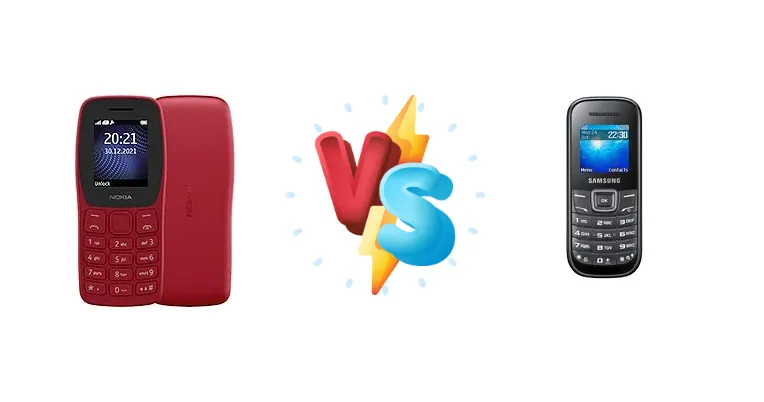
In a market saturated with smartphones, the ultra-basic feature phone persists. We pit the Nokia 105+ (2022) against the Samsung E1200 Pusha, two devices designed for essential communication, to determine which offers the best experience for users prioritizing simplicity and longevity over advanced features.
🏆 Quick Verdict
For the average user seeking a reliable, no-frills phone, the Nokia 105+ (2022) is the better choice. Its Mediatek MT6261D chipset, while modest, provides a more modern architecture than the Samsung E1200 Pusha’s 156 MHz CPU, potentially offering slightly improved responsiveness and feature support.
| Network |
|---|
| 2G bands | GSM 900 / 1800 | GSM 900 / 1800 |
| EDGE | No | No |
| GPRS | No | No |
| Technology | GSM | GSM |
| Launch |
|---|
| Announced | 2022, April 26 | 2012. Released 2012 |
| Status | Available. Released 2022, April 26 | Discontinued |
| Body |
|---|
| Dimensions | 115.2 x 49.9 x 14.3 mm (4.54 x 1.96 x 0.56 in) | 108 x 45 x 13.5 mm (4.25 x 1.77 x 0.53 in) |
| SIM | Single SIM (Mini-SIM) or Dual SIM (Mini-SIM, dual stand-by) | Mini-SIM |
| Weight | 72 g (2.54 oz) | 65.1 g (2.29 oz) |
| Display |
|---|
| Resolution | 120 x 160 pixels, 4:3 ratio (~113 ppi density) | 128 x 128 pixels, 1:1 ratio (~119 ppi density) |
| Size | 1.77 inches, 9.7 cm2 (~16.9% screen-to-body ratio) | 1.52 inches, 7.5 cm2 (~15.3% screen-to-body ratio) |
| Type | TFT LCD, 65K colors | TFT, 65K colors |
| Platform |
|---|
| CPU | - | 156 MHz |
| Chipset | Mediatek MT6261D | - |
| Memory |
|---|
| Call records | Yes | Yes |
| Card slot | microSDHC | No |
| Internal | 4MB, 4MB RAM | - |
| Phonebook | Yes | Yes |
| Sound |
|---|
| 3.5mm jack | - | No |
| 35mm jack | Yes | No |
| Loudspeaker | Yes | Yes |
| Comms |
|---|
| Bluetooth | No | No |
| NFC | No | - |
| Positioning | No | No |
| Radio | Wireless FM radio | No |
| USB | microUSB 1.1 | Proprietary |
| WLAN | No | No |
| Features |
|---|
| Games | Yes | No |
| Java | No | No |
| Messaging | SMS | SMS |
| Battery |
|---|
| Stand-by | - | Up to 720 h |
| Talk time | - | Up to 7 h |
| Type | Li-Ion 800 mAh, removable | Removable Li-Ion 800 mAh battery |
| Misc |
|---|
| Colors | Red, Charcoal | Black, White, Blue |
| Models | TA-1447, TA-1456 | - |
| Price | About 20 EUR | About 20 EUR |
| SAR EU | - | 0.81 W/kg (head) |
Nokia 105+ (2022)
- More modern Mediatek MT6261D chipset
- Potentially better software support
- Likely slightly improved responsiveness
- May be slightly more expensive
- Still a very basic feature phone
Samsung E1200 Pusha
- Extremely simple and easy to use
- Potentially lower price point
- Excellent battery life
- Outdated 156 MHz CPU
- Limited feature set
- Potentially limited software support
Display Comparison
Neither device boasts a sophisticated display. Both likely utilize basic monochrome or low-resolution color LCDs, typical of this market segment. Without specific resolution or brightness data, it's safe to assume both offer adequate visibility for basic call and text functions, but are unsuitable for media consumption. The focus here is on legibility, not visual fidelity.
Camera Comparison
Both devices are unlikely to feature cameras of any significant quality. The market segment prioritizes cost reduction, and including a functional camera would add unnecessary expense. Any camera present on either device would likely be a very low-resolution sensor suitable only for basic image capture in ideal lighting conditions. Image quality should not be a consideration for potential buyers.
Performance
The core difference lies in the processing power. The Nokia 105+ (2022) utilizes a Mediatek MT6261D chipset, a common choice for feature phones, offering a more modern architecture and potentially better power efficiency than the Samsung E1200 Pusha’s 156 MHz CPU. While neither is capable of demanding tasks, the MT6261D likely handles menu navigation and basic applications with slightly more fluidity. The 156 MHz CPU in the Samsung E1200 Pusha represents a significantly older generation of mobile processing, likely limiting its responsiveness and future software compatibility.
Battery Life
Both phones excel in battery life due to their minimal power requirements. The absence of a power-hungry display and processor allows for days, even weeks, of standby time. Without specific battery capacity data, it’s difficult to declare a clear winner. However, the Mediatek chipset in the Nokia 105+ (2022) *may* offer slightly better power management, potentially extending battery life marginally, but real-world usage will be the deciding factor.
Buying Guide
Buy the Nokia 105+ (2022) if you need a phone with slightly more modern processing capabilities for basic tasks like FM radio and potentially more reliable software updates. Buy the Samsung E1200 Pusha if you prioritize extreme simplicity and a potentially lower price point, accepting a very limited feature set and older processor architecture.
Frequently Asked Questions
❓ Will the Nokia 105+ (2022) support modern Bluetooth accessories?
The Nokia 105+ (2022) likely supports Bluetooth, but its version is likely older (possibly Bluetooth 3.0 or 4.0). This means compatibility with some newer accessories may be limited. Expect reliable connectivity with basic Bluetooth headsets, but advanced features may not function.
❓ Can the Samsung E1200 Pusha store a large number of contacts?
The Samsung E1200 Pusha’s memory is extremely limited. While it can store contacts, the capacity is likely only a few hundred at most. Do not expect to be able to store extensive contact lists or detailed information for each contact.
❓ Is the Nokia 105+ (2022) a good choice for someone who needs a phone for emergencies only?
Yes, the Nokia 105+ (2022) is an excellent choice for emergency use. Its long battery life and reliable call functionality make it ideal for situations where access to power is limited or infrequent. The Mediatek chipset provides a degree of future-proofing compared to the Samsung.