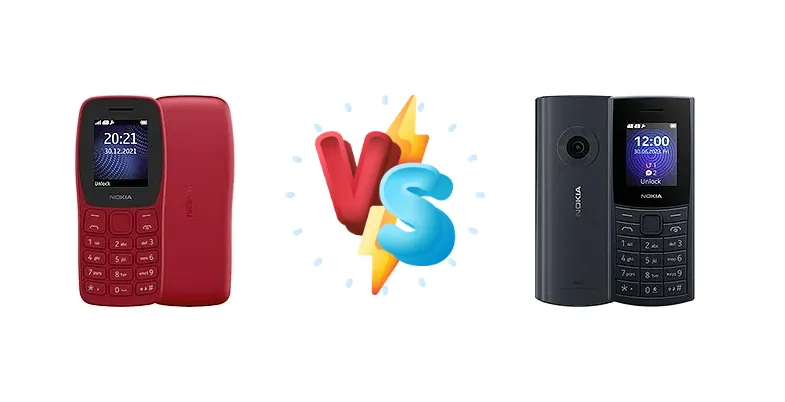
In a market saturated with smartphones, Nokia continues to cater to a specific niche: the ultra-budget feature phone. We're pitting the Nokia 105+ (2022) against the Nokia 110 4G 2nd Edition, two devices designed for basic communication, long battery life, and extreme affordability. This comparison focuses on the subtle differences that matter when choosing a phone primarily for calls and texts.
🏆 Quick Verdict
For the average user prioritizing basic connectivity and a known chipset, the Nokia 105+ (2022) is the better choice. Its Mediatek MT6261D provides a predictable experience, while the Nokia 110 4G 2nd Edition's specifications remain largely unknown, making it a riskier purchase despite potentially offering 4G connectivity.
| Network |
|---|
| 2G bands | GSM 900 / 1800 | GSM 900 / 1800 |
| 3G bands | - | HSDPA 850 / 900 / 1700(AWS) / 1900 / 2100 |
| 4G bands | - | LTE |
| EDGE | No | - |
| GPRS | No | - |
| Speed | - | HSPA, LTE |
| Technology | GSM | GSM / HSPA / LTE |
| Launch |
|---|
| Announced | 2022, April 26 | 2024, December |
| Status | Available. Released 2022, April 26 | Available. Released 2024, December |
| Body |
|---|
| Dimensions | 115.2 x 49.9 x 14.3 mm (4.54 x 1.96 x 0.56 in) | 121.5 x 50 x 14.4 mm (4.78 x 1.97 x 0.57 in) |
| SIM | Single SIM (Mini-SIM) or Dual SIM (Mini-SIM, dual stand-by) | · Nano-SIM· Nano-SIM + Nano-SIM |
| Weight | 72 g (2.54 oz) | 94.5 g (3.35 oz) |
| Display |
|---|
| Resolution | 120 x 160 pixels, 4:3 ratio (~113 ppi density) | 120 x 160 pixels, 4:3 ratio (~111 ppi density) |
| Size | 1.77 inches, 9.7 cm2 (~16.9% screen-to-body ratio) | 1.8 inches, 10.0 cm2 (~16.5% screen-to-body ratio) |
| Type | TFT LCD, 65K colors | IPS LCD |
| Platform |
|---|
| Chipset | Mediatek MT6261D | - |
| Memory |
|---|
| Call records | Yes | Yes |
| Card slot | microSDHC | microSDHC |
| Internal | 4MB, 4MB RAM | 48MB 128MB RAM |
| Phonebook | Yes | Yes |
| Main Camera |
|---|
| Single | - | QVGA |
| Video | - | Yes |
| Sound |
|---|
| 35mm jack | Yes | Yes |
| Loudspeaker | Yes | Yes |
| Comms |
|---|
| Bluetooth | No | 5.0, A2DP |
| NFC | No | No |
| Positioning | No | No |
| Radio | Wireless FM radio | Wireless FM radio |
| USB | microUSB 1.1 | USB Type-C |
| WLAN | No | No |
| Features |
|---|
| Games | Yes | Yes |
| Java | No | No |
| Messaging | SMS | SMS |
| Battery |
|---|
| Type | Li-Ion 800 mAh, removable | Li-Ion 1450 mAh, removable |
| Misc |
|---|
| Colors | Red, Charcoal | Midnight Blue, Arctic Purple |
| Models | TA-1447, TA-1456 | - |
| Price | About 20 EUR | About 60 EUR |
Nokia 105+ (2022)
- Known and reliable Mediatek chipset
- Long battery life due to chipset efficiency
- Predictable performance for basic tasks
- Lacks 4G connectivity
- Basic display quality
Nokia 110 4G 2nd Edition
- Potential for 4G connectivity
- Ultra-affordable price point
- Compact and lightweight design
- Unknown chipset and performance
- Potentially shorter battery life due to 4G
- Uncertain quality control
Display Comparison
Both devices feature small, low-resolution displays typical of feature phones. Specifics regarding panel technology (TFT, LCD) and brightness are unavailable for the Nokia 110 4G 2nd Edition. The Nokia 105+’s display, while basic, benefits from the established manufacturing process of Mediatek-supported devices, suggesting a degree of quality control. Bezels are expected to be substantial on both, as maximizing screen real estate isn't a priority at this price point.
Camera Comparison
Neither device is intended for photography. Both likely include a basic camera, but image quality will be extremely limited. The Nokia 105+’s camera is likely a VGA sensor, sufficient for very basic snapshots. The Nokia 110 4G 2nd Edition’s camera specifications are unavailable, but it’s unlikely to offer a significant improvement over the 105+.
Performance
The Nokia 105+ (2022) is powered by the Mediatek MT6261D chipset, a well-established solution for basic feature phones. This chipset is optimized for low power consumption and essential functions like calling and texting. The Nokia 110 4G 2nd Edition’s chipset is unspecified. The presence of '4G' in the name suggests a more modern chipset capable of handling cellular data, but its performance relative to the MT6261D is unknown. Without knowing the processor architecture or RAM capacity of the 110 4G, it's difficult to assess its responsiveness or ability to handle even simple applications.
Battery Life
Both phones prioritize long battery life. The Nokia 105+ (2022) boasts a 1000mAh battery, providing days of standby time and hours of talk time. The Nokia 110 4G 2nd Edition’s battery capacity is unknown. However, the inclusion of 4G connectivity will likely result in faster battery drain compared to the 105+, even in standby mode. The MT6261D’s power efficiency in the 105+ provides a tangible advantage in maximizing uptime.
Buying Guide
Buy the Nokia 105+ (2022) if you need a reliable, predictable experience with a known chipset and prioritize simplicity. Buy the Nokia 110 4G 2nd Edition if 4G connectivity is absolutely essential and you're willing to accept uncertainty regarding its internal components and performance. Both are ideal as emergency phones or for users who intentionally avoid smartphones.
Frequently Asked Questions
❓ Does the Nokia 110 4G 2nd Edition's 4G connectivity significantly impact battery life compared to the Nokia 105+?
Yes, it likely will. Maintaining a 4G connection requires more power than the 2G/GSM network used by the Nokia 105+. While the 110 4G may offer faster data speeds, expect to charge it more frequently, especially with even moderate usage of data-intensive features like web browsing.
❓ Is the Mediatek MT6261D chipset in the Nokia 105+ sufficient for running basic apps like a calculator or FM radio?
Absolutely. The MT6261D is specifically designed for these types of simple tasks. It provides enough processing power for a calculator, FM radio, and basic text-based applications without significant lag or performance issues. It's optimized for efficiency, not speed.
❓ What kind of SIM card does each phone use?
Both the Nokia 105+ (2022) and the Nokia 110 4G 2nd Edition support Dual SIM functionality, utilizing Micro-SIM cards. This allows users to easily switch between two different mobile networks or plans.