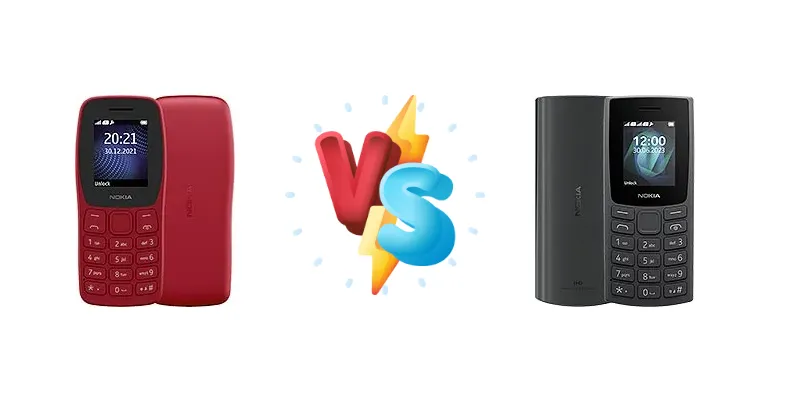
The Nokia 105+ (2022) and the Nokia 105 4G 2nd Edition represent the pinnacle of affordable mobile communication. Both cater to users prioritizing call functionality, text messaging, and extended battery life over smartphone features. However, a key difference lies in the 105+'s inclusion of the Mediatek MT6261D chipset, while the 105 4G's internal specifications remain largely undisclosed, forcing us to analyze it based on its market positioning and Nokia's historical feature phone offerings.
🏆 Quick Verdict
For the average user seeking a reliable, basic phone with a slight edge in processing capability, the Nokia 105+ (2022) is the better choice. The Mediatek MT6261D chipset, while modest, provides a more defined platform for potential software features and future-proofing compared to the largely unknown internals of the 105 4G 2nd Edition.
| Network |
|---|
| 2G bands | GSM 900 / 1800 | GSM 900 / 1800 |
| 3G bands | - | HSDPA 850 / 900 / 1700(AWS) / 1900 / 2100 |
| 4G bands | - | LTE |
| EDGE | No | - |
| GPRS | No | - |
| Speed | - | HSPA, LTE |
| Technology | GSM | GSM / HSPA / LTE |
| Launch |
|---|
| Announced | 2022, April 26 | 2024, December |
| Status | Available. Released 2022, April 26 | Available. Released 2024, December |
| Body |
|---|
| Dimensions | 115.2 x 49.9 x 14.3 mm (4.54 x 1.96 x 0.56 in) | 121.5 x 50 x 14.4 mm (4.78 x 1.97 x 0.57 in) |
| SIM | Single SIM (Mini-SIM) or Dual SIM (Mini-SIM, dual stand-by) | · Nano-SIM· Nano-SIM + Nano-SIM |
| Weight | 72 g (2.54 oz) | 93 g (3.28 oz) |
| Display |
|---|
| Resolution | 120 x 160 pixels, 4:3 ratio (~113 ppi density) | 120 x 160 pixels, 4:3 ratio (~111 ppi density) |
| Size | 1.77 inches, 9.7 cm2 (~16.9% screen-to-body ratio) | 1.8 inches, 10.0 cm2 (~16.5% screen-to-body ratio) |
| Type | TFT LCD, 65K colors | IPS LCD |
| Platform |
|---|
| Chipset | Mediatek MT6261D | - |
| Memory |
|---|
| Call records | Yes | Yes |
| Card slot | microSDHC | microSDHC |
| Internal | 4MB, 4MB RAM | 48MB 128MB RAM |
| Phonebook | Yes | Yes |
| Sound |
|---|
| 35mm jack | Yes | Yes |
| Loudspeaker | Yes | Yes |
| Comms |
|---|
| Bluetooth | No | 5.0, A2DP |
| NFC | No | No |
| Positioning | No | No |
| Radio | Wireless FM radio | Wireless FM radio |
| USB | microUSB 1.1 | USB Type-C |
| WLAN | No | No |
| Features |
|---|
| Games | Yes | Yes |
| Java | No | No |
| Messaging | SMS | SMS |
| Battery |
|---|
| Type | Li-Ion 800 mAh, removable | Li-Ion 1450 mAh, removable |
| Misc |
|---|
| Colors | Red, Charcoal | Charcoal |
| Models | TA-1447, TA-1456 | - |
| Price | About 20 EUR | About 50 EUR |
Nokia 105+ (2022)
- Known chipset (Mediatek MT6261D) offers a baseline for performance.
- Potential for smoother operation of features like FM radio.
- Wider availability of information and support.
- Still a very basic feature phone with limited functionality.
- Small display and low resolution.
Nokia 105 4G 2nd Edition
- 4G connectivity for potentially faster data speeds (depending on region).
- Ultra-simple interface for users who prefer minimal complexity.
- Exceptional battery life.
- Unknown chipset and internal specifications.
- Limited potential for software updates or feature enhancements.
Display Comparison
Both devices feature small, low-resolution displays typical of feature phones. Given the lack of detailed specifications for the 105 4G 2nd Edition, we can assume a similar display quality to the 105+ (2022). Neither phone is intended for media consumption, so display quality is a secondary concern. Bezels are expected to be substantial on both models, maximizing screen real estate within the compact form factor.
Camera Comparison
Neither device is equipped with a camera worth discussing in detail. Feature phones in this price range typically omit cameras or include extremely low-resolution sensors unsuitable for anything beyond basic image capture. Any camera functionality on the 105 4G 2nd Edition is likely comparable to, or even less capable than, the 105+'s potential (but unconfirmed) camera.
Performance
The Nokia 105+ (2022) is powered by the Mediatek MT6261D chipset, a basic but functional processor designed for feature phones. The Nokia 105 4G 2nd Edition's chipset is unknown. However, given its '4G' designation, it likely includes a modem capable of 4G LTE connectivity, potentially utilizing a different chipset architecture than the 105+. The MT6261D offers a defined baseline for performance, allowing for smoother operation of features like the FM radio and potentially more responsive menu navigation. The 105 4G's performance will depend entirely on its undisclosed chipset.
Battery Life
Both phones prioritize exceptional battery life. The Nokia 105+ (2022) boasts a 1000mAh battery, and the 105 4G 2nd Edition likely features a similar capacity. Standby times can extend for weeks, and talk times are measured in hours, making them ideal for users who need a phone for emergencies or infrequent use. Charging times are expected to be slow, utilizing micro-USB connectivity on both devices.
Buying Guide
Buy the Nokia 105+ (2022) if you need a phone with a known chipset for potential software updates or if you anticipate using features beyond basic calling and texting, such as FM radio with recording. Buy the Nokia 105 4G 2nd Edition if you prioritize absolute simplicity and are solely focused on core communication functions, and potentially benefit from wider 4G network compatibility depending on your region.
Frequently Asked Questions
❓ Does the Nokia 105 4G 2nd Edition support VoLTE (Voice over LTE)?
While not explicitly stated, the '4G' designation strongly suggests VoLTE support on the Nokia 105 4G 2nd Edition. However, compatibility depends on your carrier and region. The Nokia 105+ (2022) does not explicitly advertise VoLTE support, making the 105 4G a potentially better choice for areas where 3G networks are being phased out.
❓ Can I use WhatsApp or other messaging apps on either of these phones?
Officially, neither the Nokia 105+ (2022) nor the Nokia 105 4G 2nd Edition support WhatsApp or similar smartphone apps. However, some users have reported success installing lightweight versions of these apps through unofficial methods, but this is not guaranteed and may void any warranty. The Mediatek MT6261D in the 105+ *might* offer slightly better compatibility with such workarounds, but it's not a reliable solution.
❓ What type of SIM card do these phones use?
Both the Nokia 105+ (2022) and the Nokia 105 4G 2nd Edition utilize a Micro-SIM card. This is a standard size for feature phones, but it's important to ensure you have the correct SIM card format before purchasing.