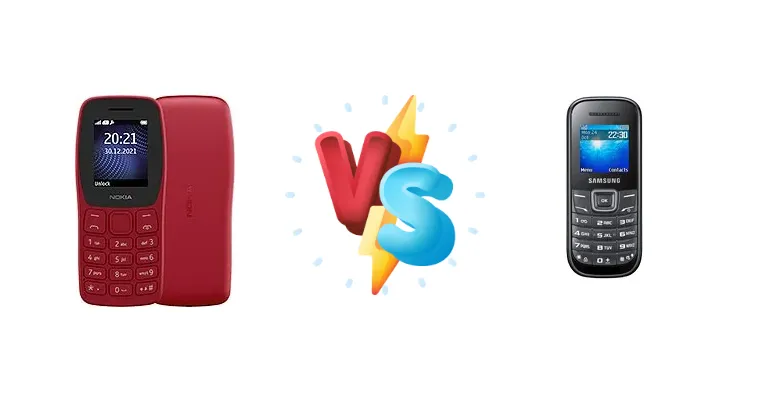
In a market saturated with smartphones, the ultra-basic feature phone continues to hold appeal for those seeking simplicity, durability, and extended battery life. We pit the Nokia 105+ (2022) against the Samsung E1200 Pusha, two of the most affordable options available, to determine which offers the best experience for its target demographic.
🏆 Quick Verdict
For the average user prioritizing even a minimal level of modern functionality, the Nokia 105+ (2022) emerges as the better choice. Its Mediatek MT6261D chipset, while still basic, offers a slight performance edge over the Samsung E1200 Pusha’s 156 MHz CPU, enabling features like FM radio recording and potentially smoother menu navigation.
| Network |
|---|
| 2G bands | GSM 900 / 1800 - SIM 1 & SIM 2 (dual-SIM model only) | GSM 900 / 1800 |
| EDGE | No | No |
| GPRS | No | No |
| Technology | GSM | GSM |
| Launch |
|---|
| Announced | 2022, April 26 | 2012. Released 2012 |
| Status | Available. Released 2022, April 26 | Discontinued |
| Body |
|---|
| Dimensions | 115.2 x 49.9 x 14.3 mm (4.54 x 1.96 x 0.56 in) | 108 x 45 x 13.5 mm (4.25 x 1.77 x 0.53 in) |
| SIM | Single SIM (Mini-SIM) or Dual SIM (Mini-SIM, dual stand-by) | Mini-SIM |
| Weight | 72 g (2.54 oz) | 65.1 g (2.29 oz) |
| Display |
|---|
| Resolution | 120 x 160 pixels, 4:3 ratio (~113 ppi density) | 128 x 128 pixels, 1:1 ratio (~119 ppi density) |
| Size | 1.77 inches, 9.7 cm2 (~16.9% screen-to-body ratio) | 1.52 inches, 7.5 cm2 (~15.3% screen-to-body ratio) |
| Type | TFT LCD, 65K colors | TFT, 65K colors |
| Platform |
|---|
| CPU | - | 156 MHz |
| Chipset | Mediatek MT6261D | - |
| Memory |
|---|
| Call records | Yes | Yes |
| Card slot | microSDHC | No |
| Internal | 4MB, 4MB RAM | - |
| Phonebook | Yes | Yes |
| Sound |
|---|
| 3.5mm jack | Yes | No |
| 35mm jack | - | No |
| Loudspeaker | Yes | Yes |
| Comms |
|---|
| Bluetooth | No | No |
| NFC | No | - |
| Positioning | No | No |
| Radio | Wireless FM radio | No |
| USB | microUSB 1.1 | Proprietary |
| WLAN | No | No |
| Features |
|---|
| Games | Yes | No |
| Java | No | No |
| Messaging | SMS | SMS |
| Battery |
|---|
| Stand-by | - | Up to 720 h |
| Talk time | - | Up to 7 h |
| Type | Li-Ion 800 mAh, removable | Removable Li-Ion 800 mAh battery |
| Misc |
|---|
| Colors | Red, Charcoal | Black, White, Blue |
| Models | TA-1447, TA-1456 | - |
| Price | ₹ 1,355 | About 20 EUR |
| SAR EU | - | 0.81 W/kg (head) |
Nokia 105+ (2022)
- Slightly more powerful chipset (Mediatek MT6261D)
- Potential for FM radio recording
- Generally more modern feature set
- Still a very basic feature phone
- Limited functionality compared to smartphones
Samsung E1200 Pusha
- Extremely affordable
- Long battery life
- Simple and easy to use
- Very limited processing power (156 MHz CPU)
- Outdated chipset
- Minimal features
Display Comparison
Neither device boasts a sophisticated display. Both are likely to utilize monochrome or very low-resolution color panels, typical of this market segment. Without specific display specs, it's reasonable to assume both prioritize legibility over visual fidelity. The Nokia 105+’s potential for slightly more complex software features suggests a marginally more capable display driver, but the difference will be negligible in real-world use.
Camera Comparison
Both devices are highly unlikely to feature cameras of any significant quality. The market segment prioritizes cost and battery life over imaging capabilities. Any camera included would likely be a very low-resolution sensor suitable only for basic image capture, and image quality would be poor. Therefore, camera performance is not a differentiating factor.
Performance
The core difference lies in the chipsets. The Nokia 105+ (2022) utilizes the Mediatek MT6261D, a low-power chipset commonly found in basic feature phones. While clock speed isn’t the defining factor here, the MT6261D generally offers more processing power than the Samsung E1200 Pusha’s 156 MHz CPU. This translates to potentially faster menu navigation and the ability to handle slightly more complex tasks, such as FM radio recording. The Samsung’s CPU is likely a very basic single-core processor, optimized for minimal power consumption but limited in its capabilities.
Battery Life
Both phones excel in battery life due to their low-power chipsets and basic feature sets. The Nokia 105+ (2022) likely has a slight advantage due to the MT6261D’s power efficiency optimizations. However, both devices should easily provide several days of standby time and hours of talk time on a single charge. Charging times will be slow, as both likely utilize micro-USB and lack fast charging capabilities.
Buying Guide
Buy the Nokia 105+ (2022) if you need a phone with basic multimedia capabilities like FM radio recording, a slightly more responsive user interface, and a generally more modern feature set. Buy the Samsung E1200 Pusha if your absolute priority is minimizing cost and you only require core calling and texting functionality, and are comfortable with a very basic, older-generation chipset.
Frequently Asked Questions
❓ Will the Nokia 105+ (2022) support WhatsApp or other modern messaging apps?
No. The Nokia 105+ (2022), like the Samsung E1200 Pusha, lacks the processing power and operating system capabilities to run modern apps like WhatsApp. It is limited to SMS messaging.
❓ Can I use the Samsung E1200 Pusha as a temporary phone while traveling abroad?
Yes, the Samsung E1200 Pusha is a viable option for temporary use abroad, provided you can obtain a local SIM card. Its simplicity and long battery life make it suitable for basic communication needs.
❓ Is the FM radio on the Nokia 105+ (2022) a significant benefit?
For users in areas with limited data access, the FM radio with recording capability on the Nokia 105+ (2022) is a notable feature. It allows access to news and entertainment without incurring data charges.