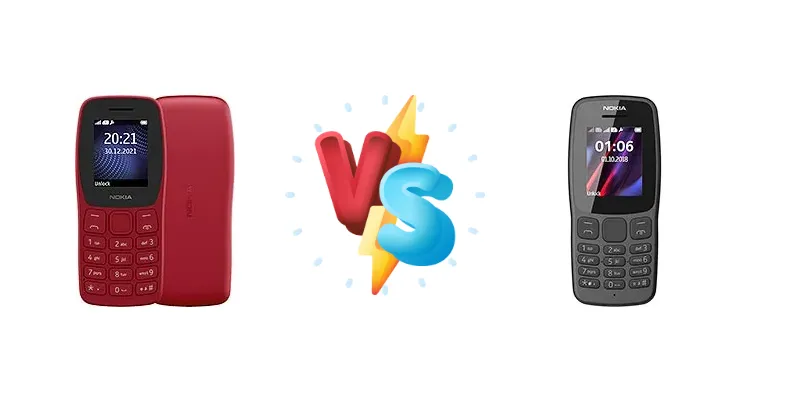
In the world of smartphones, it's easy to forget the enduring appeal of simple, reliable feature phones. The Nokia 105+ (2022) and Nokia 106 (2018) are prime examples, offering essential communication and entertainment at an incredibly affordable price. But which one reigns supreme?
🏆 Quick Verdict
The Nokia 105+ (2022) edges out the 106 (2018) thanks to its slightly improved audio, FM radio enhancements, and a more modern design. Both are excellent budget choices, but the 105+ offers a subtle upgrade that justifies its existence.
| Network |
|---|
| 2G bands | GSM 900 / 1800 - SIM 1 & SIM 2 (dual-SIM model only) | GSM 900 / 1800 |
| EDGE | No | No |
| GPRS | No | No |
| Technology | GSM | GSM |
| Launch |
|---|
| Announced | 2022, April 26 | 2018, November. Released 2018, November |
| Status | Available. Released 2022, April 26 | Discontinued |
| Body |
|---|
| Build | - | Glass front, plastic back, plastic frame |
| Dimensions | 115.2 x 49.9 x 14.3 mm (4.54 x 1.96 x 0.56 in) | 111.2 x 49.5 x 14.4 mm (4.38 x 1.95 x 0.57 in) |
| SIM | Single SIM (Mini-SIM) or Dual SIM (Mini-SIM, dual stand-by) | Dual SIM (Mini-SIM, dual stand-by) |
| Weight | 72 g (2.54 oz) | 70.2 g (2.47 oz) |
| | - | Flashlight |
| Display |
|---|
| Resolution | 120 x 160 pixels, 4:3 ratio (~113 ppi density) | 120 x 160 pixels, 4:3 ratio (~111 ppi density) |
| Size | 1.77 inches, 9.7 cm2 (~16.9% screen-to-body ratio) | 1.8 inches, 10.0 cm2 (~18.2% screen-to-body ratio) |
| Type | TFT LCD, 65K colors | TFT, 65K colors |
| Platform |
|---|
| Chipset | Mediatek MT6261D | Mediatek MT6261D |
| Memory |
|---|
| Call records | Yes | Yes |
| Card slot | microSDHC | No |
| Internal | 4MB, 4MB RAM | 4MB 4MB RAM |
| Phonebook | Yes | Yes |
| Sound |
|---|
| 3.5mm jack | Yes | TBC |
| 35mm jack | - | TBC |
| Loudspeaker | Yes | Yes |
| Comms |
|---|
| Bluetooth | No | No |
| NFC | No | No |
| Positioning | No | No |
| Radio | Wireless FM radio | FM radio |
| USB | microUSB 1.1 | microUSB 2.0 (charging only) |
| WLAN | No | No |
| Features |
|---|
| Games | Yes | Yes |
| Java | No | No |
| Messaging | SMS | SMS |
| Battery |
|---|
| Stand-by | - | Up to 504 h |
| Talk time | - | Up to 16 h |
| Type | Li-Ion 800 mAh, removable | Li-Ion 800 mAh, removable |
| Misc |
|---|
| Colors | Red, Charcoal | Black |
| Models | TA-1447, TA-1456 | TA-1114 |
| Price | ₹ 1,355 | About 20 EUR |
| SAR EU | - | 1.49 W/kg (head) 1.23 W/kg (body) |
Nokia 105+ (2022)
- Improved Audio Quality
- Enhanced FM Radio
- Slightly More Modern Design
- Longer Battery Life (1000mAh)
- Still a very basic feature phone
- Limited functionality beyond calls and texts
Nokia 106 (2018)
- Extremely Affordable
- Durable and Reliable Design
- Long Standby Time (800mAh)
- Basic Audio Quality
- Older Design
- Shorter Battery Life compared to 105+
Display Comparison
Both phones feature a 1.8-inch QVGA (320 x 240) TFT display. While the resolution is identical, the 105+ may have slightly improved color reproduction and viewing angles due to minor panel refinements. However, the difference is minimal and unlikely to be noticeable in everyday use.
Camera Comparison
Neither phone boasts a camera. They are designed for core communication features, not photography.
Performance
Powered by the same Mediatek MT6261D chipset, performance is virtually identical. Expect basic functionality – calls, texts, FM radio, and simple games. Neither phone is designed for demanding tasks.
Battery Life
The Nokia 105+ (2022) offers a 1000mAh battery, while the Nokia 106 (2018) has an 800mAh battery. This translates to slightly longer talk time and standby time on the 105+. Expect several days of use on a single charge for both.
Buying Guide
The Nokia 105+ (2022) is ideal for those seeking a basic, reliable phone for calls and texts, with a focus on audio quality and a slightly more contemporary aesthetic. The Nokia 106 (2018) remains a fantastic option for users prioritizing affordability and a proven, durable design, especially if they find it at a significantly lower price.
Frequently Asked Questions
❓ What is the difference between the Nokia 105+ and the Nokia 106?
The Nokia 105+ (2022) features improved audio quality, an enhanced FM radio, and a slightly more modern design compared to the Nokia 106 (2018). Battery life is also slightly better on the 105+.
❓ Are these phones suitable for emergencies?
Yes, both phones are excellent for emergency situations due to their long battery life and reliable call functionality. They are also often more resilient to damage than smartphones.