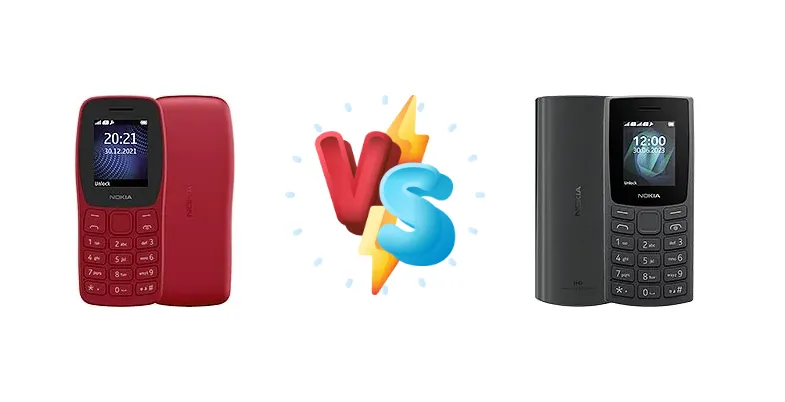
The Nokia 105+ (2022) and the Nokia 105 4G 2nd Edition represent the pinnacle of affordable mobile connectivity. Both cater to users prioritizing essential communication over smartphone features, but subtle differences in their internal hardware and connectivity options can significantly impact the user experience. This comparison dissects these nuances to help you choose the right device for your needs.
🏆 Quick Verdict
For most users, the Nokia 105+ (2022) is the better choice. Its Mediatek MT6261D chipset, while basic, provides a known quantity and potentially better software optimization compared to the largely unspecified hardware of the 105 4G 2nd Edition. The 105+ offers a more predictable experience for voice calls and basic text messaging.
| Network |
|---|
| 2G bands | GSM 900 / 1800 - SIM 1 & SIM 2 (dual-SIM model only) | GSM 900 / 1800 |
| 3G bands | - | HSDPA 850 / 900 / 1700(AWS) / 1900 / 2100 |
| 4G bands | - | LTE |
| EDGE | No | - |
| GPRS | No | - |
| Speed | - | HSPA, LTE |
| Technology | GSM | GSM / HSPA / LTE |
| Launch |
|---|
| Announced | 2022, April 26 | 2024, December |
| Status | Available. Released 2022, April 26 | Available. Released 2024, December |
| Body |
|---|
| Dimensions | 115.2 x 49.9 x 14.3 mm (4.54 x 1.96 x 0.56 in) | 121.5 x 50 x 14.4 mm (4.78 x 1.97 x 0.57 in) |
| SIM | Single SIM (Mini-SIM) or Dual SIM (Mini-SIM, dual stand-by) | · Nano-SIM· Nano-SIM + Nano-SIM |
| Weight | 72 g (2.54 oz) | 93 g (3.28 oz) |
| Display |
|---|
| Resolution | 120 x 160 pixels, 4:3 ratio (~113 ppi density) | 120 x 160 pixels, 4:3 ratio (~111 ppi density) |
| Size | 1.77 inches, 9.7 cm2 (~16.9% screen-to-body ratio) | 1.8 inches, 10.0 cm2 (~16.5% screen-to-body ratio) |
| Type | TFT LCD, 65K colors | IPS LCD |
| Platform |
|---|
| Chipset | Mediatek MT6261D | - |
| Memory |
|---|
| Call records | Yes | Yes |
| Card slot | microSDHC | microSDHC |
| Internal | 4MB, 4MB RAM | 48MB 128MB RAM |
| Phonebook | Yes | Yes |
| Sound |
|---|
| 3.5mm jack | Yes | - |
| 35mm jack | - | Yes |
| Loudspeaker | Yes | Yes |
| Comms |
|---|
| Bluetooth | No | 5.0, A2DP |
| NFC | No | No |
| Positioning | No | No |
| Radio | Wireless FM radio | Wireless FM radio |
| USB | microUSB 1.1 | USB Type-C |
| WLAN | No | No |
| Features |
|---|
| Games | Yes | Yes |
| Java | No | No |
| Messaging | SMS | SMS |
| Battery |
|---|
| Type | Li-Ion 800 mAh, removable | Li-Ion 1450 mAh, removable |
| Misc |
|---|
| Colors | Red, Charcoal | Charcoal |
| Models | TA-1447, TA-1456 | - |
| Price | ₹ 1,355 | About 50 EUR |
Nokia 105+ (2022)
- Known and reliable Mediatek chipset
- Excellent standby time
- Simple and intuitive user interface
- Limited features
- Low-resolution display
Nokia 105 4G 2nd Edition
- 4G connectivity for faster data speeds
- Potentially future-proof against 2G/3G network shutdowns
- Compact and lightweight design
- Unspecified chipset raises performance concerns
- Potential for less optimized software
- Battery life may be slightly reduced with 4G usage
Display Comparison
Both devices feature small, low-resolution displays typical of feature phones. Specific details like brightness (nits) and color accuracy are unavailable for the Nokia 105 4G 2nd Edition, but given the price point, expectations should be tempered. The Nokia 105+ (2022) likely utilizes a standard TFT panel, prioritizing visibility over color fidelity. The primary difference will be user perception of clarity, which is unlikely to be significant between these two.
Camera Comparison
Both devices are equipped with basic VGA cameras, primarily intended for occasional snapshots. Image quality will be extremely limited on both, and neither phone is suitable for serious photography. The small sensor size and lack of any image processing features mean that these cameras are best reserved for documenting basic information, not capturing memories. Comparing camera performance is largely irrelevant given the shared limitations.
Performance
The Nokia 105+ (2022) is powered by the Mediatek MT6261D chipset. This is a well-established, ultra-low-power chipset designed for basic phone functions. The Nokia 105 4G 2nd Edition’s chipset remains unspecified. While the '4G' designation suggests a more modern processor to handle cellular data, the lack of detailed specifications raises concerns about potential performance bottlenecks or software optimization. The MT6261D’s known stability and efficiency give the 105+ a slight edge.
Battery Life
Both phones boast impressive standby times due to their low-power chipsets and small displays. The Nokia 105+ (2022) typically offers several days of use on a single charge, and the 105 4G 2nd Edition likely achieves similar results. However, the 4G connectivity of the latter *could* lead to slightly faster battery drain when actively connected to a cellular network. The actual difference in real-world usage will depend heavily on network conditions and usage patterns.
Buying Guide
Buy the Nokia 105+ (2022) if you need a reliably basic phone with a known chipset and a focus on call quality and text messaging. Buy the Nokia 105 4G 2nd Edition if 4G connectivity is absolutely paramount and you're willing to accept potential uncertainties regarding chipset performance and software support. Consider the 105 4G if your network is phasing out 2G/3G and you need future-proofing.
Frequently Asked Questions
❓ Will the Nokia 105 4G 2nd Edition work on all 4G networks?
While the phone supports 4G, specific band compatibility varies by region. It's crucial to check with your mobile carrier to ensure the Nokia 105 4G 2nd Edition is compatible with their 4G frequencies before purchasing. The lack of detailed specifications makes this verification essential.
❓ Is the Nokia 105+ (2022) a good choice for someone who primarily needs a phone for making calls and sending texts?
Absolutely. The Nokia 105+ (2022) excels at these core functions. The Mediatek MT6261D chipset is optimized for voice calls and text messaging, providing reliable performance and excellent battery life for these essential tasks. It's a perfect solution for users who want a simple, dependable phone without the complexities of a smartphone.
❓ Can I use WhatsApp or Facebook on either of these phones?
While some limited versions of WhatsApp and Facebook may be compatible, the experience will be severely restricted due to the phones' limited processing power and small screens. Functionality will be basic, and performance will likely be slow. These phones are not designed for running modern social media apps.