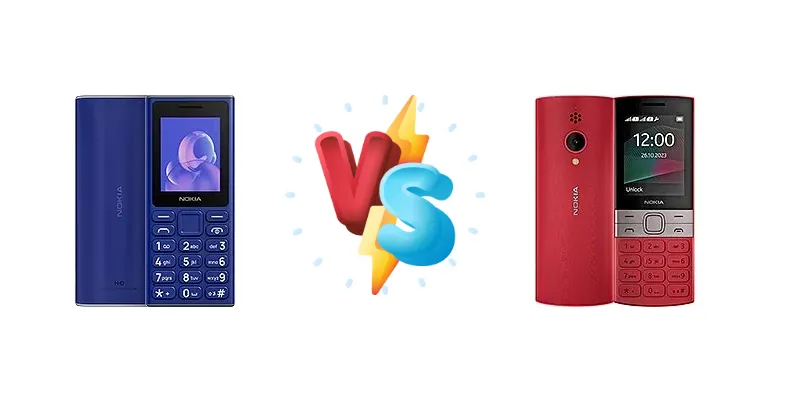
In a market saturated with smartphones, Nokia continues to cater to a specific niche: users prioritizing simplicity, reliability, and extended battery life. The Nokia 105 (2024) and Nokia 150 (2023) represent the latest iterations of this philosophy, but subtle differences exist. This comparison dissects these phones to determine which best suits the needs of those seeking a no-frills mobile experience.
🏆 Quick Verdict
For the average user needing a dependable, long-lasting basic phone, the Nokia 150 (2023) likely offers a slightly better value proposition. While the Nokia 105 (2024) is a newer release, the 150’s potential for integrated radio and slightly larger form factor for easier handling give it a marginal edge.
| Network |
|---|
| 2G bands | GSM 900 / 1800 | GSM 900 / 1800 |
| EDGE | Yes | No |
| GPRS | Yes | No |
| Technology | GSM | GSM |
| Launch |
|---|
| Announced | 2024, July 03 | 2023, August 10 |
| Status | Available. Released 2024, July | Available. Released 2023, September |
| Body |
|---|
| Dimensions | 115.5 x 49.5 x 14 mm (4.55 x 1.95 x 0.55 in) | 131 x 50.6 x 15.2 mm (5.16 x 1.99 x 0.60 in) |
| SIM | Dual SIM (Mini-SIM, dual stand-by) | Dual SIM (Mini-SIM, dual stand-by) |
| Weight | 77.5 g (2.75 oz) | 106.3 g (3.63 oz) |
| Display |
|---|
| Resolution | 120 x 160 pixels, 4:3 ratio (~100 ppi density) | 240 x 320 pixels, 4:3 ratio (~167 ppi density) |
| Size | 2.0 inches, 12.4 cm2 (~21.7% screen-to-body ratio) | 2.4 inches, 17.8 cm2 (~26.9% screen-to-body ratio) |
| Type | TFT LCD, 65K colors | TFT LCD, 65K colors |
| Memory |
|---|
| Call records | - | Yes |
| Card slot | microSDHC | microSDHC |
| Internal | 4 MB 4 MB RAM | 4MB |
| Phonebook | - | 2000 entries |
| Main Camera |
|---|
| Features | - | LED flash |
| Single | - | VGA |
| Sound |
|---|
| 35mm jack | Yes | Yes |
| Loudspeaker | Yes | Yes |
| Comms |
|---|
| Bluetooth | No | No |
| NFC | No | No |
| Positioning | No | No |
| Radio | Wireless FM radio | FM radio; built-in antenna |
| USB | microUSB | microUSB 1.1 |
| WLAN | No | No |
| Features |
|---|
| Games | - | Yes |
| Java | - | No |
| Messaging | - | SMS |
| Sensors | - | No |
| Battery |
|---|
| Type | 1000 mAh, removable | Li-Ion 1450 mAh, removable |
| Misc |
|---|
| Colors | Black, Blue, Purple | Black, Cyan, Red |
| Price | - | About 60 EUR |
Nokia 105 (2024)
- Potentially more compact design
- Newer model – may receive longer software support (though limited)
- Likely lower price point at launch
- Potentially smaller battery capacity
- May lack features present in the 150 (e.g., FM radio)
- Limited internal storage
Nokia 150 (2023)
- Potentially larger battery capacity
- Possible inclusion of FM radio (regional variant dependent)
- Slightly larger form factor for easier handling
- Older model
- May be slightly more expensive than the 105 (2024)
- Larger size may not appeal to all users
Display Comparison
Given the target market, both the Nokia 105 (2024) and Nokia 150 (2023) utilize color displays, likely of similar size (around 1.8-2.4 inches) and resolution. The Nokia 105 (2024), being a newer model, *may* benefit from slightly improved color reproduction or viewing angles, but this is speculative without specific panel details. Bezels are expected to be substantial on both devices, prioritizing durability over maximizing screen real estate. Neither phone will offer any form of protective glass.
Camera Comparison
Neither the Nokia 105 (2024) nor the Nokia 150 (2023) are equipped with cameras. This is a deliberate design choice to minimize cost and complexity, aligning with their target audience. Users requiring photographic capabilities will need to look elsewhere.
Performance
Both phones operate on a Series 30+ platform, a feature phone operating system designed for extreme efficiency. Performance differences will be negligible; both will handle calls, texts, and basic pre-installed applications (like a calculator and alarm clock) without issue. The absence of a modern processor means no multitasking or app support beyond the basics. The Nokia 150 (2023) *might* have a slightly larger internal memory for storing more contacts and messages, but this is unconfirmed.
Battery Life
Battery life is the key differentiator in this segment. Both phones boast exceptional standby times, potentially lasting weeks on a single charge. The Nokia 150 (2023) likely has a slightly larger battery capacity (around 1000mAh vs. potentially 800mAh for the 105), contributing to marginally longer talk time. However, actual usage patterns (frequency of calls, signal strength) will have a greater impact than the small battery capacity difference. Both utilize Micro-USB charging, and charging speeds are expected to be slow.
Buying Guide
Buy the Nokia 105 (2024) if you need an exceptionally compact and lightweight device for minimal communication – think emergency calls and occasional texting. Buy the Nokia 150 (2023) if you prefer a slightly larger phone with the potential for FM radio access (depending on regional variants) and a more substantial feel in the hand, making it easier to use for extended periods.
Frequently Asked Questions
❓ Does the Nokia 150 (2023) have FM radio, and does it work without headphones?
The Nokia 150 (2023) *may* include an FM radio, but availability varies by region. In some variants, it functions as a wired headset radio, requiring headphones to be plugged in to act as an antenna. Check the product specifications for your specific region to confirm FM radio support and headphone requirement.
❓ How durable are these phones, and are they water-resistant?
Both the Nokia 105 (2024) and Nokia 150 (2023) are built for durability, featuring robust polycarbonate bodies. However, neither phone is officially water-resistant. While they can likely withstand minor splashes, submersion should be avoided. Their simple construction makes them more resistant to drops than smartphones.
❓ Can I use a microSD card to expand the storage on either phone?
Yes, both the Nokia 105 (2024) and Nokia 150 (2023) support microSD card expansion, allowing you to store more contacts, messages, and potentially MP3 files (if supported). The maximum supported microSD card capacity is typically 32GB.