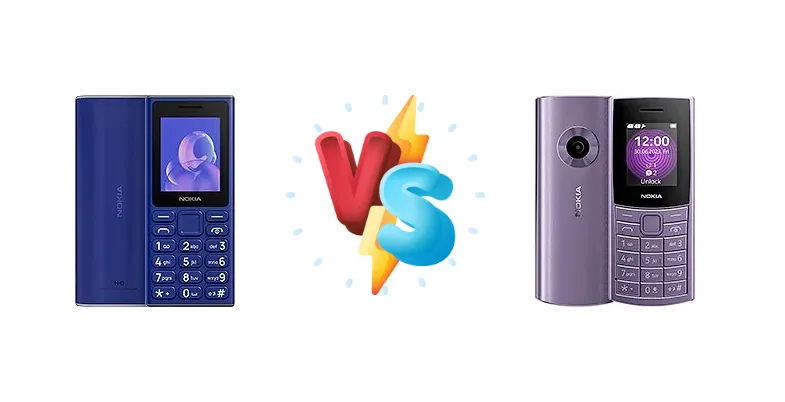
In a market saturated with smartphones, Nokia continues to cater to a specific niche: the demand for reliable, ultra-affordable feature phones. The Nokia 105 (2024) represents the latest iteration of this classic, while the Nokia 110 4G (2023) brought 4G connectivity to the entry-level segment. This comparison dissects the nuances between these two devices, focusing on what truly matters for users prioritizing simplicity and longevity.
🏆 Quick Verdict
For the average user seeking a basic, dependable phone, the Nokia 110 4G (2023) offers a slight edge due to its inclusion of 4G connectivity, providing a more future-proof experience. However, the Nokia 105 (2024) remains a viable option for those needing a truly minimalist device and potentially benefiting from any improvements in battery optimization Nokia may have implemented.
| Network |
|---|
| 2G bands | GSM 900 / 1800 | GSM 900 / 1800 |
| 3G bands | - | HSDPA 850 / 900 / 1700(AWS) / 1900 / 2100 |
| 4G bands | - | LTE |
| EDGE | Yes | - |
| GPRS | Yes | - |
| Speed | - | HSPA, LTE |
| Technology | GSM | GSM / HSPA / LTE |
| Launch |
|---|
| Announced | 2024, July 03 | 2023, May 18 |
| Status | Available. Released 2024, July | Available. Released 2023, June |
| Body |
|---|
| Dimensions | 115.5 x 49.5 x 14 mm (4.55 x 1.95 x 0.55 in) | 121.5 x 50 x 14.4 mm (4.78 x 1.97 x 0.57 in) |
| SIM | Dual SIM (Mini-SIM, dual stand-by) | · Nano-SIM· Nano-SIM + Nano-SIM |
| Weight | 77.5 g (2.75 oz) | 94.5 g (3.35 oz) |
| | - | Flashlight
Splash resistant |
| Display |
|---|
| Resolution | 120 x 160 pixels, 4:3 ratio (~100 ppi density) | 120 x 160 pixels, 4:3 ratio (~111 ppi density) |
| Size | 2.0 inches, 12.4 cm2 (~21.7% screen-to-body ratio) | 1.8 inches, 10.0 cm2 (~16.5% screen-to-body ratio) |
| Type | TFT LCD, 65K colors | TFT LCD, 65K colors |
| Memory |
|---|
| Call records | - | Yes |
| Card slot | microSDHC | microSDHC |
| Internal | 4 MB 4 MB RAM | Unspecified |
| Phonebook | - | Yes |
| Sound |
|---|
| 3.5mm jack | - | Yes |
| 35mm jack | Yes | Yes |
| Loudspeaker | Yes | Yes |
| Comms |
|---|
| Bluetooth | No | 5.0, A2DP |
| NFC | No | No |
| Positioning | No | No |
| Radio | Wireless FM radio | Wireless FM radio |
| USB | microUSB | microUSB 2.0 |
| WLAN | No | No |
| Features |
|---|
| Games | - | Yes |
| Java | - | No |
| Messaging | - | SMS |
| | - | MP3 player |
| Battery |
|---|
| Type | 1000 mAh, removable | Li-Ion 1450 mAh |
| Misc |
|---|
| Colors | Black, Blue, Purple | Midnight Blue, Arctic Purple |
| Price | - | About 40 EUR |
Nokia 105 (2024)
- Potentially optimized battery life due to lack of 4G.
- Ultra-simple user interface for ease of use.
- Durable build quality typical of Nokia feature phones.
- Lacks 4G connectivity, limiting future-proofing.
- Basic VGA camera with limited image quality.
- Small, low-resolution display.
Nokia 110 4G (2023)
- 4G connectivity for faster data speeds and VoLTE calls.
- FM radio for entertainment without data usage.
- Slightly more versatile due to 4G capabilities.
- 4G connectivity can reduce battery life.
- Basic VGA camera with limited image quality.
- Small, low-resolution display.
Display Comparison
Given the lack of detailed specifications, we can assume both devices feature similar, low-resolution color displays, likely around 1.77 inches. The Nokia 110 4G’s display, while similar in size, may benefit from slightly improved color calibration due to being a newer model. However, neither display is expected to offer high brightness or wide viewing angles; their primary function is basic readability. The absence of any mention of protective glass suggests both screens are susceptible to scratches.
Camera Comparison
Both the Nokia 105 (2024) and Nokia 110 4G (2023) are equipped with basic VGA cameras. These cameras are not intended for high-quality photography; their primary function is for occasional snapshots. Image quality will be extremely limited, and the cameras are best suited for capturing basic documentation rather than memorable photos. The lack of any mention of features like autofocus or flash further underscores their limited capabilities.
Performance
Both phones utilize MediaTek’s Series 30+ platform, a chipset designed for basic feature phone functionality. The Nokia 110 4G’s inclusion of 4G connectivity necessitates a more capable modem integrated into the chipset, potentially impacting power consumption. RAM is likely limited to a few megabytes in both devices, sufficient for the limited tasks they perform. Performance differences will be negligible in real-world usage, focusing on call quality and menu navigation speed.
Battery Life
Battery life is a critical factor for feature phones. The Nokia 105 (2024) likely benefits from Nokia’s ongoing optimization efforts, potentially offering slightly improved standby time compared to the Nokia 110 4G (2023). The 4G radio in the 110 4G will consume more power when connected to a 4G network, reducing overall battery life. Both phones are expected to offer days, if not weeks, of standby time on a single charge, but active 4G usage will significantly decrease the Nokia 110 4G’s longevity.
Buying Guide
Buy the Nokia 105 (2024) if you need a phone solely for calls and texts, prioritizing maximum simplicity and potentially longer standby time. Buy the Nokia 110 4G (2023) if you want the added benefit of 4G connectivity for occasional internet access, VoLTE calling, and a slightly more versatile experience, even if it comes at the cost of potentially reduced battery life due to the 4G radio.
Frequently Asked Questions
❓ Will the Nokia 110 4G's 4G connectivity significantly impact battery life?
Yes, actively using 4G on the Nokia 110 4G will noticeably reduce battery life compared to the Nokia 105 (2024). While standby time will still be good, frequent data usage or calls over VoLTE will drain the battery faster. If you primarily need a phone for calls and texts, the Nokia 105 (2024) may offer longer overall usage between charges.
❓ Can I use WhatsApp or other messaging apps on either of these phones?
While some feature phones support limited versions of WhatsApp or Facebook, the Nokia 105 (2024) and Nokia 110 4G (2023) are unlikely to offer a seamless experience. Their limited processing power and memory make running these apps reliably challenging. They are best suited for basic SMS messaging.
❓ Is the FM radio on the Nokia 110 4G useful, and does it require headphones?
The FM radio on the Nokia 110 4G is a valuable feature, allowing you to listen to local radio stations without consuming mobile data. Yes, it typically requires a wired headset to act as an antenna, though some models may have a built-in antenna with reduced performance.