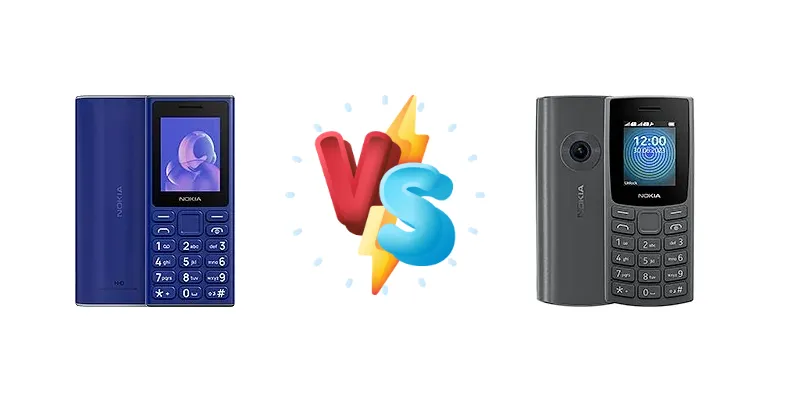
In a market saturated with smartphones, Nokia continues to cater to a specific niche: users prioritizing simplicity, reliability, and extended battery life. The Nokia 105 (2024) and Nokia 110 (2023) represent the latest iterations of this philosophy. While both are ultra-budget feature phones, subtle differences in design, features, and potentially internal components dictate which model best suits individual needs. This comparison aims to dissect those differences, moving beyond basic specs to understand the user experience.
🏆 Quick Verdict
For the average user seeking a dependable, long-lasting basic phone, the Nokia 110 (2023) likely offers a slightly better value proposition. Given the lack of detailed specifications for the 105 (2024), the 110’s established features like FM radio and potentially larger battery capacity (based on historical Nokia models) give it a slight edge.
| Network |
|---|
| 2G bands | GSM 900 / 1800 | GSM 900 / 1800 |
| EDGE | Yes | Yes |
| GPRS | Yes | Yes |
| Technology | GSM | GSM |
| Launch |
|---|
| Announced | 2024, July 03 | 2023, May 18 |
| Status | Available. Released 2024, July | Available. Released 2023, June 01 |
| Body |
|---|
| Dimensions | 115.5 x 49.5 x 14 mm (4.55 x 1.95 x 0.55 in) | 115.1 x 49.4 x 14.5 mm (4.53 x 1.94 x 0.57 in) |
| SIM | Dual SIM (Mini-SIM, dual stand-by) | Single SIM (Mini-SIM) or Dual SIM (Mini-SIM, dual stand-by) |
| Weight | 77.5 g (2.75 oz) | 79.6 g (2.82 oz) |
| | - | Flashlight
Splash resistant |
| Display |
|---|
| Resolution | 120 x 160 pixels, 4:3 ratio (~100 ppi density) | 120 x 160 pixels, 4:3 ratio (~111 ppi density) |
| Size | 2.0 inches, 12.4 cm2 (~21.7% screen-to-body ratio) | 1.8 inches, 10.0 cm2 (~17.6% screen-to-body ratio) |
| Type | TFT LCD, 65K colors | TFT LCD, 65K colors |
| Memory |
|---|
| Call records | - | Yes |
| Card slot | microSDHC | microSDHC |
| Internal | 4 MB 4 MB RAM | Unspecified |
| Phonebook | - | Yes |
| Sound |
|---|
| 3.5mm jack | - | No |
| 35mm jack | Yes | No |
| Loudspeaker | Yes | Yes |
| Comms |
|---|
| Bluetooth | No | No |
| NFC | No | No |
| Positioning | No | No |
| Radio | Wireless FM radio | Wireless FM radio |
| USB | microUSB | microUSB 1.1 |
| WLAN | No | No |
| Features |
|---|
| Games | - | Yes |
| Java | - | No |
| Messaging | - | SMS |
| | - | MP3 player |
| Battery |
|---|
| Type | 1000 mAh, removable | Li-Ion 1000 mAh |
| Misc |
|---|
| Colors | Black, Blue, Purple | Charcoal, Cloudy Blue |
| Price | - | About 50 EUR |
Nokia 105 (2024)
- Potentially more compact design
- Likely lighter weight for easier portability
- Nokia’s reputation for build quality
- Lack of detailed specifications makes comparison difficult
- Potentially smaller battery capacity
- Limited feature set compared to some competitors
Nokia 110 (2023)
- FM radio for entertainment
- Potentially longer battery life based on historical models
- Established feature set and known performance
- Slightly larger and heavier than the 105 (2024)
- Basic VGA camera offers limited functionality
- Micro-USB charging is becoming outdated
Display Comparison
Given the target market, both the Nokia 105 (2024) and 110 (2023) likely feature similar low-resolution color displays, around 1.77 inches. Expect limited viewing angles and modest brightness. The key difference, if any, will likely be in the display coating – a potential improvement in scratch resistance on the 105 (2024) could be a minor advantage. However, neither phone is designed for media consumption, so display quality is a secondary concern.
Camera Comparison
Neither the Nokia 105 (2024) nor the Nokia 110 (2023) are marketed for their camera capabilities. Both likely include a basic VGA camera, suitable only for extremely low-resolution snapshots. Image quality will be poor in all lighting conditions. The camera is primarily a marketing feature rather than a functional one, and should not be a deciding factor for potential buyers.
Performance
Both devices utilize MediaTek’s Series 30+ platform, a highly efficient chipset designed for basic feature phone functionality. Performance differences will be negligible; both will handle calls, texts, and simple games without issue. The absence of a complex operating system means RAM capacity is minimal, and processing power is not a limiting factor. Thermal management is also non-existent, as the chipset generates very little heat.
Battery Life
Battery life is the critical performance metric for these devices. Historically, Nokia feature phones excel in this area. The Nokia 110 (2023) likely boasts a battery capacity in the 800-1000 mAh range, potentially offering several days of standby time and hours of talk time. The Nokia 105 (2024) may have a slightly smaller battery to achieve its more compact form factor, potentially resulting in marginally shorter usage times. Both phones will charge via Micro-USB, with charging times expected to be under 2 hours.
Buying Guide
Buy the Nokia 105 (2024) if you need an exceptionally compact and lightweight device for minimal communication – think emergency calls and basic texting. Buy the Nokia 110 (2023) if you prefer a phone with added entertainment features like FM radio, potentially longer battery life, and a slightly more robust build quality for everyday use. Both are ideal for those avoiding smartphone complexity or needing a reliable backup device.
Frequently Asked Questions
❓ Does the Nokia 105 (2024) support dual SIM functionality?
Given Nokia’s history with feature phones, it’s highly probable that both the 105 (2024) and 110 (2023) offer dual SIM support, allowing users to utilize two separate mobile networks simultaneously. This is a key feature for cost-conscious users or those needing to separate work and personal calls.
❓ How durable is the Nokia 110 (2023) compared to other feature phones?
Nokia feature phones are generally known for their robust build quality. The 110 (2023) likely features a polycarbonate body designed to withstand everyday wear and tear. While not ruggedized, it should be more durable than many similarly priced smartphones, offering better resistance to drops and scratches.
❓ Can I use WhatsApp or other messaging apps on either of these phones?
No, the Series 30+ platform used in both the Nokia 105 (2024) and 110 (2023) does not support modern smartphone applications like WhatsApp, Facebook Messenger, or Telegram. These phones are designed for basic communication – calls and texts – and do not have the processing power or operating system to run such apps.